A phenomenon that was thought to be impossible on Mars is squeezing the Red Planet’s atmosphere like toothpaste from a tube, a new study finds. The surprising discovery, uncovered by a NASA spacecraft during a powerful solar storm, could change how we think of dangerous space weather throughout the solar system, researchers say.
The unlikely phenomenon, dubbed the Zwan-Wolf effect, was first discovered on Earth in 1976 and occurs when “charged particles are squeezed like toothpaste coming out of a tube along magnetic structures called flux tubes,” NASA representatives wrote in a statement. These flux tubes are located within Earth’s magnetosphere, the invisible field that is generated by the movements of our planet’s molten metal core and shields us from radiation.
While similar phenomena likely occur on Jupiter and Saturn, experts have long assumed that the Zwan-Wolf effect could not happen on Mars because our next-door neighbor’s core has long since solidified and, therefore, does not generate a proper magnetosphere. (This is also why the Red Planet has such a thin and wispy atmosphere; without magnetic shielding, most of its gases have been stripped away by solar storms.)
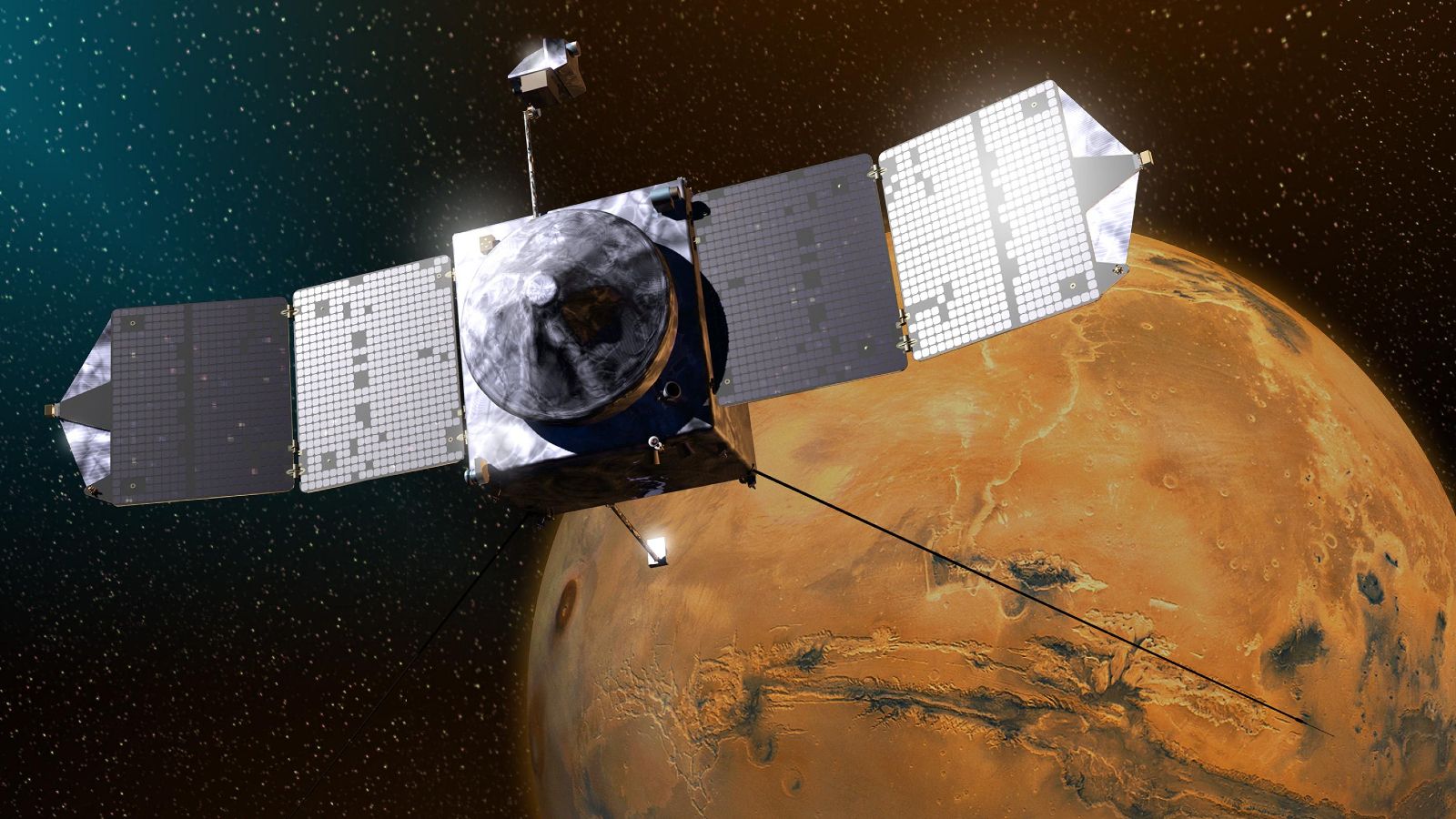
But in the new study, published May 18 in the journal Nature Communications, researchers analyzed data from NASA’s Mars Atmosphere and Volatile Evolution (MAVEN) spacecraft, which has been orbiting the Red Planet since 2014 (though NASA lost contact with it last year), and found something strange.
In December 2023, a powerful coronal mass ejection (CME) erupted from the sun and slammed into Mars, temporarily scrambling the remnants of its upper atmosphere and revealing disturbances that could be explained only by the Zwan-Wolf effect.
The Zwan-Wolf effect squeezes plasma along the edges of Mars’ ionosphere, similar to what happens in Earth’s magnetosphere.
(Image credit: LASP/CU Boulder)
“When investigating the data, I all of a sudden noticed some very interesting wiggles,” study lead author Christopher Fowler, a planetary scientist at West Virginia University, said in the statement. “I would never have guessed it would be this effect,” he added.
Unlike on Earth, where the Zwan-Wolf effect occurs tens of thousands of miles above our planet’s surface, the Martian equivalent occurs in the ionosphere — the upper part of the atmosphere, which is full of ionized gas, or plasma — at an altitude of around 125 miles (200 kilometers).
Get the world’s most fascinating discoveries delivered straight to your inbox.
“No one expected that this effect could even occur in the atmosphere,” Fowler said. “That’s what makes this even more exciting.”
Mars’ Zwan-Wolf effect is likely powered by a localized magnetic field at the boundary where solar wind — the constant stream of charged particles that shoots from the sun — collides with ionospheric plasma, the researchers wrote. This means it is probably happening all the time, but we only realized it now because the radiation from the CME exaggerated the effect.
As a result, experts are keen to study this phenomenon further to better understand how it may impact future missions to Mars, since changes to the ionosphere will likely affect orbiting spacecraft, communications equipment, and the levels of harmful radiation that reach the planet’s surface.
“Knowing how space weather interacts with Mars is essential,” study co-author Shannon Curry, a research scientist at the Laboratory for Atmospheric Space Physics at the University of Colorado Boulder and the principal investigator for MAVEN, said in the statement. It is, therefore, vitally important to understand “these links between our host star and the Red Planet,” she added.
Now that we know the Zwan-Wolf effect can occur within planetary atmospheres, we may also soon discover it on other solar system worlds, such as Venus and Saturn’s largest moon, Titan, the researchers hypothesized.
Fowler, C. M., Hanley, K. G., McFadden, J., Mitchell, D., Halekas, J., Andersson, L., Bark, D., Ma, Y., Chaston, C., Sanchez-Cano, B., Lester, M., Brain, D., Mazelle, C., Espley, J., Benna, M., Jolitz, R., Ramstad, R., & Curry, S. (2026). Detection of Zwan-Wolf effect in the ionosphere of Mars. Nature Communications, 17(1). https://doi.org/10.1038/s41467-026-72251-9