
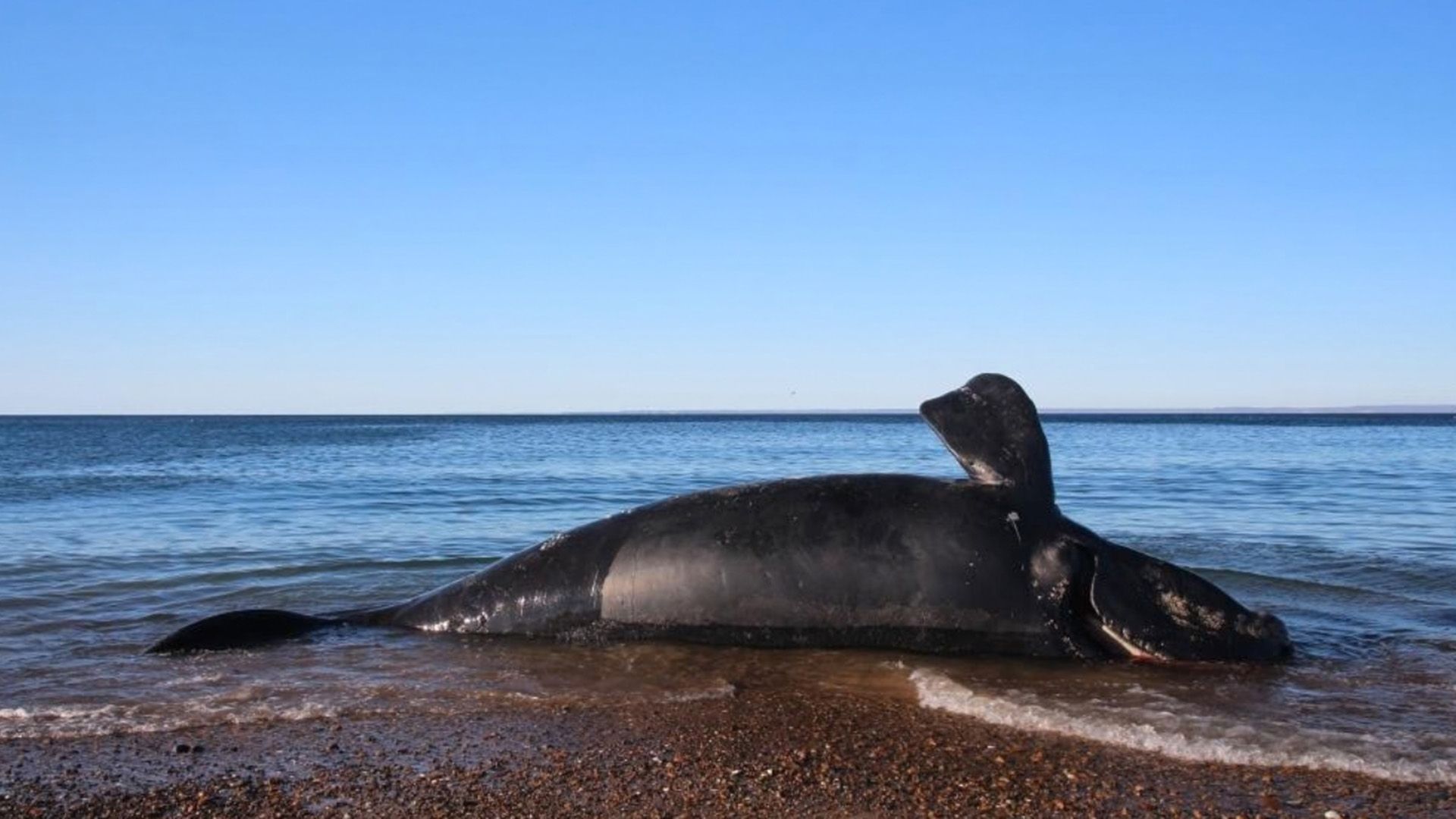

Since June, more than 300 southern right whale (Eubalaena australis) calves have died in Argentine Patagonia, in what scientists describe as an “exceptional” die-off. The preliminary figure already far exceeds the previous annual record set in 2012, when 113 southern right whale calves died — the highest number ever documented for the species, both locally and globally.
Now, scientists are racing to figure out exactly what’s causing the record-breaking die-off.
Laboratory analyses of specimens that died this year tested positive for the pathogenic bacterium Erysipelothrix rhusiopathiae, environmental authorities in Chubut province told Live Science. E. rhusiopathiae was first identified in southern right whale calves in 2013, but scientists don’t know what might have changed this year to cause an infection-driven die-off of this magnitude.
Researchers say they need to quickly find the answer to better understand the changing threat this species faces, the risk to the wider ecosystem and humans, and what can be done to manage it.
“The battle between living organisms and pathogens is constant,” said Carla Fiorito, a researcher at the Center for the Study of Marine Systems (CESIMAR) who previously identified the bacterium in right whales. “But for this to happen now, there must have been a shift in the balance between the agent, the host, and the environment,” she told Live Science.
Record-breaking number
The first dead calves appeared on the beaches of Península Valdés in June, at the start of the breeding season, which runs through to December. Península Valdés is located in Chubut province, on the coast of northern Patagonia.
In a typical year, calf mortality reaches 20% to 30% of a cohort from various causes, including infections. But this year’s losses have already far surpassed that.
In September, 409 calves were counted among a total of 1,375 southern right whales during a survey conducted by CESIMAR’s Marine Mammal Laboratory. With more than 300 deaths already recorded, the die-off represents an exceptional proportion of these calves. The final figure will be released by the Southern Right Whale Health Monitoring Program in December.
Scientists have responded by expediting routine research to determine what’s different this year to previous years.
“Samples were sent for analysis earlier than usual — typically, they are analyzed at the end of the year — because the higher-than-usual mortality is a cause for concern,” said Víctor Fratto, the director of the Native Wildlife Rescue Program and a contributor with the whale monitoring program. “What those samples are showing is that the calves died from erysipelas,” he told Live Science.
A known bacterium full of unknowns
A person suffering from a case of facial erysipelas.
(Image credit: CDC/Dr. Thomas F. Sellers/Emory University, Public domain, via Wikimedia Commons)
Erysipelas is a bacterial infection that affects the skin. In its most severe form, it can spread through the bloodstream and cause a systemic infection, damaging vital organs and sometimes leading to death. Animals that catch the disease, for example through a wound, may develop characteristic skin lesions, which are rhomboid or rectangular in shape, caused by alterations in the blood vessels.
The bacterium that causes erysipelas, E. rhusiopathiae, is not exclusive to whales. It can be found in marine environments and in a wide variety of animals, including fish, crustaceans and birds. Pigs are one of its natural reservoirs.
“It is a ubiquitous and opportunistic bacterium,” Fiorito said. (The human illness of the same name is different and caused by Group A streptococcal bacteria, although humans can also catch the E. rhusiopathiae form of the illness.)
The presence of E. rhusiopathiae does not necessarily mean an animal is diseased. Yet many questions remain about E. rhusiopathiae in whales.
“We don’t know much about the bacterium itself; we don’t know which serotypes are present in the whales, or how common it is in healthy animals or other species,” Fiorito said. “There is also no data on the environment.”
Calves are especially vulnerable because their immune systems are still developing and they spend more time at the surface than adults do, exposing them to more attacks by gulls, which can transfer the disease.
“The working hypothesis is that the gull is the vector: Pecking causes wounds on the back, allowing the bacteria to enter,” Fratto said. “The bacteria might already be present on the skin, or they could be carried on the beak of a gull that had previously pecked another whale suffering from erysipelas.”
The potential role of gulls
Attacks by kelp gulls (Larus dominicanus) on southern right whales were first recorded at Península Valdés in the 1970s. The behavior began with just a few individuals in Patagonia’s San José Gulf and became increasingly frequent over time, Ricardo Bastida, a marine biologist and professor emeritus at the National University of Mar del Plata who has studied these cetaceans for more than four decades, told Live Science. The birds also began scavenging the carcasses of stranded whales, Bastida said
Gull populations have grown and new breeding colonies have emerged in the region thanks to increased food availability linked to fishing activities and discarded catch, he noted. However, the attacks alone do not explain the 2026 mortality event: They have been occurring for decades, and gulls are a regular part of the ecosystem.
The working hypothesis is that the gull is the vector: Pecking causes wounds on the back, allowing the bacteria to enter.
Víctor Fratto, director of the Native Wildlife Rescue Program and a contributor with the whale monitoring program
Fratto said that swabs will be taken from gulls to check for the presence of E. rhusiopathiae and assess whether the results could help develop a management strategy for the species.
Diego Rodríguez, a marine biologist at the National University of Mar del Plata, said that research must go beyond the dead calves and examine the ecosystem’s fauna to determine where the bacterium is present and how it might be circulating. “It is far more likely that [the die-off event] is linked to cross-infection,” Rodríguez told Live Science.
What changed this year?
The major question for scientists is what might have changed this year to cause a bacterium already present in the ecosystem to trigger a die-off of this magnitude. Experts told Live Science they believe the phenomenon could be the result of several factors acting simultaneously.
“The bacterium was present, but this year it resulted in a widespread infection, making this event unusual,” Mariano Coscarella, a researcher at the Marine Mammal Laboratory at CESIMAR, told Live Science. “It is a major step forward to have a fairly clear idea of what caused the disease, but we do not know what changed.”
One factor could be the environment. Changes in water temperature, salinity, pH or rainfall could alter the conditions under which infection occurs. There could also be changes in food availability, affecting the mothers’ body condition and the vulnerability of their calves. Another possibility is that the pathogen itself has changed — for instance, through the emergence or increased circulation of a more virulent strain or a different serotype, Fiorito said.
The El Niño phenomenon could also play a role by altering oceanographic conditions and food availability, although the researchers said there’s insufficient evidence to link it to the die-off.
Exclusive to Live Science Pro
It is too early to determine what impact this die-off will have on the southern right whale population. Rodríguez suggested that losing such a large proportion of a season’s calves could have demographic consequences. “It is very risky to predict what will happen in the future at this stage, but clearly, this year’s cohort of live-born calves will essentially be absent from the adult records of future populations,” he said.
Coscarella is more cautious. Southern right whales are extremely long-lived, and calves represent only a fraction of the population. Therefore, a single season of exceptionally high mortality does not necessarily mean the population will go into decline, he argued. “What would be concerning is if there were two, three or four episodes like this,” he noted.
The event also has public health implications. Fiorito pointed out that erysipelas can infect humans, usually through skin wounds. The whales’ carcasses could also pose a risk of exposure to anyone coming into contact with them, as could seawater for people swimming in the area.
Help us improve Live Science Pro: We’re always trying to make our content better. Leave us feedback about Pro here.