



Follow us
Add us as a preferred source on Google
Subscribe to our newsletter
Homo erectus was adaptable enough to live in rainforests in what is now southern China and may have lived alongside Denisovans there, two new studies hint.
The research is based on the incredibly rare findings of nine fossil teeth from ancient humans — eight from H. erectus and one from a mystery human in the genus Homo. The teeth reveal that H. erectus lived in China much more recently than previously thought and that this population likely devoured tropical food found there.
“I think it’s exciting because it means that there are two hominin populations occupying these rainforest conditions there at the same time,” study first author Frido Welker, a molecular palaeoanthropologist at the University of Copenhagen in Denmark, told Live Science.
Latest Videos FromLive Science
H. erectus is generally seen as the first human species to venture out of Africa, after evolving about 2 million years ago. It spread through eastern Eurasia, reaching China and Indonesia between about 1.6 million and 1.8 million years ago. It is one of the longest-surviving hominin species, and the last known record of it is from 108,000 years ago in river flood plains in Java, Indonesia. However, there was no physical evidence of H. erectus being on the Asian mainland more recently than 400,000 years ago.
But in two caves in Guangxi province in southern China, researchers have found thousands of mammalian fossils, accumulated there by porcupines that scavenged for and collected bones. The Baxian and Naxian caves are about 9 miles (15 kilometers) apart, sitting in a karst landscape of limestone formations that are prone to dissolving to create caves that would have offered crucial shelter for H. erectus.
The entrance to Naxian Cave, as seen by a drone, is the tall and wide opening of a cave that goes back around 330 feet (100 meters) to a fossil chamber.
(Image credit: Professor Yingqi Zhang (IVPP – CAS))
Researchers found the nine human teeth among more than 18,000 fossils, including from apes, elephants, rhinoceroses and other ancient hoofed animals, Welker and his colleagues reported in a study published Wednesday (Nov. 18) in the journal Nature.
Radiometric dating of the fossils and surrounding sediments by methods including assessing the decay of uranium, pins them to about 324,000 to 184,000 years ago. Eight of the teeth have physical features reminiscent of H. erectus, but the ninth is more elusive. It looks distinct from H. erectus, Neanderthals and modern humans, Welker said.
Get the world’s most fascinating discoveries delivered straight to your inbox.
Ancient signature
Welker’s team took samples from five teeth — four from the group that seemed to be H. erectus and one from the mysterious tooth — to see which ancient proteins were present, since DNA tends to degrade more easily than the proteins in an organism. (The study of these proteins is known as proteomics.)
The four similar ones had protein signatures that matched what had been seen before in H. erectus.
“The morphology is nicely confirmed by the proteomics,” Welker told Live Science. Three of these teeth were from males, and the other was from a female, which the team was able to determine based on the presence or absence of amelogenin-Y, a protein coded for only by the Y chromosome.

Researchers investigating two caves in China have found nine human teeth, eight of which have been confidently identified as belonging to Homo erectus.
(Image credit: Professor Kira Westaway (Macquarie University))
However, some parts of the protein signatures differed from what had been seen in other H. erectus remains in China, so the new specimens may be from a previously unknown H. erectus population that perhaps had a slightly different genetic makeup, Welker said.
The finding that H. erectus was present in mainland Asia until at least 184,000 years ago — rather than 400,000 years ago — fills a geographical and chronological gap, helping to explain how H. erectus was on Java 108,000 years ago.
“This brings the history of H. erectus in East Asia closer in age to the late Javanese examples, raising the possibility that these populations were connected through land bridges at times of lowered sea level,” Chris Stringer, a paleoanthropologist at the Natural History Museum in London who was not involved in the research, told Live Science in an email.
Change of opinion
John Hawks, an anthropologist at the University of Wisconsin-Madison who wasn’t involved in the study, previously believed that specimens from the past 400,000 years or so flagged as H. erectus were actually Denisovans — ancient humans who lived in Asia, disappeared around 30,000 years ago and belonged to the Homo longi lineage. But he told Live Science that the new morphological and protein findings provide convincing evidence that H. erectus did survive until relatively recently in some places.
The fifth analyzed tooth, known as PA1796, remains mysterious. The protein analysis revealed it was from a male, but it didn’t show a recognizable signature in the protein sequence data. Therefore, Welker’s team suggested it could be from another hominin species that was present in the region at the same time.
Welker didn’t want to speculate about which species it might be, but said: “Sequence-wise it doesn’t have this Homo erectus substitution and morphologically, it doesn’t look like an erectus tooth.”
The tooth could be from a previously unknown human species, but many experts suspect it is from a Denisovan.
“With some of the new material probably dating to less than 200,000 years old, this already brings it close in age to known or putative Homo longi/Denisovan samples in southern China and Laos, implying potentially long overlaps between these species,” Stringer said. “Tooth PA1796 could represent a longi/Denisovan, though it is relatively small in size, and relevant comparative data for longi/Denisovans is sparse.”

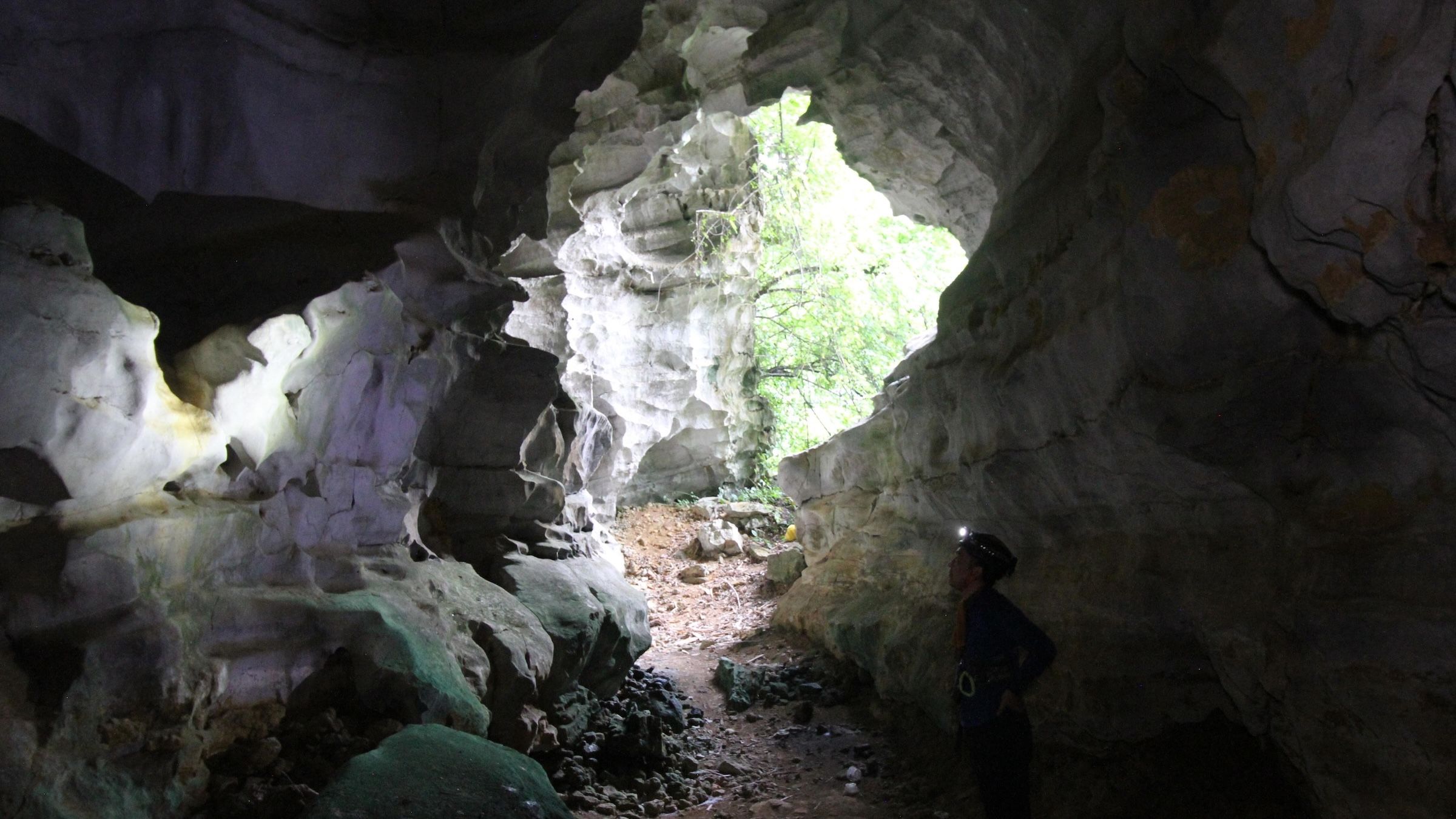
The entrance to China’s Naxian Cave, which has a small opening and goes back around 164 feet (50 m) to a fossil chamber.
(Image credit: Professor Kira Westaway (Macquarie University))
Recent research suggests there was interbreeding between the H. erectus and Denisovan lineages, and the new evidence increases the likelihood that this happened, at least occasionally, Stringer said.
Any firm conclusions of who the tooth is from will have to wait for further finds of similar teeth elsewhere, Welker said.
Hawks agreed that the tooth is most likely from a Denisovan, perhaps from a divergent branch for which we don’t have protein data. But it could also be from a novel H. erectus population or someone from the same population as the other teeth who, for developmental or genetic reasons, wasn’t typical. “I would have liked to see additional comparisons in the paper to more Denisovan teeth,” Hawks said.
Adaptable ancestors
In another paper, also published Nov. 18 in the journal Nature, Kira Westaway, a geochronologist at Macquarie University in Sydney, and her colleagues examined trace elements in the same teeth, as well as in animal teeth from the caves, to see what they revealed about the hominins’ diet and local habitat.
Their analysis indicated that this H. erectus population found plants and animals to eat in tropical, rainforest-like ecosystems. Previously, it was thought that only our own species, Homo sapiens, was able to adapt to this type of environment.
“Rather than being confined to open woodland and grassland environments, H. erectus was considerably more ecologically adaptable than many of us have assumed,” Stringer said.
“Being adaptable and being flexible are not traits that we associate with ancient human species — these are traits that we associate with H. sapiens,” Westaway told Live Science. “Suddenly we’re seeing H. erectus being able to survive in environments that we didn’t think they could possibly survive in.”
And given the mysterious tooth, it is possible that two different early human populations were this adaptable, said Welker, who was a co-author of the study.

A view from Naxian Cave in China, where Homo erectus teeth were found.
(Image credit: Professor Kira Westaway (Macquarie University))
Westaway and her colleagues also looked at levels of the element strontium in the teeth, which can shed light on where someone grew up based on the unique strontium levels in water and foods they consumed as children. The team matched these strontium levels to another karst landscape about 200 miles (320 km) away, in the Red River valley of northern Vietnam.
“It looks like H. erectus moved across large areas, traversing this karst landscape in the rainforests” — a finding that adds to our understanding of these ancient humans, Westaway said.
It’s absurd that people often think of H. erectus as an unsuccessful species, she added. “We think they were the first to leave Africa, the first to use fire. It blows my mind because they survived six times longer than H. sapiens has survived so far, so I don’t see them as unsuccessful.”
Hawks’ big question, however, is linked to modern humans, who were in the Chinese region from at least 45,000 years ago.
“Denisovan DNA is present in the peoples of Island Southeast Asia, so, modern humans must have run into Denisovans at some point,” he said. “If H. erectus was enduring in the same area at the same time, might H. sapiens also have encountered late H. erectus?”
Liao, W., Zanolli, C., Ásmundsdóttir, R. D., Wu, Z., Yi, Z., Villa-Islas, V., Fagernäs, Z., Troché, G., Zhou, K., Feng, X., Liu, F., Olsen, J. V., Shao, Q., Yu, W., Quinn, M., Bacon, A.-M., Liang, H., Pan, Y., Yang, L., . . . Welker, F. (2026). Evidence for late Middle Pleistocene Homo erectus in mainland East Asia. Nature. https://doi.org/10.1038/s41586-026-11271-3
Westaway, K. E., Joannes-Boyau, R., Liao, W., Shao, Q., Yu, W., Quinn, M., Bacon, A.-M., Liang, H., Bourgon, N., Zhao, J. -x., Roberts, P., Kono, R., Pan, Y., Yang, L., Wang, Y., Jin, C., Wu, Z., Murray, S., Zanolli, C., . . . Zhang, Y. (2026). Rainforest adaptation in late Homo erectus from southern China. Nature. https://doi.org/10.1038/s41586-026-11155-6
What do you know about early humans? Test your knowledge with our human origins quiz!