

NEWYou can now listen to articles!
If you have ever searched for a home online, you know the routine. Set a price range. Click a few filters. Run the search. Start over. Again and again.
Now imagine skipping all of that and simply saying, “I want a home near good schools with high ceilings, a short commute and a kitchen that feels modern.” Then the platform responds like it already understands what matters most to you. Well, that future tech is here.
Homes.com, powered by Microsoft Azure OpenAI, has launched Homes AI, a fully integrated conversational home search experience. Instead of clicking through a bunch of filters, you talk or type your way to the right home. And this is more than just a new feature. It could completely change how people search for and ultimately buy houses.
Sign up for my FREE CyberGuy Report
Get my best tech tips, urgent security alerts and exclusive deals delivered straight to your inbox. Plus, you’ll get instant access to my Ultimate Scam Survival Guide – free when you join my CYBERGUY.COM newsletter.
DOORDASH LAUNCHES ZESTY, AN AI APP FOR FINDING LOCAL FOOD
Instead of guessing which filters to use, buyers can ask detailed questions about schools, commute times or neighborhood trends and get instant answers in one place. (David Cooper/Toronto Star via Getty Images)
Why AI home search fixes the old filter problem
For years, homebuyers had to search like they were programming a database. That meant checking boxes, toggling filters and running multiple searches just to piece together what they actually wanted.
“Searching for a home previously forced prospective buyers to think like a database — checking boxes, toggling filters and manually running multiple searches to piece together what they wanted,” Livia Sponseller, head of Homes.com Product at CoStar Group, told CyberGuy. “We understand that isn’t how people best operate, so conversational search removes the silos of data so that all information, whether it’s about neighborhood average home prices, schools or in-depth details about a specific home, allows buyers to easily and simply describe what they’re looking for in their own words.”
That line hits home. No one dreams about toggling filters. People dream about backyards, school districts and a kitchen where everyone gathers. With Homes AI, you can describe what matters to you in plain language. The system pulls from deep property data, 3D Matterport tours, neighborhood insights and proprietary school data to guide you.
“Direct conversations with our AI guide, Homes AI, capture nuances in buyer preferences that traditional filters do not,” Sponseller added. “These nuances are ultimately what lead a buyer to choose the right home for them, making it feel less like browsing listings and more like truly experiencing the home.”
In other words, this moves home search from mechanical to meaningful.
Why AI home search works right now
AI assistants are already part of everyday life. Millions of people already talk to generative AI tools every week. That comfort level matters. As Sponseller explained, “People have become very accustomed to interacting with AI assistants like ChatGPT. Hundreds of millions of people are using its generative AI tools each week, so people are beginning to tap into the power of these generative pre-trained transformers (GPT) and large language models (LLMs). The experience we built for Homes.com represents the natural next step — seamlessly integrating advanced AI into the existing site infrastructure and shifting the heavy lifting of filtering and refining search results from the homebuyer to the technology itself.”
That shift is huge. The burden moves from you to technology. Instead of refining results manually, the AI refines them for you in real time. And it does so inside the Homes.com ecosystem. Your data stays within the platform and is not used to train external models.
CRIMINALS ARE USING ZILLOW TO PLAN BREAK-INS. HERE’S HOW TO REMOVE YOUR HOME IN 10 MINUTES
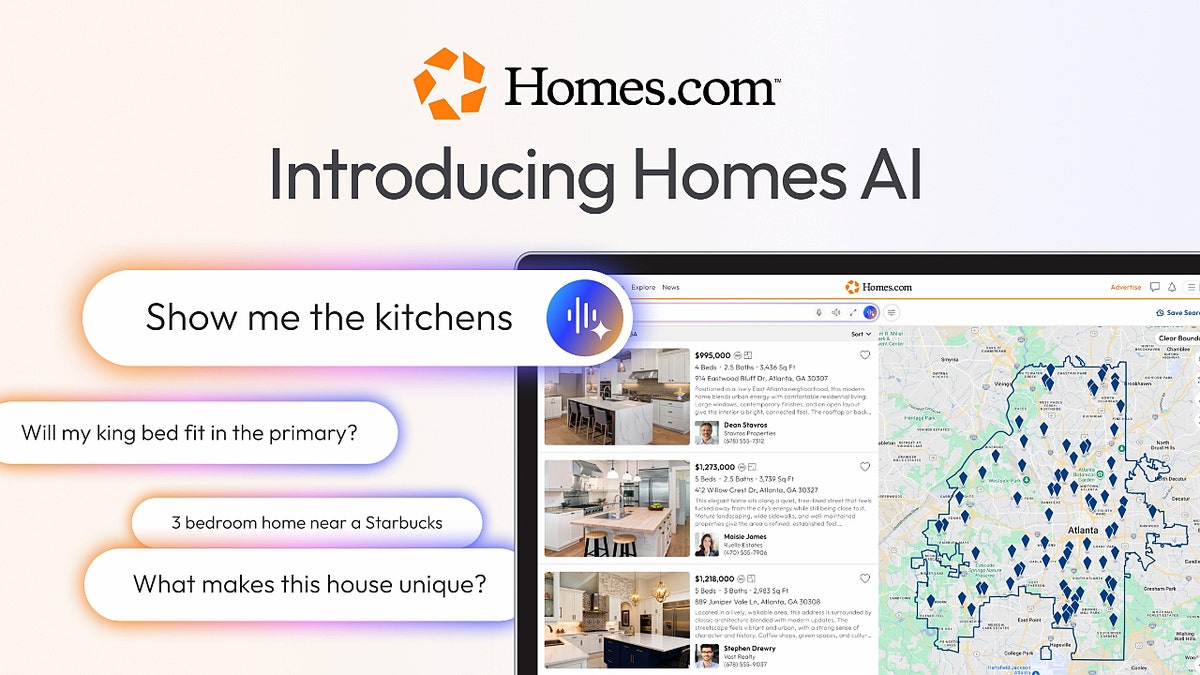
Instead of guessing which filters to use, buyers can ask detailed questions about schools, commute times or neighborhood trends and get instant answers in one place. (Homes.com)
What surprises buyers about AI home search
The first time someone uses conversational artificial intelligence for home search, the biggest surprise may be how human it feels. Sponseller said, “I think users will be genuinely surprised by how closely it mirrors the experience of working with the most knowledgeable agent. Whether you’re looking for comparable sales, average home values in an area or the lifestyle of a specific neighborhood, buyers can ask virtually any home-related question and get an answer immediately, as opposed to referring to multiple sites for all that information.”
Instead of hopping between tabs, you stay in one seamless experience. You can ask about commute times, neighborhood trends or interior details without starting over. She also pointed out, “Homes AI is a transparent, fast, data-rich and ad-free tool, elevating the experience for consumers to another level.” That ad-free part matters. It keeps the focus on your goals, not on who paid for placement.

As the system learns your preferences, it refines recommendations over time, helping you narrow choices with more clarity and confidence. (Homes.com)
What AI home search means for the future of real estate
Sponseller believes this goes beyond one platform: “This is bigger than real estate. It’s only a matter of time until we see conversational experiences extend across industries, not just real estate portals. Why leave the heavy lifting to the searcher-consumer if ultimately this simplifies the process? Homes.com is simply the first to fully integrate this approach at scale, but I think it’s safe to say that shopping experiences across the board are entering a new era.”
And when we look back? “We have full confidence that people will look back at the current state of portals and have a laugh at how clunky, manual, and fragmented the process felt.”
She added, “The housing market has evolved to a point where applying filters and needing to run multiple consecutive searches to capture all the filters will feel as outdated as flipping through the Yellow Pages.” That comparison says it all.
CLICK HERE TO DOWNLOAD THE APP
What this means for you
If you are thinking about buying a home in the next few years, this could make the process feel a lot less stressful. Instead of endlessly scrolling and tweaking filters, you can simply explain what matters to you. The system does the sorting. It narrows the list based on your real priorities, not just basic checkboxes. That means you may tour fewer homes that miss the mark. You could spot red flags earlier. You might even feel more prepared before you ever walk through the front door. In a market where every decision counts, having clearer information upfront can make a real difference.
Take my quiz: How safe is your online security?
Think your devices and data are truly protected? Take this quick quiz to see where your digital habits stand. From passwords to Wi-Fi settings, you’ll get a personalized breakdown of what you’re doing right and what needs improvement. Take my Quiz here: Cyberguy.com.
Kurt’s key takeaways
Buying a home is a big deal. It is emotional. It is expensive. And it can feel overwhelming fast. For years, online search tools helped, but they also made you do most of the work. You had to adjust filters, rerun searches and keep track of what mattered. AI home search changes that dynamic. You explain what you want. The technology handles the sorting. Over time, it even remembers your priorities. That could mean fewer wasted showings. Fewer surprises. More confidence before you ever step inside a house.
If this is where home search is headed, will you trust a system that learns your preferences, or will you still want full control of every filter yourself? Let us know by writing to us at Cyberguy.com.
Sign up for my FREE CyberGuy Report
Get my best tech tips, urgent security alerts and exclusive deals delivered straight to your inbox. Plus, you’ll get instant access to my Ultimate Scam Survival Guide – free when you join my CYBERGUY.COM newsletter.
Copyright 2026 CyberGuy.com. All rights reserved.