
In the 1970s, paleontologist John Ostrom revived the theory that modern birds are evolved from theropod dinosaurs, a group that includes Tyrannosaurus rex. But a key piece of evidence was missing: feathered fossils. Then, a chance discovery in China upended our understanding of bird evolution.
In this excerpt from “The Story of Birds: An Evolutionary History of the Dinosaurs That Live Among Us” (Mariner Books, 2026), author and paleontologist Steve Brusatte looks at the monumental shift in dinosaur research after the first feathered dinosaur was discovered.
For well over a century, since its discovery in the Bavarian lithographic mines in 1861, the fossil bird Archaeopteryx was the oldest and most primitive creature known to have feathers. Then, in the autumn of 1996, this understanding was upended. Some revolutions start with a single shot; this one began with a chance encounter and a handful of photographs.
As the trees in Central Park dropped their leaves, paleontologists from around the world converged across the street, at the American Museum of Natural History, in mid-October for the annual meeting of the Society of Vertebrate Paleontology. A few weeks earlier, the Canadian dinosaur hunter Phil Currie had been in China, leading a group of tourists to dinosaur dig sites. While there, he spied something peculiar in the backroom of a Beijing museum, discovered by a farmer named Yumin Li two months prior. It was the skeleton of a small dinosaur, about the size of a chicken, fossilized as if frozen in time, in a muddy rock imbued with volcanic ash, a sign it was overcome by a sudden cataclysm.
Rapid burial had locked in the dainty details of the skeleton, but it was the stuff surrounding the bones that caught Currie’s attention. The dinosaur’s body was encircled by a halo of fluff. Thin, tufty, delicate strands ran along the dinosaur’s back, from the top of its head to the tip of its tail. Some of the strands looked like they branched at their base. For all the world, the fuzz looked like the downfeathers of a bird.
But this wasn’t a bird; it didn’t have wings, and obviously couldn’t fly. It was a bona fide dinosaur — a small coelurosaur theropod, very similar to the German Compsognathus, which Huxley had held up in the 1860s as the type of transitional reptilian species birds might have evolved from.
Currie and his Chinese colleague Pei-ji Chen snapped photographs, which they printed out at the size of index cards and brought to the conference in New York. Once there, word spread fast; the rumors of a fluffy dinosaur billowed through the hallways and meeting rooms. Somebody tracked down John Ostrom, then in the twilight of his career, three decades after his discovery of the raptor Deinonychus had reignited the theory that birds evolved from dinosaurs. Currie and Chen handed him the photos. Ostrom looked shell-shocked. He began to cry, and almost fell to the floor. “I need to sit down,” he stuttered, delirium taking hold.
Here it was, finally: a dinosaur with feathers. Just as Ostrom had predicted. Just as the doubters had demanded. The final piece of the puzzle, the strongest evidence that birds have dinosaur ancestry.
A crafty journalist from The New York Times caught wind of the excitement, and the next day, the front page of the Saturday edition blared with the headline “Feathery Fossil Hints Dinosaur-Bird Link,” along-side articles about Bill Clinton’s reelection campaign and a Yankees World Series preview. Above the bold print was a drawing of a small meat-eating dinosaur, running on its hind legs, small arms curled up, its tail a long seesaw for balance, its neck, back, and chest covered with bushy fuzz.
The artwork was needed, because the Chinese authorities barred publication of the photos. Before the year was out, Chinese scientists published a formal description of the fossil and gave it a name: Sinosauropteryx, the “Chinese reptilian wing,” in honor of its transitional status between dinosaurs and birds.
Sinosauropteryx was the firing gun for a fossil rush, as farmers across Liaoning Province — a bucolic region of fields and rolling hills along the Chinese border with North Korea — fanned out in search of more feathered dinosaurs.
They knew the land better than anyone, and they knew museums would pay top money for such precious fossils. Soon, they were finding feather-covered dinosaurs in droves. The whole area, it turned out, had been bombarded by volcanic eruptions in the Jurassic and Cretaceous Periods, which quickly entombed entire ecosystems.
This was the key to the fine preservation: Normally soft bits like skin and feathers decay before a skeleton can harden into a fossil, but in this one remarkable place, feathers could easily fossilize. It was a dinosaurian Pompeii. As the new millennium dawned, the mounting Chinese discoveries transformed our image of dinosaurs.
One feathered dinosaur became ten, then hundreds, then thousands of skeletons, belonging to several dozen distinct species. Some, like the ostrich-size Beipiaosaurus, were adorned with simple filaments that looked like oversize versions of the bristle feathers of modern birds. Others, like the original Sinosauropteryx, had more complex feathers that resembled little paintbrushes, with many individual bristles branching from a root in an untidy tuft.
The roster of feathered dinosaurs got richer and richer. Even tyrannosaurs were in on the makeover
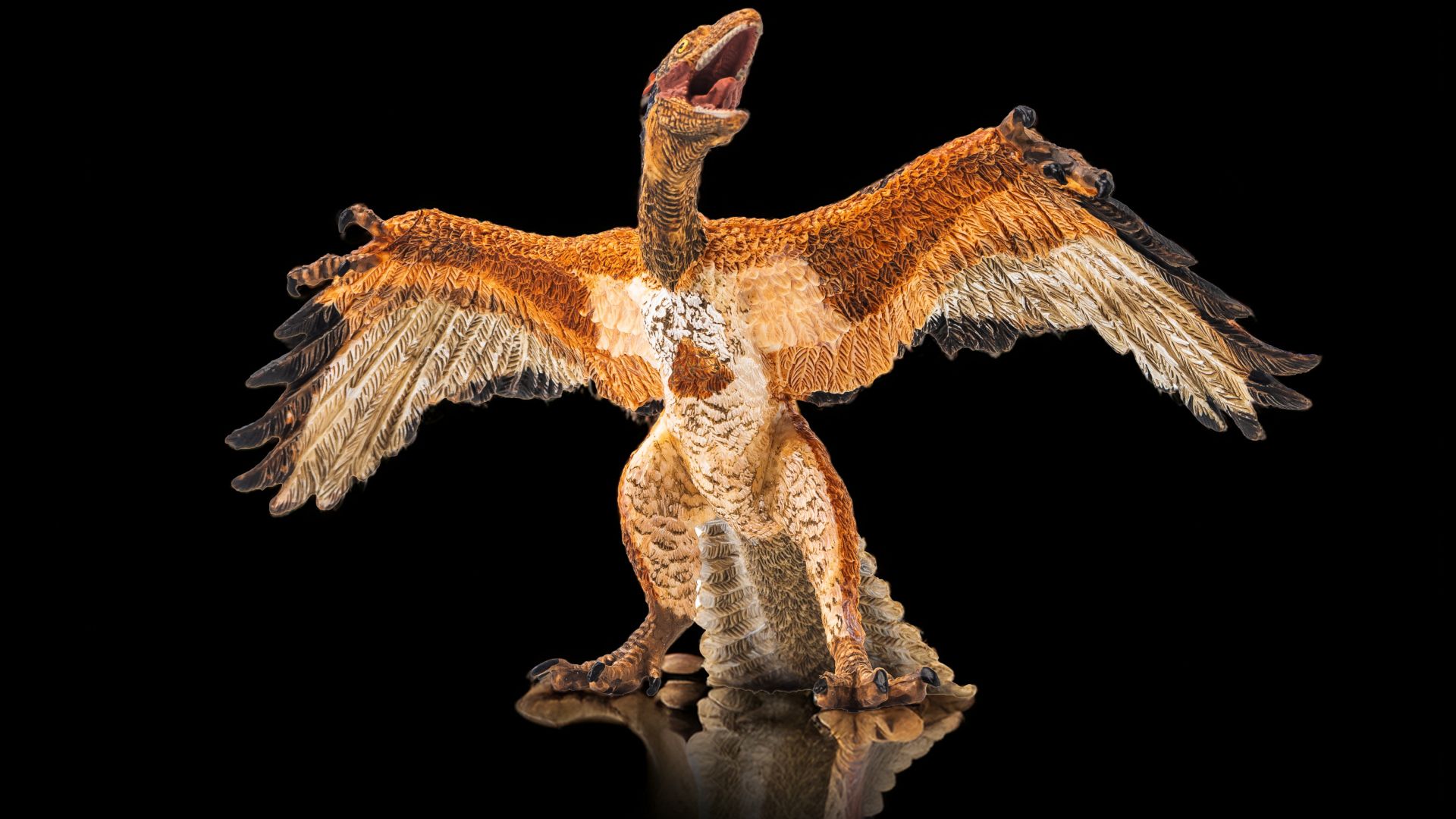
Much more extravagant were the feathers of the turkey-size Caudipteryx and dromaeosaurid “raptors” like Sinornithosaurus, which had true quill pens with a central shaft and many barbs extending off the sides to form vanes. Sometimes, these pennaceous feathers lined up along the hand and arm, making what could only be described as a wing, like in the crow-size Microraptor.
The roster of feathered dinosaurs got richer and richer. Even tyrannosaurs were in on the makeover: two early cousins of T. rex called Dilong and Yutyrannus were found coated in bristle and tufty feathers. Most of these plumose dinosaurs were theropods, members of the great group of meat-eaters on the family tree, but a few plant-eaters like Psittacosaurus, a primitive cousin of Triceratops with tiny horns on its head, had mohawks of bristles along their tails.
And most of these feathery fossils were from China, but soon they started to turn up elsewhere, like in Siberia, where a herd of hundreds of dog-size, duck-billed dinosaur cousins called Kulindadromeus were overwhelmed by their own volcano. This herbivore was resplendent with bristles on its head and body, branching downy tassels on its arms and legs, and curi-ous ribbonlike streamers on its knees — while meanwhile there were also scales on the lower legs and tail. Although Kulindadromeus was a vegetarian distantly related to theropods, its branching tufts — each formed by six or seven short filaments arising from a common anchor — look like they could be plucked from Sinosauropteryx or another meat-eater.
Initially, there was some skepticism that these wispy fossilized structures on the backs, tails, and arms of dinosaurs were true feathers. It was a legitimate question when Sinosauropteryx was first unveiled: Could its little strands and bristles have been something else, like degraded skin, or a freak by-product of decay and fossilization?
The discovery of full-on pennaceous quills — with shafts, barbs, and vanes — in species like Caudipteryx and Microraptor proved that many of these were genuine feathers. But what of those simpler filaments in other dinosaurs? We can be confident they are real. They not only look like the bristles and down feathers of birds today, but they share the same structure: They are hollow, chemical analysis shows they are formed of those rare CBP proteins, and when you look at them under powerful microscopes, you see they are full of melanosomes, the minuscule bubbles that hold pigments and give modern feathers their colors.
Still doubt it? Then gander at one of the most improbable fossils ever discovered, from Myanmar, announced in 2016. It’s a tail of a juvenile theropod embedded in amber, shrouded in feathers, their details preserved in stunning 3D. Suspended in yellow resin, like a bug frozen into an ice cube, the feathers seem almost alive.
They may as well be bundles of down that slipped out of a pillow and stuck onto your sofa. They have a small central shaft, which branches into barbs, which further branch into barbules. And they are clearly observed growing from follicles in the skin. They are absolutely feathers, and fulfill every definition we use to characterize feathers in modern birds — but they are plastered to a dinosaur.
This bounty of feathered dinosaurs, fundamentally, was that final piece of evidence to verify what has now become paleontological consensus: Today’s birds evolved from dinosaurs.
Excerpted from the book THE STORY OF BIRDS: A New History from Their Dinosaur Origins to the Present by Steve Brusatte. Copyright © 2026 by Stephen (Steve) Brusatte. From Mariner Books, an imprint of HarperCollins Publishers. Reprinted by permission.
Mariner
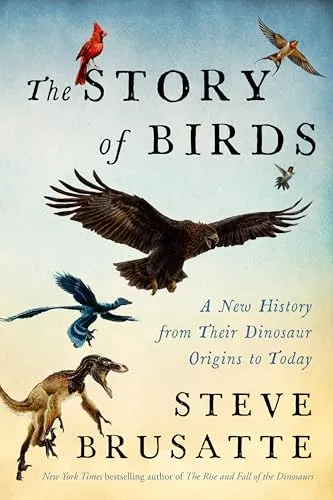
The Story of Birds: a New History From Their Dinosaur Origins to the Present
In delightfully energetic prose, expert palaeontologist Steve Brusatte takes us through their 150 million year history, from their origins among small carnivorous dinosaurs to the 10,000-plus species that thrive today.
The Story of Birds will be published in the U.K. on June 11 and is available for pre-order.