



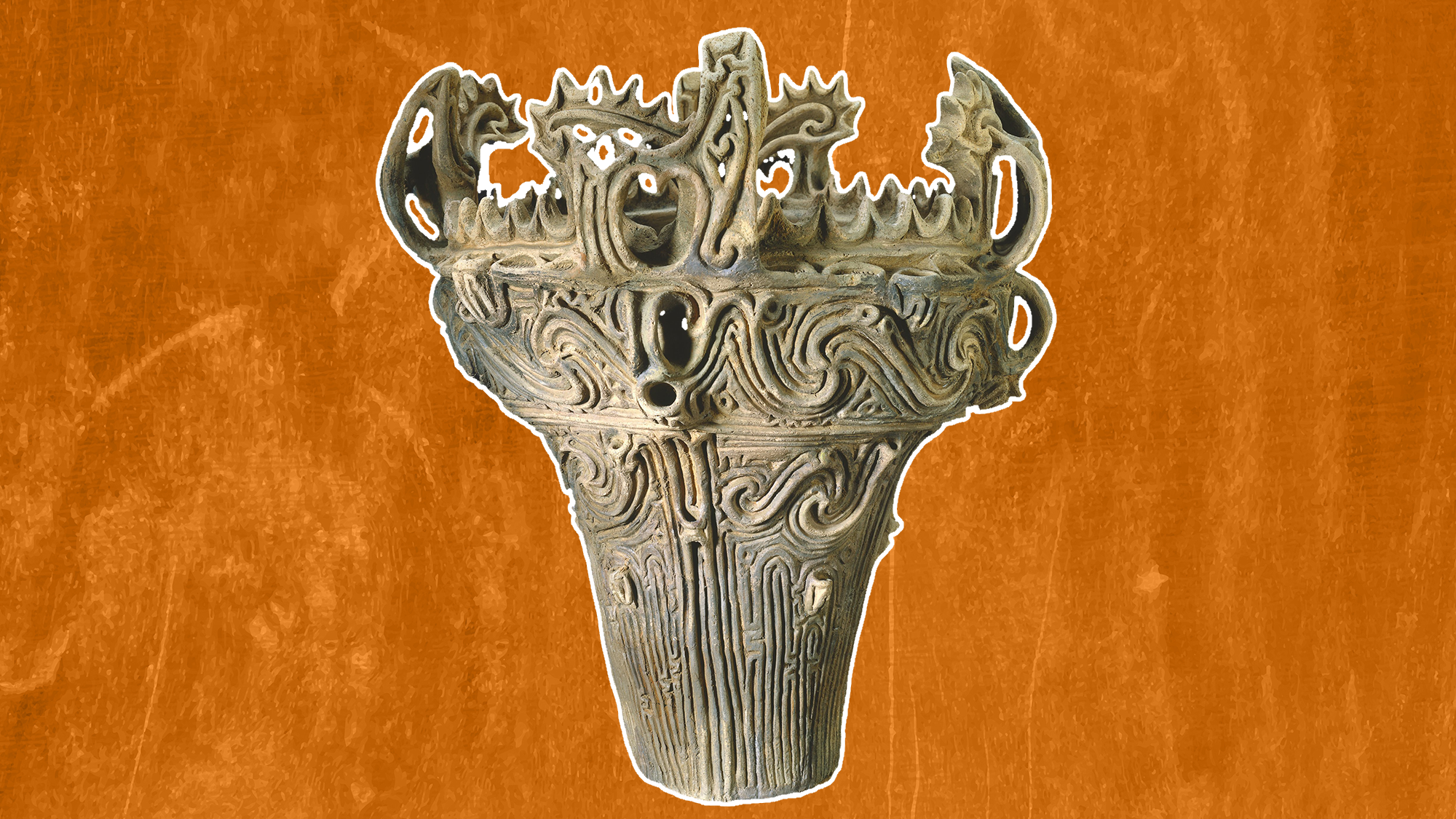

This ceramic vessel from prehistoric Japan may be decorated with flames, but archaeologists are unsure about their meaning.
(Image credit: Cleveland Museum of Art; Public Domain)
QUICK FACTS
Name: Fire-flame vessel (ka’en doki)
What it is: A decorated earthenware vessel
Where it is from: Honshu, Japan
When it was made: Circa 2500 B.C.
This ceramic vessel was made in prehistoric times on Honshu, the largest island in Japan. This type of pot is known as a fire-flame vessel (“ka’en doki” in Japanese), due to the stylized flames on the rim. Although other examples of these pots exist, the one in the Cleveland Museum of Art (CMA) is the largest and best preserved of its kind. But no one’s quite sure what its purpose was.
According to the CMA, this vessel measures 24 inches (61 centimeters) tall and about 22 inches (56 cm) in diameter. However, part of the bottom of this pot is from another vessel that was added to the piece somewhere along the line, meaning the vessel may have originally been shorter.
Fire-flame vessels were made in the Niigata area of Honshu during Japan’s prehistoric Jōmon period (circa 10500 to 300 B.C.). Because they had no written language, the Jōmon people are known from their archaeological remains. They were hunter-gatherers who settled in villages of around 100 people, according to Seema Rao, former director of intergenerational learning at the CMA, and they had sufficient spare time to create complex ceramics such as these. The vessel was built up coil by coil and then decorated with additional clay and cuts into the surface. The flame-shaped projections on the rim were added last.
Latest Videos FromLive Science
The Jōmon likely used ceramics in a variety of ways, but this form suggests it may not have been functional. The vessel was too heavy to be picked up by the flame-shaped handles, which couldn’t support the weight of the pot. Rather, with a wide mouth and a narrow base, the vessel may have been sunk into the ground for cooking, Rao said in a CMA video. Some other examples of fire-flame vessels have soot marks in them.
But this particular vessel, with its remarkably preserved delicate decoration and pointy flames, was likely not an everyday ceramic, James Ulak, former senior curator of Japanese art at the Smithsonian Institution, said in a CMA video. “Many people think this was somehow used as part of a religious ceremony and contained ritual offerings,” Ulak said, but “this dramatically rendered vessel is a bit of a mystery.”
Fire-flame vessels show that the Jōmon people had sophisticated pottery technology long before many other civilizations did and that this hunter-gatherer people enjoyed aesthetically pleasing — rather than purely functional — earthenware, according to Rao. But archaeologists are still not sure why the Jōmon crafted exquisite, flame-like pots or what the flames represented in their culture.
For more stunning archaeological discoveries, check out our Astonishing Artifacts archives.
Get the world’s most fascinating discoveries delivered straight to your inbox.
Can you put together last week’s Astonishing Artifact?
TOPICS