




QUICK FACTS
Name: Fingal’s Cave
Location: Staffa, Scotland
Coordinates: 56.4314, -6.3412
Why it’s incredible: The cave is formed entirely of hexagonal volcanic rock columns.
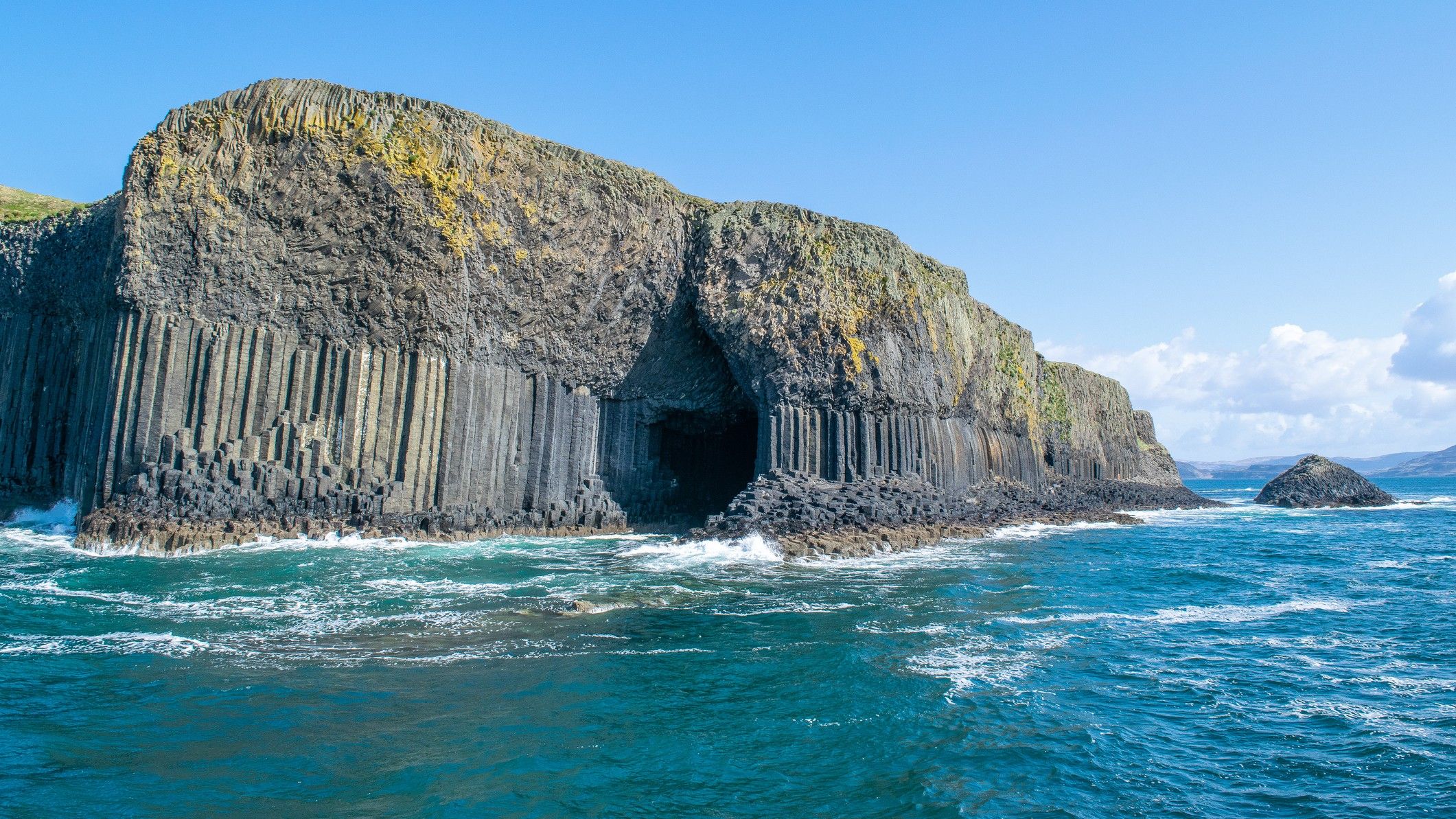
Fingal’s Cave is a sea cave in Scotland whose walls are made of hexagonally joined basalt columns. These structures may have formed within the same lava flow that shaped the Giant’s Causeway, a geological formation in Northern Ireland composed of more than 40,000 interlocking basalt pillars.
Fingal’s Cave extends 230 feet (70 meters) deep and 60 feet (18 m) high inside the small, uninhabited island of Staffa, located in Scotland’s Inner Hebrides. It was carved by a volcanic eruption sometime during the Paleocene epoch (66 million to 56 million years ago).
As giant lava flows from this eruption began to cool and solidify, their top and bottom parts contracted and fractured into hexagonal shapes similar to those formed by desiccation cracks in muddy sediments. Eventually, these fractures extended and combined in the center of the flow, forming hexagonal pillars whose sides were later revealed by waves eroding the margins of the flow, according to the National Trust for Scotland.
Fingal’s Cave formed inside Staffa due to pressure and erosion that opened cracks in the rock.
(Image credit: Paulien Dam (left) and Totajla (right) via Getty Images)
The cave gets its name from an Irish myth about a warrior called Fionn Mac Cumhaill. According to the legend, Fionn — whose full name was shortened to Fingal, meaning “white stranger” — built the Giant’s Causeway across the sea to Scotland to fight a rival called Benandonner, and Fingal’s Cave is what remains of Fionn’s path over the ocean on the Scottish side.
The 18th-century Scottish writer James Macpherson popularized the name Fingal’s Cave with a book titled “Fingal, an Ancient Epic Poem in Six Books” that was published in 1762. Then, after visiting the cave in 1829, the Romantic composer Felix Mendelssohn wrote an overture — a musical introduction to a ballet or opera — known as the “Hebrides Overture” or “Fingal’s Cave Overture.”
Mendelssohn was inspired by the natural acoustics and eerie echoes inside Fingal’s Cave, according to the National Trust for Scotland. A nod to these unique sounds is also found in the cave’s Gaelic name, “Uamh-Binn,” meaning “cave of melody” or “musical cave.” Mendelssohn’s overture established Fingal’s Cave as a tourist destination, and other famous visitors include the authors Jules Verne and Robert Louis Stevenson, the poets John Keats and Lord Alfred Tennyson, and Queen Victoria.
The cave can still be visited today through organized sightseeing cruises that take tourists inside the cathedral-like cavern when ocean conditions are calm enough.
Get the world’s most fascinating discoveries delivered straight to your inbox.
The National Trust for Scotland owns Fingal’s Cave as part of a nature reserve that was established in 2001. The cave and its surroundings host several types of birds and marine animals, including puffins, fulmars, basking sharks, dolphins, gray seals, minke whales and pilot whales.
Discover more incredible places, where we highlight the fantastic history and science behind some of the most dramatic landscapes on Earth.