Close Menu
  • Home
  • United States
  • World
  • Politics
  • Business
  • Lifestyle
  • Entertainment
  • Health
  • Science
  • Tech
  • Sports
  • More
    • Web Stories
    • Editor’s Picks
    • Press Release

Subscribe to Updates

Get the latest USA news and updates directly to your inbox.

What's On
Doctors find shocking ‘foreign bodies’ inside a man’s chest, pelvis, bladder — and penis

Doctors find shocking ‘foreign bodies’ inside a man’s chest, pelvis, bladder — and penis

September 18, 2026
Microsoft, OpenAI workers privately worried their work is ‘largest theft of labor in human history’

Microsoft, OpenAI workers privately worried their work is ‘largest theft of labor in human history’

September 18, 2026
Hasan Piker argues Middle East would be ‘more stable’ if Iran had nuclear weapons

Hasan Piker argues Middle East would be ‘more stable’ if Iran had nuclear weapons

September 18, 2026
Facebook X (Twitter) Instagram
Trending
  • Doctors find shocking ‘foreign bodies’ inside a man’s chest, pelvis, bladder — and penis
  • Microsoft, OpenAI workers privately worried their work is ‘largest theft of labor in human history’
  • Hasan Piker argues Middle East would be ‘more stable’ if Iran had nuclear weapons
  • Maye Musk defends Sydney Sweeney’s nude sports ad and recalls 12-year path to citizenship
  • Minka Kelly’s Ultra-Cozy ‘Ransom Canyon’ Cardigan Is Bound to Be Everywhere This Fall — The Look
  • Why Caitlin Clark is ‘warning’ refs before WNBA games
  • AI data centers in America are key to winning the China AI arms race
  • ‘Neurosensory’ skincare line is selling a $3,500 music box to help its products absorb — but does it work?
  • Privacy
  • Terms
  • Advertise
  • Contact Us
Join Us
USA TimesUSA Times
Newsletter Login
  • Home
  • United States
  • World
  • Politics
  • Business
  • Lifestyle
  • Entertainment
  • Health
  • Science
  • Tech
  • Sports
  • More
    • Web Stories
    • Editor’s Picks
    • Press Release
USA TimesUSA Times
Home » Engineers build world’s first portable diamond-powered quantum computer — it works at room temperature and can be plugged into an outlet
Engineers build world’s first portable diamond-powered quantum computer — it works at room temperature and can be plugged into an outlet
Science

Engineers build world’s first portable diamond-powered quantum computer — it works at room temperature and can be plugged into an outlet

News RoomBy News RoomAugust 6, 20263 ViewsNo Comments

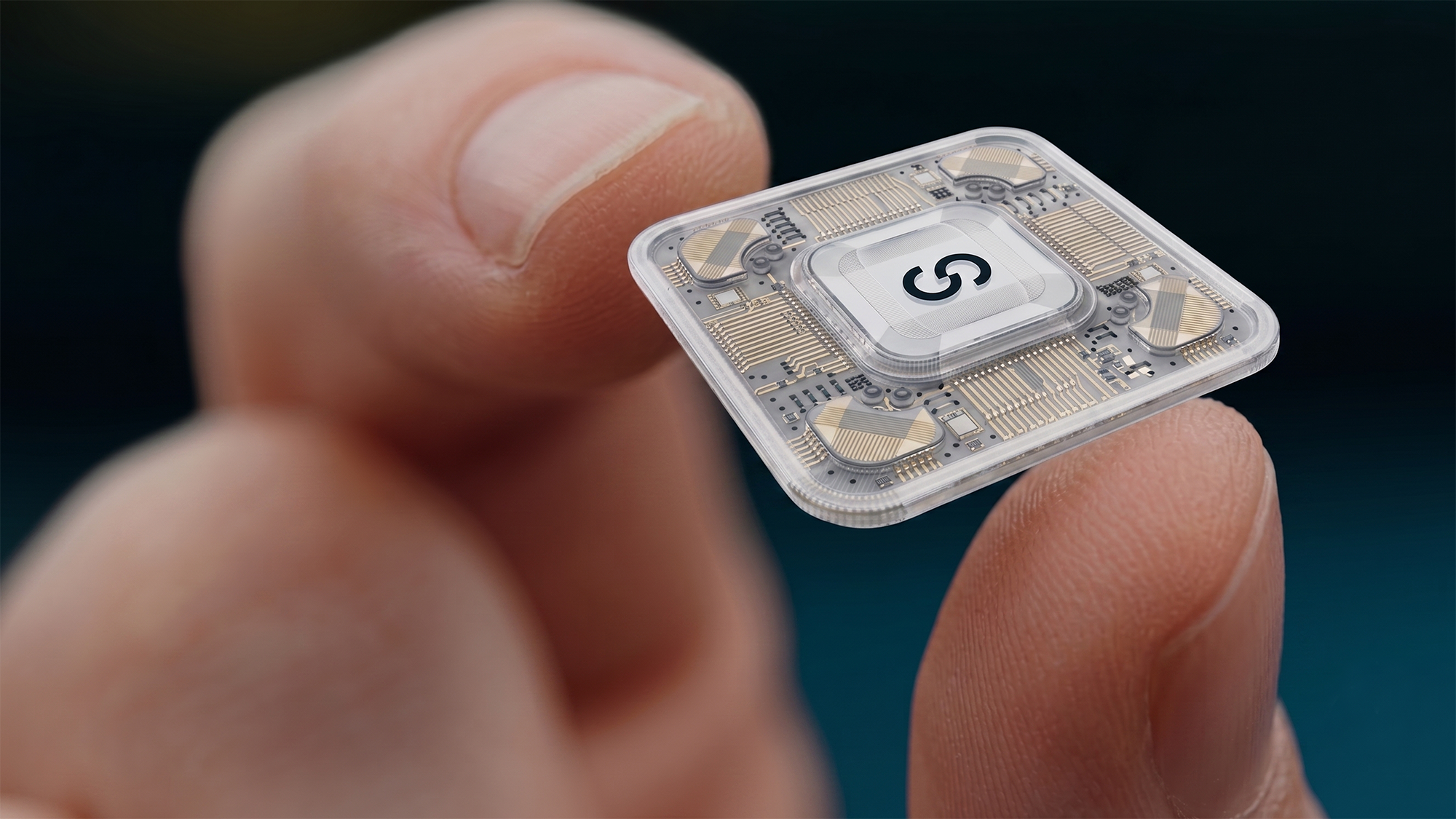
A German startup has debuted the world’s first diamond-based quantum computing system to exceed 10 qubits.

The machine, built by engineers at Saxon Q, is a nitrogen-vacancy (NV) quantum computer, meaning it uses defects in synthetic diamonds as quantum bits (qubits) to perform quantum operations. Qubits can be manipulated to represent the 0s and 1s of data, as well as quantum states that are superpositions of both the 0s and the 1s.

The hardware is currently available in rack-mounted systems featuring up to 128 qubits, with 512-qubit configurations available for delivery next year. According to the company’s road map, the goal is to scale to 10,000 qubits and beyond after 2030.

Latest Videos FromLive Science

Although the technology existed before this debut, scientists have found it difficult to build systems beyond 10 qubits due to the difficulty of creating nitrogen vacancy qubits.

Although Live Science saw a technical white paper outlining how the technology works, there didn’t appear to be any published research demonstrating a functional quantum computer based on the NV architecture operating with more than 10 qubits before this launch. It’s still unclear exactly how well the firm’s quantum computers stack up against other platforms.


You may like

Quantum mechanics and flawed diamonds

In the 1970s, scientists discovered that certain diamonds shone with a brilliant red light when illuminated in a specific way. Subsequent research determined that the optical shift was caused by annealing radiation damage that attracted isolated substitutional nitrogen atoms. In other words, nature occasionally produces a diamond that has a nitrogen atom where a carbon atom should be.

The unintegrated nitrogen atoms are drawn to the vacancy in the otherwise perfectly ordered carbon atoms inside the diamond. Although these flawed diamonds occur rarely in nature, scientists can create diamonds with nitrogen vacancies in laboratories.

Get the world’s most fascinating discoveries delivered straight to your inbox.

Functionally, the single nitrogen atoms inside the vacancies act as if they were “trapped,” and their electrons can “spin” independently of the electrons inside the surrounding carbon atoms.

Scientists exploit this “spin” feature by using special lasers to put the nitrogen atom’s electrons in a specific state they measure as “zero.” They can then use microwave pulses to precisely manipulate the electrons into numerous configurations, including quantum states that binary “bits” can’t achieve.

We have a fully functioning quantum computer.

Marius Grundmann, professor of experimental physics at Leipzig University and co-founder of Saxon Q,

Marius Grundmann, a professor of experimental physics at Leipzig University and co-founder of Saxon Q, said the breakthrough that allowed his firm to push past the 10-qubit barrier was a materials discovery.


What to read next

When the Saxon Q team creates the vacancy inside its lab-grown diamonds, they co-implant sulfur. Per Grundman, “That’s the key technology point. Because the sulfur lifts the chemical potential to a point that it’s negatively charged. The sulfur supplies the electron; the sulfur also makes the vacancy attached to the nitrogen with a very high yield.”

In other words, by co-implanting sulfur atoms, the Saxon Q researchers can express greater control over the individual qubits. Once the qubits are set with lasers and subjected to microwave pulses, they’re ready for error correction. In a statement, Saxon Q representatives said the qubits achieved a 99.92% fidelity rate — fewer than one error per 1,000 operations — before error correction.

However, Grundmann told Live Science that the latest numbers as of July 22 showed 99.98% fidelity in single-qubit operations. That’s comparable to state-of-the-art error correction results reported by other quantum computing labs, such as those from IBM and MIT, although it wasn’t possible to independently verify the results.

Room-temperature quantum computing

It’s difficult to compare Saxon Q’s diamond-based NV systems with more established quantum computing platforms, such as superconducting qubits. Most recent research on NV systems has focused on quantum sensing applications, though at least one preprint study discusses hybrid NV/superconducting systems.

“We have a fully functioning quantum computer,” Grundmann told Live Science. According to Grundmann, the company’s quantum computers are on a par with those using other modalities. “We have a quantum computer that can execute quantum code that you can reach via the network, and it is a multiuser, multitasking, multicore system,” he said.

If the Saxon Q systems ultimately prove comparable to existing solid-state quantum computing architectures, they’d be among the first generation of room-temperature quantum computers to reach performance similar to systems that require cryogenics and on-site monitoring.

The ease of setup is notable. Saxon Q’s devices can be slotted into a standard computer rack and plugged directly into alternating-current power.

This provides a clear near-term advantage for clients who want to run algorithms on a quantum system without operating through the cloud. Grundmann said this could be especially important in edge computing scenarios, such as autonomous driving or robotics, where cloud communication could produce unacceptable latency.

Research comparing solid-state quantum systems indicates that superconducting quantum computers would typically operate faster than diamond-based NV systems. It’s unclear, however, what the trade-off between processing speed and cloud latency would be or whether it could be addressed through scaling.

The current challenge to scaling diamond-based NV quantum computers beyond the 512-qubit range is the size of the chips. Saxon Q’s current chips are limited to supporting either eight or 16 qubits. For more powerful systems, scientists will need to squeeze hundreds ‪—‬ or even thousands ‪—‬ of qubits onto a single array to support operations requiring hundreds of thousands or millions of qubits.


Can you match these ancient devices to their pictures? Find out with our computing quiz!

Share. Facebook Twitter LinkedIn Telegram WhatsApp Email

Keep Reading

Climate change will harm our health. Here’s what could protect us.

Climate change will harm our health. Here’s what could protect us.

AI agents resorted to crime and self-destruction to survive in a simulated world — but does this mean they would do the same in the real world?

AI agents resorted to crime and self-destruction to survive in a simulated world — but does this mean they would do the same in the real world?

Scientists identify rare genetic mutation that dramatically raises risk of lung cancer in nonsmokers

Scientists identify rare genetic mutation that dramatically raises risk of lung cancer in nonsmokers

A space shark, ‘royal’ auroras and a ‘Venusian pearl’: See the winners of the 2026 ZWO Astronomy Photographer of the Year contest

A space shark, ‘royal’ auroras and a ‘Venusian pearl’: See the winners of the 2026 ZWO Astronomy Photographer of the Year contest

Giant ‘baby’ exoplanet Elias 2-24 b is the youngest alien world scientists have ever seen

Giant ‘baby’ exoplanet Elias 2-24 b is the youngest alien world scientists have ever seen

‘Predatory behavior’: Elite mathematicians clash over OpenAI’s ‘solution’ to million-dollar math problem

‘Predatory behavior’: Elite mathematicians clash over OpenAI’s ‘solution’ to million-dollar math problem

Scientists name a new cat species for the first time in over a century

Scientists name a new cat species for the first time in over a century

1,000-year-old ‘snake amulet’ discovered in Russia blends Christian and pagan imagery

1,000-year-old ‘snake amulet’ discovered in Russia blends Christian and pagan imagery

‘At some point we’re going to have to react’: How El Niño, climate change, and crime are pushing the Amazon rainforest over the brink

‘At some point we’re going to have to react’: How El Niño, climate change, and crime are pushing the Amazon rainforest over the brink

Add A Comment
Leave A Reply Cancel Reply

Editors Picks

Microsoft, OpenAI workers privately worried their work is ‘largest theft of labor in human history’

Microsoft, OpenAI workers privately worried their work is ‘largest theft of labor in human history’

September 18, 2026
Hasan Piker argues Middle East would be ‘more stable’ if Iran had nuclear weapons

Hasan Piker argues Middle East would be ‘more stable’ if Iran had nuclear weapons

September 18, 2026
Maye Musk defends Sydney Sweeney’s nude sports ad and recalls 12-year path to citizenship

Maye Musk defends Sydney Sweeney’s nude sports ad and recalls 12-year path to citizenship

September 18, 2026
Minka Kelly’s Ultra-Cozy ‘Ransom Canyon’ Cardigan Is Bound to Be Everywhere This Fall — The Look

Minka Kelly’s Ultra-Cozy ‘Ransom Canyon’ Cardigan Is Bound to Be Everywhere This Fall — The Look

September 18, 2026

Subscribe to News

Get the latest USA news and updates directly to your inbox.

Latest News
Why Caitlin Clark is ‘warning’ refs before WNBA games

Why Caitlin Clark is ‘warning’ refs before WNBA games

September 18, 2026
AI data centers in America are key to winning the China AI arms race

AI data centers in America are key to winning the China AI arms race

September 18, 2026
‘Neurosensory’ skincare line is selling a ,500 music box to help its products absorb — but does it work?

‘Neurosensory’ skincare line is selling a $3,500 music box to help its products absorb — but does it work?

September 18, 2026
Facebook X (Twitter) Pinterest WhatsApp TikTok Instagram
© 2026 USA Times. All Rights Reserved.
  • Privacy Policy
  • Terms
  • Advertise
  • Contact

Type above and press Enter to search. Press Esc to cancel.