



Quick facts
What it is: The collision-prone galaxy cluster MACS J0553.4-3342
Where it is: In the constellation Columba
When it was shared: July 2026
Around 100 years ago, Albert Einstein made an audacious prediction about space. The frequently right (but occasionally wrong) physicist theorized that, just as the curved lens of a magnifying glass bends light to increase an object’s apparent size, massive celestial objects can curve the very fabric of the universe with their gravity — causing distant sources of light to bend, warp, and appear magnified as their rays pass through the region on their way to Earth.
Today, this phenomenon — called gravitational lensing — has been confirmed through dozens of telescope observations, and is a crucial tool that observatories like the James Webb Space Telescope (JWST) use to probe the light of the oldest, faintest galaxies in the universe. And in this newly released JWST image of a tumultuous young galaxy cluster, Einstein’s gravitational funhouse effect is on full display.
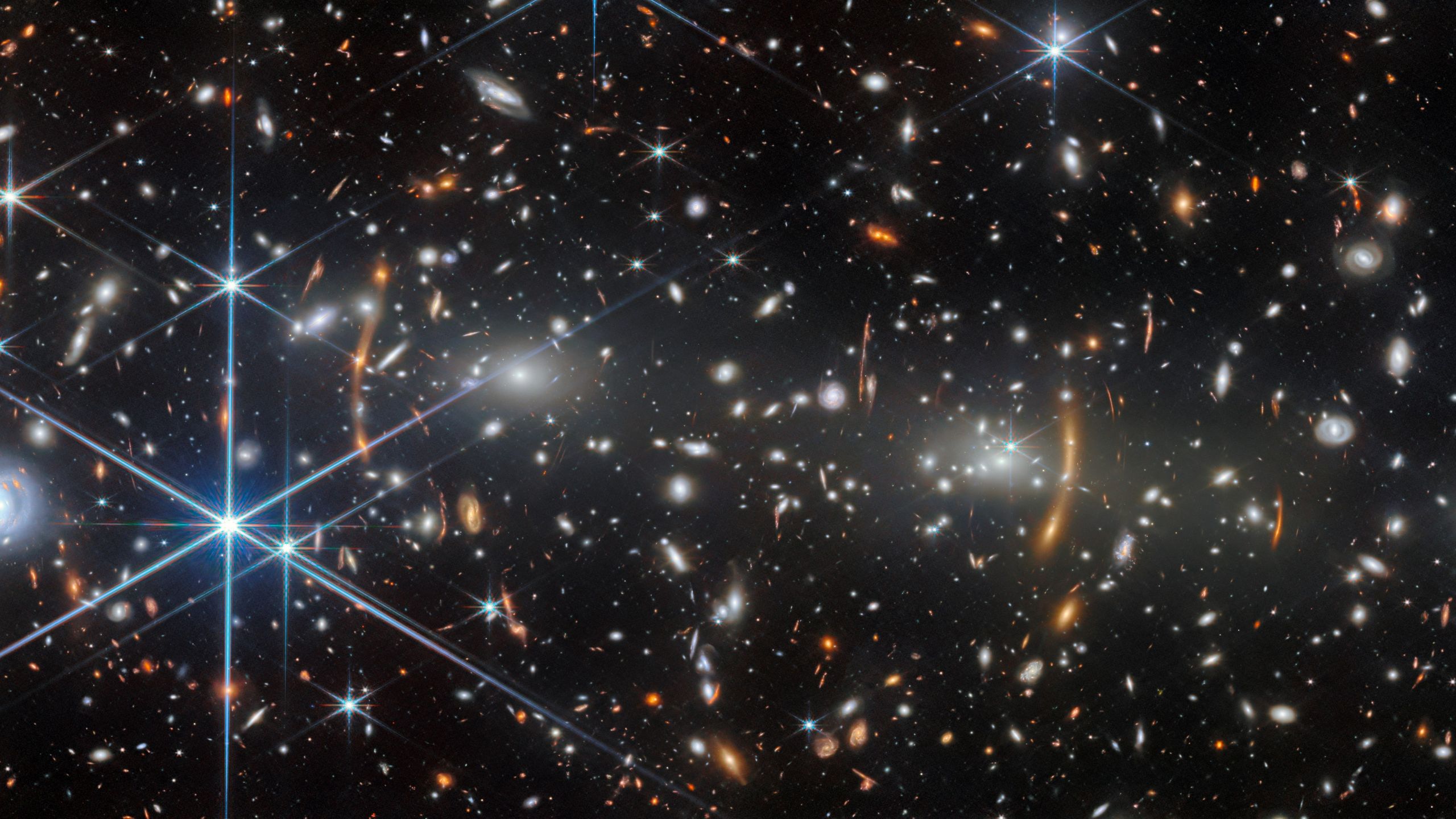
In the foreground, two bright white points of light ringed with white halos signify the gravitational center of MACS J0553.4-3342, a gargantuan collection of bound galaxies located in the constellation Columba (the dove). These two white beacons are massive elliptical galaxies, each wreathed in their own sub-cluster of smaller galaxies, according to a statement from the European Space Agency (ESA). And the two clusters are not getting along.

Studying the galaxies’ light as it appeared roughly 4.4 billion years ago, astronomers can tell the clusters are in the messy process of merging together. The two principal elliptical galaxies have already slammed through each other once, and now sit at a distance of around 1 million light-years apart (that’s about 10 Milky Ways lined up in a row). Eventually, that gap will close as the massive galaxies swoop back toward each other, finally combining into one.

A full-size view of JWST’s observations
(Image credit: ESA/Webb, NASA & CSA, S. Fujimoto)
But the real jewels in this galactic trove are hidden in the contorted, orange arcs of light that bookend the cluster on either side. Here, the magnifying effect of gravitational lensing is acting in full force — allowing JWST to detect the light of several faint galaxies from less than a billion years after the Big Bang.
Three bright dots in the arc on the left are actually three repeated images of a single galaxy, according to ESA. The trippy effect appears several times throughout the image, with each elongated orange streak cracking open a warped window onto an ancient corner of the universe that would otherwise be impossible to see.
Through observations like these, scientists using JWST have discovered that the oldest stars and galaxies in the universe have grown larger and faster than our leading theories of cosmology predict should be possible. Using one cosmic oddity to uncover another, this gravitational lens could keep astronomers busy for decades to come.
Get the world’s most fascinating discoveries delivered straight to your inbox.