





The patient: A 59-year-old woman in Wisconsin
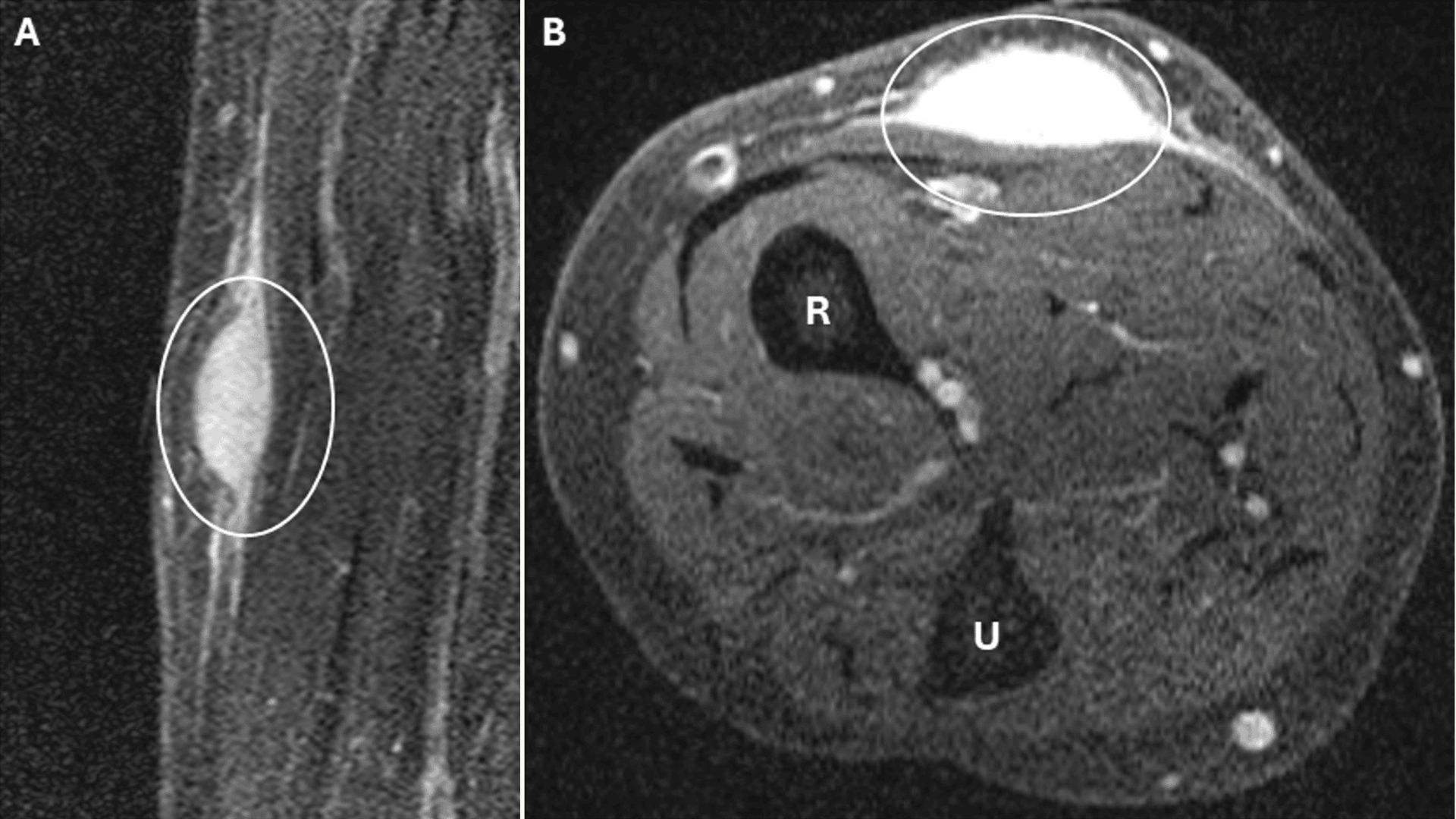
The symptoms: The woman sought medical care after noticing a rapidly growing mass in her right arm.
To further examine the lump, doctors performed a core needle biopsy, which involves inserting a small, hollow tube into the tissue to collect a sample. They also collected fine needle aspirates, or biopsies of cells and fluids collected using a small needle and syringe.
The diagnosis: Analyses of the biopsied samples showed that the woman had myxofibrosarcoma (MFS), a type of cancer that develops in connective tissues beneath the skin, often in the limbs. MFS cases make up about 5% to 10% of soft tissue sarcomas; a few hundred new cases occur in the U.S. each year.
The cancer cells in the woman’s biopsy were classified as Grade 2, or intermediate grade; in terms of the abnormality of the cells and expected speed of tumor growth, the cells were a 2 on a scale of 1 to 4, with 4 being the most abnormal and fastest growing.
The treatment: Following her biopsy, the patient reported that the mass in her arm had suddenly begun to shrink, and in two weeks, it could no longer be felt through her skin. Although the mass seemed to have disappeared, her medical team performed a procedure to remove the tissue where the lump had been “to ensure disease control,” doctors wrote in a report describing the case.
They performed a wide local excision, meaning they removed tissue from the tumor site and a bit of healthy tissue surrounding it, to help prevent regrowth. However, the team spotted no viable cancer cells in the tissue they removed. The tissue showed scarring and inflammation that might be expected following an anti-cancer immune response, but the cancer itself had gone.
One year later, the patient remained cancer-free, the report said.
An X-ray of the woman’s arm, taken before the biopsy, showed where a mass was rapidly growing within the tissue.
(Image credit: Gannon M. C., Gabor R. M., Gupta A., et al. (April 15, 2026) Spontaneous Regression of Soft Tissue Sarcoma Following Biopsy: A Case Report and Systematic Review of the Literature. Cureus 18(4): e107111. doi:10.7759/cureus.107111 (CC-BY 4.0))
What makes the case unique: The woman experienced what’s known as a spontaneous regression of malignancy, meaning the partial or complete disappearance of cancer without any treatment. Spontaneous regression can also sometimes occur after a patient receives a treatment that wouldn’t be expected to effectively shrink a cancerous tumor.
Spontaneous regression is rare across all cancer types, but given that sarcomas are rare at baseline, there aren’t many published descriptions of the phenomenon. In their report of the woman’s case, which was published in April, the doctors found 32 previous reports of spontaneous regression of malignancy in sarcomas, including nine involving MFS.
Of the 32 cases of spontaneous regression, eight (25%) began after a diagnostic biopsy or some other physical trauma to the tumor, they found. Infections, such as pneumonia, appeared to be the trigger in three cases, and for most of the remainder, a specific trigger couldn’t be identified.
The median time from biopsy to regression in these biopsy-triggered cases was less than a month. Regression due to infections had a median response time of five months, while the others regressed in about three months.
Half of the biopsy-associated cases saw complete tumor regression, while the others had near-complete or partial regression. Surgical resection was still performed in most of the cases, with some patients showing no signs of cancer cells in the resected tissue and others having some lingering cells.
The report authors hypothesized that physical disruptions to the tumor’s structure during a biopsy releases tumor-related proteins into circulation that can then be spotted by the immune system. Simultaneously, the biopsy summons immune cells to the tissue by triggering a wound-healing process.
This chain of events may expose the tumor to the immune system while also spurring a local immune reaction at the tumor site. The scarring and inflammation evident in the patient’s resected tissue may support that hypothesis.
That said, “the observation of a regressing sarcoma presents a clinical trap. It may tempt the clinician to cancel surgery,” the case report authors wrote. “However, our systematic review reveals that while some regressions are complete, many are partial or transient. Furthermore, in the biopsy group, nearly 40% of resected specimens still contained residual tumor cells despite clinical regression.”
They recommended removing the tissue where the tumor had been regardless of the regression, in case some cancer cells persist. The authors also told New Scientist that they hope to unravel exactly what happens in these rare regressions in order to replicate it through some sort of treatment.
For more intriguing medical cases, check out our Diagnostic Dilemma archives.
This article is for informational purposes only and is not meant to offer medical advice.
Gannon M. C., Gabor R. M., Gupta A., et al. (April 15, 2026) Spontaneous Regression of Soft Tissue Sarcoma Following Biopsy: A Case Report and Systematic Review of the Literature. Cureus 18(4): e107111. doi.org/10.7759/cureus.107111
TOPICS