


Close Menu
  • Home
  • United States
  • World
  • Politics
  • Business
  • Lifestyle
  • Entertainment
  • Health
  • Science
  • Tech
  • Sports
  • More
    • Web Stories
    • Editor’s Picks
    • Press Release

Subscribe to Updates

Get the latest USA news and updates directly to your inbox.

What's On
Once-a-week activity may cut older people’s dementia risk by 30%

Once-a-week activity may cut older people’s dementia risk by 30%

March 25, 2026
Meta, YouTube found liable for woman’s debilitating social media addiction in M landmark trial

Meta, YouTube found liable for woman’s debilitating social media addiction in $3M landmark trial

March 25, 2026
Inside Meta’s play to turn 250M SMBs into AI customers

Inside Meta’s play to turn 250M SMBs into AI customers

March 25, 2026
Facebook X (Twitter) Instagram
Trending
  • Once-a-week activity may cut older people’s dementia risk by 30%
  • Meta, YouTube found liable for woman’s debilitating social media addiction in $3M landmark trial
  • Inside Meta’s play to turn 250M SMBs into AI customers
  • California Dem dating San Diego billionaire heiress accused of fudging his Navy service
  • US military kills 4 alleged narco-terrorists in Caribbean vessel strike
  • 25 Must-Watch Hallmark Shows on Right Now (March 2026): ‘The Chicken Sisters’ and More
  • NBA votes to open Seattle, Las Vegas expansion bids in potential $20 billion boon
  • Grab a free $50 Amazon Gift Card, and up to 77% off NordVPN — enjoy all your favorite natural history documentaries
  • Privacy
  • Terms
  • Advertise
  • Contact Us
Join Us
USA TimesUSA Times
Newsletter Login
  • Home
  • United States
  • World
  • Politics
  • Business
  • Lifestyle
  • Entertainment
  • Health
  • Science
  • Tech
  • Sports
  • More
    • Web Stories
    • Editor’s Picks
    • Press Release
USA TimesUSA Times
Home » Chinese lander reveals giant ‘cavity’ of radiation between Earth and the moon — and it could change how lunar exploration is done
Chinese lander reveals giant ‘cavity’ of radiation between Earth and the moon — and it could change how lunar exploration is done
Science

Chinese lander reveals giant ‘cavity’ of radiation between Earth and the moon — and it could change how lunar exploration is done

News RoomBy News RoomMarch 25, 20260 ViewsNo Comments

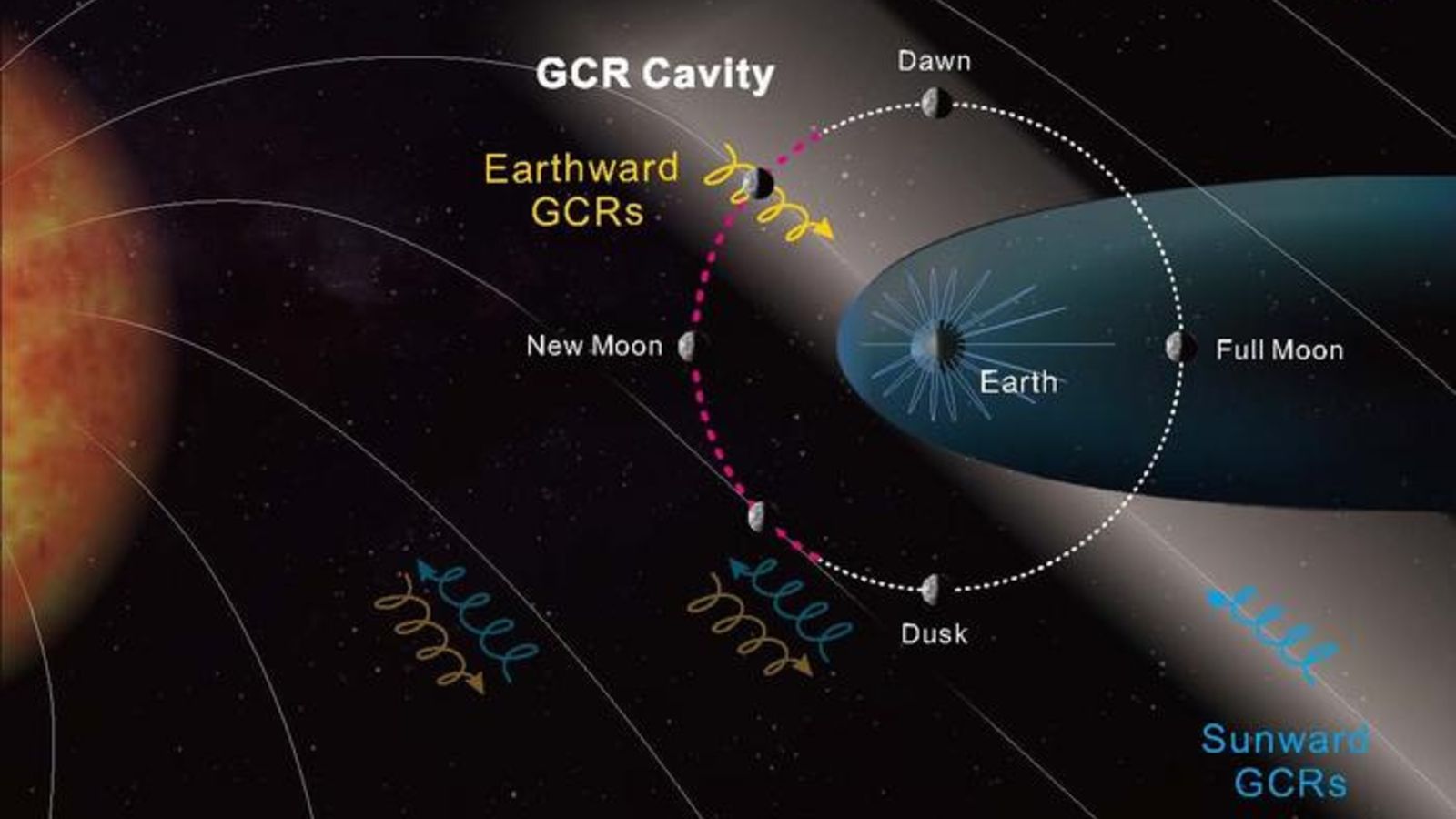
Could being a “morning person” improve your health … on the moon? Scientists have identified what appears to be a “cavity” of reduced cosmic radiation near Earth’s moon. The finding could help lower astronauts’ exposure to harmful radiation on future lunar missions by timing some surface operations for local morning hours.

The discovery, based on data from China’s Chang’e-4 lunar lander, suggests Earth’s magnetic field may affect distances in space farther than scientists previously expected. According to the researchers, the finding challenges the long-held assumption that galactic cosmic rays are roughly uniform throughout the space between Earth and the moon outside our planet’s protective magnetic field.

The study, published Wednesday (March 25) in the journal Science Advances, analyzed measurements from the Lunar Lander Neutron and Dosimetry experiment aboard Chang’e-4. Researchers reported a region of reduced galactic cosmic rays during the moon’s local morning, roughly a few hours after lunar sunrise.

Article continues below


You may like

Cosmic rays are among the biggest radiation hazards for astronauts traveling beyond low Earth orbit. These high-energy particles can penetrate spacecraft and human tissue, in turn damaging DNA and increasing the risk of cancer. With more crewed trips planned to the moon, starting with NASA’s Artemis II mission launching as soon as April 1, researchers said a better map of radiation intensity could help mission planners reduce astronauts’ radiation exposure during surface explorations.

“The next landings will probably be in the polar regions,” which can be permanently sunlit, Robert Wimmer-Schweingruber, a professor at the Institute of Experimental and Applied Physics at Kiel University in Germany and a corresponding author of the study, told Live Science in an email. He said lunar morning appears to be the best time for excursions because it reduces the amount of radiation on astronauts’ skin by about 20% compared to average radiation levels on the moon.

Calculating cosmic rays

I had not expected to see this ‘shadow’ or cavity,

Robert Wimmer-Schweingruber, professor at the Institute of Experimental and Applied Physics at Kiel University

To find this cosmic-ray cavity, the researchers analyzed data collected over 31 lunar cycles from January 2019 to January 2022, focusing on quiet times in the solar cycle, when the measured space radiation was predominantly from galactic cosmic rays. They looked for repeated changes in Chang’e-4’s measured proton counts from the rays as the moon moved through different parts of its orbit around Earth.

The Lunar Lander Neutron and Dosimetry instrument recorded galactic cosmic ray protons in two energy ranges, which the researchers then grouped by lunar local time. They found that the lower-energy protons, in the 9.18 to 34.14 mega-electron-volt range, dropped by about 20% during the moon’s local morning, during the moon’s waxing gibbous phase (in the period between a new moon and a full moon) compared with later hours.

Get the world’s most fascinating discoveries delivered straight to your inbox.

Because the decrease showed up in a specific, recurring part of the moon’s waxing phase rather than across all times, the team inferred that the moon was passing through a real region of reduced cosmic ray radiation, which they believed was being created as Earth’s magnetic field blocked some high-energy protons. To investigate this idea, they ran simulations of the protons’ movement through the moon’s orbit and found the same cavity.

“I had not expected to see this ‘shadow’ or cavity,” Wimmer-Schweingruber said. “It makes absolute sense in retrospect, but I was very skeptical when I first saw this result,” and that’s why the team performed so many tests, he added.

Stretching Earth’s magnetic influence

The findings point to a new picture of how cosmic radiation behaves between Earth and the moon. Scientists had generally believed that, once galactic cosmic rays crossed Earth’s magnetosphere, they were spread fairly evenly throughout the Earth-moon space and were only minimally affected by Earth’s magnetic field.

“Basically this result means that the Earth’s magnetosphere influences space even beyond its extension,” Wimmer-Schweingruber said. The team expected Earth to affect the moon in the magnetotail, the long stream of magnetic field extending away from the sun on Earth’s nightside, he noted, but they did not predict the similar effect ahead of the magnetosphere on the sunward side

A rendering of Earth’s magnetotail extending behind it, away from the sun. (Image credit: NASA’s Scientific Visualization Studio – ADNET Systems, Inc./AJ Christensen, Kyoto University/Yusuke Ebihara, University of California, Berkeley/Robert Lillis, eMITS/Vanessa Thomas, eMITS/Joy Ng, Public domain, via Wikimedia Commons)

Wimmer-Schweingruber said future studies with bigger datasets could better define the size and behavior of this cavity, which could help pave the way for a more practical era of lunar exploration. He suggested a familiar rule of thumb may apply for safer moon missions: It’s “best for astronauts to venture out onto the lunar surface in the local morning hours,” Wimmer-Schweingruber said — “just like for humans on Earth!”

Shang, W., Liu, J., Xu, Z., Yue, C., Guo, R., Xiao, C., Shi, Q., Wimmer-Schweingruber, R., Guo, J., William, D. A., Rankin, R., Tian, A., Zong, Q., Han, C., Park, J., Wang, H., Liu, W., Fu, S., Zhai, L. M., . . . Chen, T. (2026). A galactic cosmic ray cavity in Earth-Moon space. Science Advances. 12(1), eadv1908. www.science.org/doi/10.1126/sciadv.adv1908
Moon quiz: What do you know about our nearest celestial neighbor?

Share. Facebook Twitter LinkedIn Telegram WhatsApp Email

Keep Reading

Grab a free  Amazon Gift Card, and up to 77% off NordVPN — enjoy all your favorite natural history documentaries

Grab a free $50 Amazon Gift Card, and up to 77% off NordVPN — enjoy all your favorite natural history documentaries

NASA announces ‘near‑impossible’ space plans, including B moon base and humanity’s first nuclear-powered interplanetary spacecraft

NASA announces ‘near‑impossible’ space plans, including $20B moon base and humanity’s first nuclear-powered interplanetary spacecraft

Is the metaverse finally dead and buried? What’s really going on with the embattled idea of living in virtual worlds.

Is the metaverse finally dead and buried? What’s really going on with the embattled idea of living in virtual worlds.

Critically endangered hare spotted in surprising location for the first time in 40 years — but it was already dead

Critically endangered hare spotted in surprising location for the first time in 40 years — but it was already dead

Scientists are racing to save Australia’s ‘zombie tree’ from a fast-spreading fungal disease

Scientists are racing to save Australia’s ‘zombie tree’ from a fast-spreading fungal disease

Explore the natural world from the comfort of your own home with this Paramount+ streaming deal

Explore the natural world from the comfort of your own home with this Paramount+ streaming deal

Live Science Today: NASA announces  billion moonbase as unprecedented wildfires spread

Live Science Today: NASA announces $20 billion moonbase as unprecedented wildfires spread

Diagnostic dilemma: A cross tattoo on a man’s neck disappeared — killing his skin as it did so

Diagnostic dilemma: A cross tattoo on a man’s neck disappeared — killing his skin as it did so

Mars is hiding a secret clutch of gemstone-like crystals, including rubies and possibly sapphires

Mars is hiding a secret clutch of gemstone-like crystals, including rubies and possibly sapphires

Add A Comment
Leave A Reply Cancel Reply

Editors Picks

Meta, YouTube found liable for woman’s debilitating social media addiction in M landmark trial

Meta, YouTube found liable for woman’s debilitating social media addiction in $3M landmark trial

March 25, 2026
Inside Meta’s play to turn 250M SMBs into AI customers

Inside Meta’s play to turn 250M SMBs into AI customers

March 25, 2026
California Dem dating San Diego billionaire heiress accused of fudging his Navy service

California Dem dating San Diego billionaire heiress accused of fudging his Navy service

March 25, 2026
US military kills 4 alleged narco-terrorists in Caribbean vessel strike

US military kills 4 alleged narco-terrorists in Caribbean vessel strike

March 25, 2026

Subscribe to News

Get the latest USA news and updates directly to your inbox.

Latest News
25 Must-Watch Hallmark Shows on Right Now (March 2026): ‘The Chicken Sisters’ and More

25 Must-Watch Hallmark Shows on Right Now (March 2026): ‘The Chicken Sisters’ and More

March 25, 2026
NBA votes to open Seattle, Las Vegas expansion bids in potential  billion boon

NBA votes to open Seattle, Las Vegas expansion bids in potential $20 billion boon

March 25, 2026
Grab a free  Amazon Gift Card, and up to 77% off NordVPN — enjoy all your favorite natural history documentaries

Grab a free $50 Amazon Gift Card, and up to 77% off NordVPN — enjoy all your favorite natural history documentaries

March 25, 2026
Facebook X (Twitter) Pinterest WhatsApp TikTok Instagram
© 2026 USA Times. All Rights Reserved.
  • Privacy Policy
  • Terms
  • Advertise
  • Contact

Type above and press Enter to search. Press Esc to cancel.