




NEWYou can now listen to articles!
Chicago’s chief financial officer, who formerly worked for a top credit ratings bureau, resigned Friday citing financial integrity concerns, casting a shadow over the fiscal management of progressive Mayor Brandon Johnson amid a fight over the FY-2027 budget.
Chicago CFO Ashlee Gabrysch served only three months before the onetime Fitch Ratings executive stepped down, saying she could no longer meet her professional obligations under the conditions of her employment, according to a resignation letter obtained by the Chicago Tribune.
“The chief financial officer’s statements about the city’s finances are relied upon by investors, rating agencies, City Council, and taxpayers, and they must be complete and accurate,” Gabrysch wrote, according to the Tribune.
“I am not able to fulfill those obligations under the conditions in which I have been asked to serve.”
Johnson did not immediately respond to Digital’s request for comment, but his press secretary accused Gabrysch of being “largely absent” during key parts of the next budget’s creation process.
CHICAGO MAYOR CALLS ICE RAIDS ‘TERRORISM,’ SAYS TRUMP’S AMERICA APPEARS AS ‘IF THE CONFEDERACY WON’
The mayor’s office also accused Gabrysch of improperly directing a $75 million payment to city pension funds before the required legal procedures had been completed, saying it would refer the matter to Chicago’s Office of Inspector General for review.
The Tribune recounted recent events in the budget process involving Gabrysch, including that she disagreed with Johnson over assertions about the size of the city’s deficit.
In September, Johnson announced that the Windy City faces a projected $882 million budget shortfall in 2027, which local media described as smaller than a typical election year and lighter than the $1.15 billion deficit projected in 2025. The city holds its elections in odd years.
“We have difficult and consequential decisions ahead of us as we work to address the structural financial challenges that have confronted Chicago for decades,” Johnson said at the time, according to Chicago’s PBS affiliate.
However, according to the Tribune, Johnson claimed the true figure is now $662 million, “adjusted” in concert with planned borrowing to help fund settlement amounts involving police officers.
CHICAGO MAYOR CALLS DOGE AN ‘ACT OF WAR’
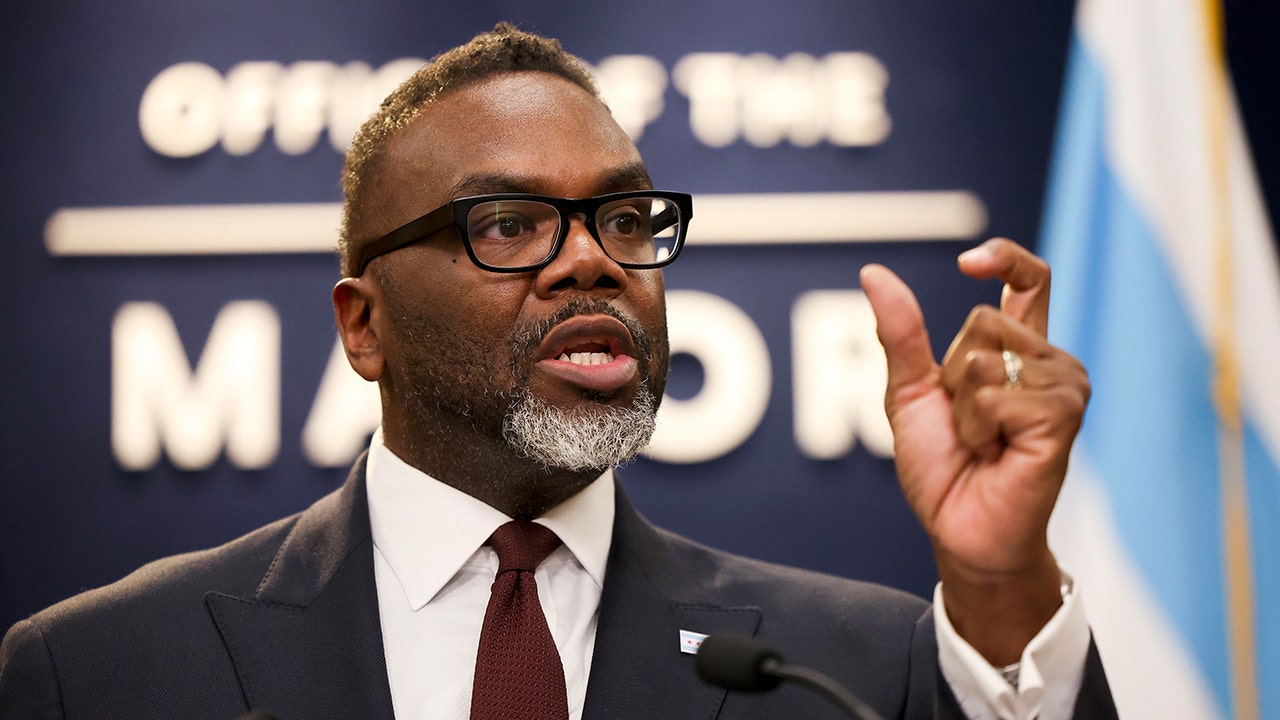
Chicago Mayor Brandon Johnson has launched a community engagement effort called “Repair Chicago” to gather experiences of harm of Black Chicagoans as part of an effort to implement reparations. (Eileen T. Meslar/Chicago Tribune/Tribune News Service via Getty Images)
Gabrysch challenged that accounting during budget hearings, arguing that the settlement expenses should remain part of the deficit and that borrowing to pay them amounted to a temporary fix rather than a lasting solution.
While the administration maintained that 76% of its budget measures addressed underlying financial problems, Gabrysch calculated the figure at just 56%, according to the Tribune.
Ald. Marty Quinn, D-Midway, questioned Johnson’s handling at the time, according to the paper, saying he was “not surprised that the mayor may be a little disingenuous here, that seems to be his normal course.”
Gabrysch also stopped short of calling Johnson’s proposed $17.6 billion budget balanced during an October City Council hearing, arguing that the city needed to demonstrate progress toward reducing future deficits, according to Crain’s Chicago Business.
City Comptroller Michael Belsky maintained that proposed revenues matched expenditures, while acting Budget Director Jonathan Ernst defended the administration’s calculations and its plan to borrow roughly $480 million to cover legal settlements.
Gabrysch warned that the city anticipated issuing $350 million in settlement-related bonds in 2027, with an estimated $190 million in interest costs over seven years, according to Crain’s.
CLICK HERE TO GET THE APP
SIGN UP TO GET THE POLITICS NEWSLETTER
Her resignation prompted Council Finance Committee chairman Pat Dowell, D-South Loop, to call for an independent audit.
The departure adds to a wave of turnover in Johnson’s financial leadership, including two previous CFO departures this year and the resignation of the city’s budget director in August. The upheaval comes as Chicago grapples with mounting financial obligations and credit-rating downgrades.