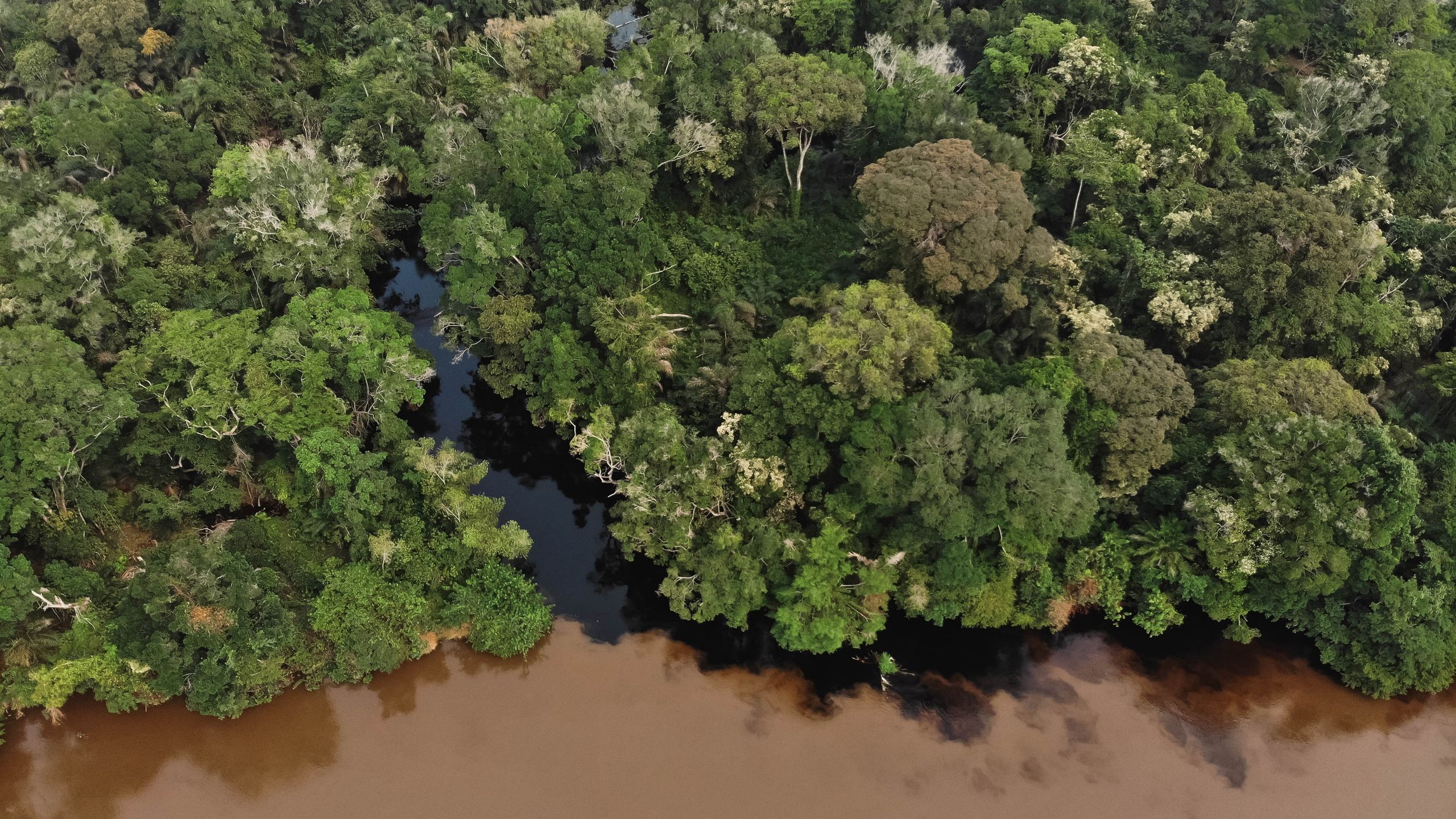

Blackwater lakes and rivers in the Congo Basin are releasing ancient carbon into the atmosphere, a new study shows. Previously, scientists thought this carbon was safely stored in the surrounding peatlands, but the research reveals that’s not the case.
The finding contradicts the long-held assumption that old peat carbon remains trapped underground, suggesting that some tropical peatlands could switch from being carbon sinks to major carbon sources.
Article continues below
Drake and his colleagues have conducted three research trips to the Congo Basin over the past four years. Specifically, the team traveled to the Cuvette Centrale, a 56,000-square-mile (145,000 square kilometers) region of forests and swamps in the Democratic Republic of the Congo that holds Earth’s largest known tropical peatland complex. Situated in the heart and to the south of the Cuvette Centrale are two large blackwater lakes — Lake Mai Ndombe and Lake Tumba — while a major blackwater river, the Ruki River, flows west-northwest across it to meet the Congo River.
Blackwater lakes and rivers contain high levels of decaying plant debris, or dissolved organic carbon, which gives them their black color. This dissolved organic matter, together with direct inputs of carbon dioxide (CO2) from the surrounding swamps and forests, creates supersaturated concentrations of CO2 in lakes Mai Ndombe and Tumba and in the Ruki River. As a result, these waters emit enormous amounts of CO2 into the atmosphere.
Crucially, however, none of the CO2 was previously thought to originate from the Cuvette Centrale’s ancient peat, as these deposits, protected from decomposition by their oxygen-depleted, waterlogged environment, were believed to be highly stable.
But in a paper published Feb. 23 in the journal Nature Geoscience, Drake and his colleagues found otherwise. Their results showed that a significant proportion of the CO2 escaping the Cuvette Centrale’s blackwater bodies is from peat carbon that is between 2,170 and 3,500 years old.
“We were very surprised because we fully expected the carbon dioxide to be modern,” Drake said.
The researchers drew their conclusions from measurements they took at Lake Mai Ndombe in 2022 and 2024, and at Lake Tumba and the Ruki River in 2025. They accessed Lake Mai Ndombe with small boats, which was difficult due to strong winds that almost capsized them, Drake said.
“The ecosystems remain in relatively pristine condition,” he said. “There are some small settlements and villages scattered around Lake Mai Ndombe, but they are far and few between.”
The team measured sediments, greenhouse gases, dissolved organic carbon and dissolved inorganic carbon, which includes dissolved CO2, bicarbonate ions (HCO3–) and carbonate ions (CO32-). Later, in the lab, the researchers analyzed their samples with high-precision spectrometry to separate modern carbon from plants and older carbon from soils.
“Because the organic carbon in the lake was modern, we assumed the inorganic carbon would be too, so we initially just analyzed a single sample to confirm,” Drake said. But when about 40% of the inorganic carbon in that sample turned out to be millennia old, the team decided to test the remaining samples.
The results were consistent across Lake Mai Ndombe, so the researchers returned to the Cuvette Centrale to sample Lake Tumba and the Ruki River. Both contained high levels of inorganic carbon derived from ancient peat, suggesting that microbes in the region are breaking down peat carbon into CO2 and methane, which then seep into lakes and rivers before wafting into the atmosphere.

The Cuvette Centrale is estimated to hold one-third of the carbon stored in tropical peatlands globally, equivalent to about 33 billion tons (30 billion metric tons). It’s possible that recent losses of ancient peat carbon are linked to the formation of new peat deposits, in which case the phenomenon might be nature returning to a state of equilibrium, according to the study. But it’s also possible that climate change is destabilizing long-buried deposits and that the Congo Basin’s peatlands are nearing a tipping point.
“This pathway highlights a critical vulnerability,” Drake said. “If the region experiences future drought, this export mechanism could accelerate, potentially tipping these massive carbon reservoirs from a sink into a major source to the atmosphere.”
Next, the researchers will analyze water trapped in the Congo Basin’s peat to explore if and how microbes are releasing ancient carbon.
“Ultimately, we aim to confirm whether this process is happening across the entire Cuvette Centrale and quantify oxidation rates to determine if this leakage is a natural baseline or a sign of instability in this large carbon reservoir,” Drake said.
Drake, T. W., Hemingway, J. D., Barthel, M., De Clippele, A., Haghipour, N., Wabakanghanzi, J. N., Van Oost, K., & Six, J. (2026). Millennial-aged peat carbon outgassed by large humic lakes in the Congo Basin. Nature Geoscience. https://doi.org/10.1038/s41561-026-01924-3