




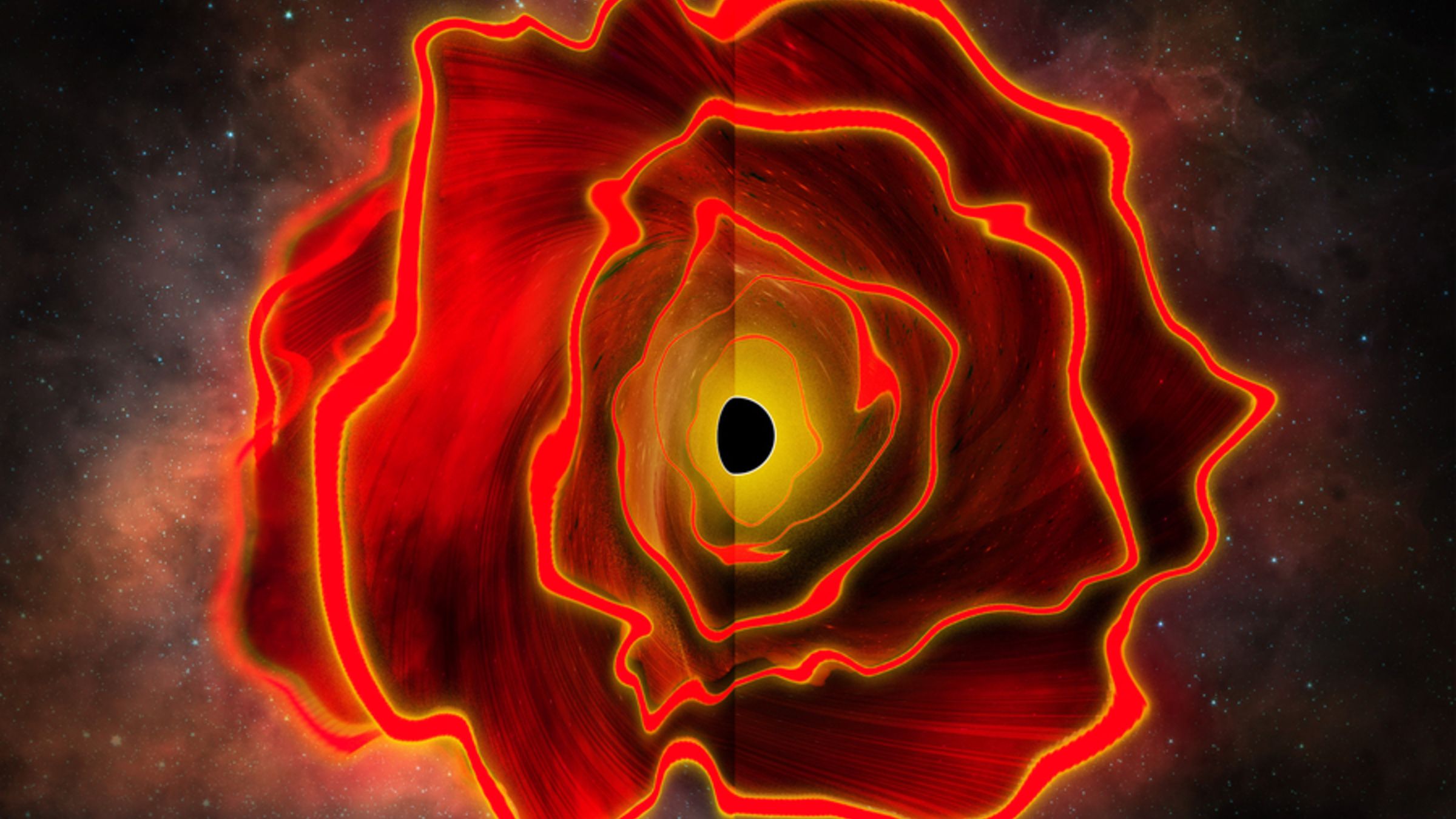

Astronomers have found the most promising candidate yet for a “black hole star,” a new type of astrophysical object lurking in the early universe’s “cosmic dawn.”
If confirmed, the findings could help to unravel the mysterious origin of “little red dots” (LRDs), an infamous group of hundreds of distant, crimson lights spotted by the James Webb Space Telescope (JWST). These dots, which are almost as old as the universe itself, shine much brighter than stars but are too dim to be fully formed galaxies, making them one of the biggest puzzles in modern astronomy.
The newly discovered dot, which is around the size of our solar system, was spotted by JWST’s Miracle or Mirage (MoM) survey, which scours the night sky for far-off galaxies. The reddish light JWST detected was emitted about 660 million years after the Big Bang, when the universe was approximately one-twentieth its current age, and it is roughly 100 billion times brighter than a typical star, researchers reported in a new study, published Aug. 12 in the journal Nature.
The researchers propose that this dot is a black hole star — an enormous, hypothetical ball of dense gas that surrounds and is superheated by a giant black hole. They’ve named it MoM-BH*-1, combining the survey that found it with the moniker “black hole star one.”
“Our picture of this object is evolving very rapidly,” study first author Rohan Naidu, an astronomer at the University of Hawaii and a former NASA Hubble fellow at MIT, said in a statement from MIT. It is “truly singular in so many ways,” he added.
The James Webb Space Telescope spotted the new object as part of its Miracle or Mirage survey, which recently discovered the most distant known galaxy.
(Image credit: Getty Images)
This is not the first proposed black hole star. Last year, a study that included many of the same authors identified a black hole star candidate dubbed “the Cliff,” which displayed many similar characteristics as MoM-BH*-1. However, the team believes the latest find is “our best evidence” of this never-before-seen cosmic object, the researchers said in a separate statement from the Institute of Science and Technology Austria.
MoM-BH*-1 is farther away from us (and therefore older) than the Cliff, making it even more important for understanding how these newly revealed objects form.
Get the world’s most fascinating discoveries delivered straight to your inbox.
Following cosmic clues
The first clue that MoM-BH*-1 was unusual was its striking ruby hue; it is redder than many other LRDs.
“When we see something very red in the universe, we often assume that it is surrounded by dust,” study co-author Robert Simcoe, director of MIT’s Kavli Institute for Astrophysics and Space Research, said in the MIT statement. Dust blocks out shorter blue wavelengths of light, making the remaining light appear redder, similar to how ash and smoke can make the skies turn orange after a large wildfire, he added.
However, we can be fairly certain that the shining material is not dust because some wavelengths of light are missing from its electromagnetic spectrum. The absence of these wavelengths, known as a Balmer break, suggests that some light particles are being completely blocked. This, in turn, likely means the light is shining through an extremely dense shell of gas, similar to some massive stars, like Vega.
The object is also severely lacking in heavy metals, suggesting that this dense gas is composed almost purely of hydrogen and helium, similar to stars like the sun. However, “the [Balmer] break we observed in this object is the deepest break we have ever observed in any object, ruling out ‘ordinary’ stars as the source,” Naidu said.

Black holes are usually surrounded by glowing rings of superheated matter, which we can occasionally see (like this one at the center of the M87 galaxy). But in theory, they could also be surrounded by giant cocoons of gas.
(Image credit: Event Horizon Telescope Collaboration)
To figure out why the gas was acting as if it were part of a massive star, when it clearly was not, the researchers ran multiple simulations, which revealed that the only plausible scenario was that the gas was hiding a hefty black hole.
Normally, black holes suck in all the matter around them via swirling accretion disks. However, particularly large and fast-spinning black holes, known as quasars, can pull in matter so quickly that they also shoot out giant beams of energy. The researchers believe that if such an object were surrounded by a giant cloud of gas, it could not only hold this material in a tight ball but also superheat it, replacing the role of nuclear fusion that occurs at the heart of a typical star.
The team estimates that the black hole lurking within MoM-BH*-1 weighs up to 100,000 solar masses, which is just large enough to qualify as supermassive.
Unmasking the “little red dots”
The central conundrum of the LRD mystery is that these distant dots are too massive to be regular stars and too dim to be galaxies. Quasars — which lie somewhere between stars and galaxies in terms of luminosity — have, therefore, long been touted as potential contenders for these distant objects.
However, until now, scientists could not explain why these objects were not emitting any detectable high-energy radiation (i.e., X-rays and gamma rays), which we see coming from quasars elsewhere in the universe. Black hole stars could solve this issue because their dense gas cocoons could theoretically block out a lot of the high-energy radiation they produce, essentially masking their true identity.

The “little red dots” are one of the biggest puzzles in modern astronomy. There have been nearly 1,000 studies published on the topic since they were first spotted in 2023.
(Image credit: NASA, ESA, CSA, STScI, Dale Kocevski (Colby College))
This is not the first time that scientists have suggested black hole stars could be responsible for LRDs. But until now, researchers could not figure out how these objects formed. In addition, many of the LRDs astronomers have spotted are much larger than MoM-BH*-1, and it is unclear how large black hole stars could really be.
Instead, the researchers suspect most LRDs are actually mini-galaxies, each with a black hole star at its core. If so, such configurations likely arose when black hole stars collided with primordial stellar clusters, the team proposed. Images of MoM-BH*-1 suggest that it could collide with such a galaxy in around 100 million years, showing that this idea is possible. (The two objects likely collided long ago, but we have not seen the light of such an interaction yet.)
The researchers noted that MoM-BH*-1 could already be part of a larger galactic structure but is so bright that it is “outshining its surrounding host galaxy, such that we’re seeing pure black hole star light,” Naidu said.
However, much more research is needed before scientists can confidently claim that all LRDs are tied to black hole stars.
TOPICS