Close Menu
  • Home
  • United States
  • World
  • Politics
  • Business
  • Lifestyle
  • Entertainment
  • Health
  • Science
  • Tech
  • Sports
  • More
    • Web Stories
    • Editor’s Picks
    • Press Release

Subscribe to Updates

Get the latest USA news and updates directly to your inbox.

What's On
Popular erection meds could make you go blind: study

Popular erection meds could make you go blind: study

August 18, 2026
Nearly 1M Chrysler, Jeep, Dodge and Ram vehicles recalled over camera glitch

Nearly 1M Chrysler, Jeep, Dodge and Ram vehicles recalled over camera glitch

August 18, 2026
Trump says Strait of Hormuz has been de-mined, is ‘open and operating’ after 60-day Iran talks window shuts

Trump says Strait of Hormuz has been de-mined, is ‘open and operating’ after 60-day Iran talks window shuts

August 18, 2026
Facebook X (Twitter) Instagram
Trending
  • Popular erection meds could make you go blind: study
  • Nearly 1M Chrysler, Jeep, Dodge and Ram vehicles recalled over camera glitch
  • Trump says Strait of Hormuz has been de-mined, is ‘open and operating’ after 60-day Iran talks window shuts
  • Penn State fraternity cocaine ring ringleader arrested, denied bail
  • Giants sign Najee Harris in intriguing addition to crowded running back room
  • Neanderthals may have trekked through the Saudi Arabian desert 55,000 years ago, farther south than experts thought possible
  • Taylor Swift, Drake and Kendrick Lamar album releases linked to more deadly car crashes, study finds
  • New York ranks No. 1 in US as most social media-addicted — find out which platforms your state is scrolling
  • Privacy
  • Terms
  • Advertise
  • Contact Us
Join Us
USA TimesUSA Times
Newsletter Login
  • Home
  • United States
  • World
  • Politics
  • Business
  • Lifestyle
  • Entertainment
  • Health
  • Science
  • Tech
  • Sports
  • More
    • Web Stories
    • Editor’s Picks
    • Press Release
USA TimesUSA Times
Home » ‘Beyond human intuition’: AI designs chip components 500 times smaller than what engineers could ever imagine
‘Beyond human intuition’: AI designs chip components 500 times smaller than what engineers could ever imagine
Science

‘Beyond human intuition’: AI designs chip components 500 times smaller than what engineers could ever imagine

News RoomBy News RoomAugust 18, 20263 ViewsNo Comments

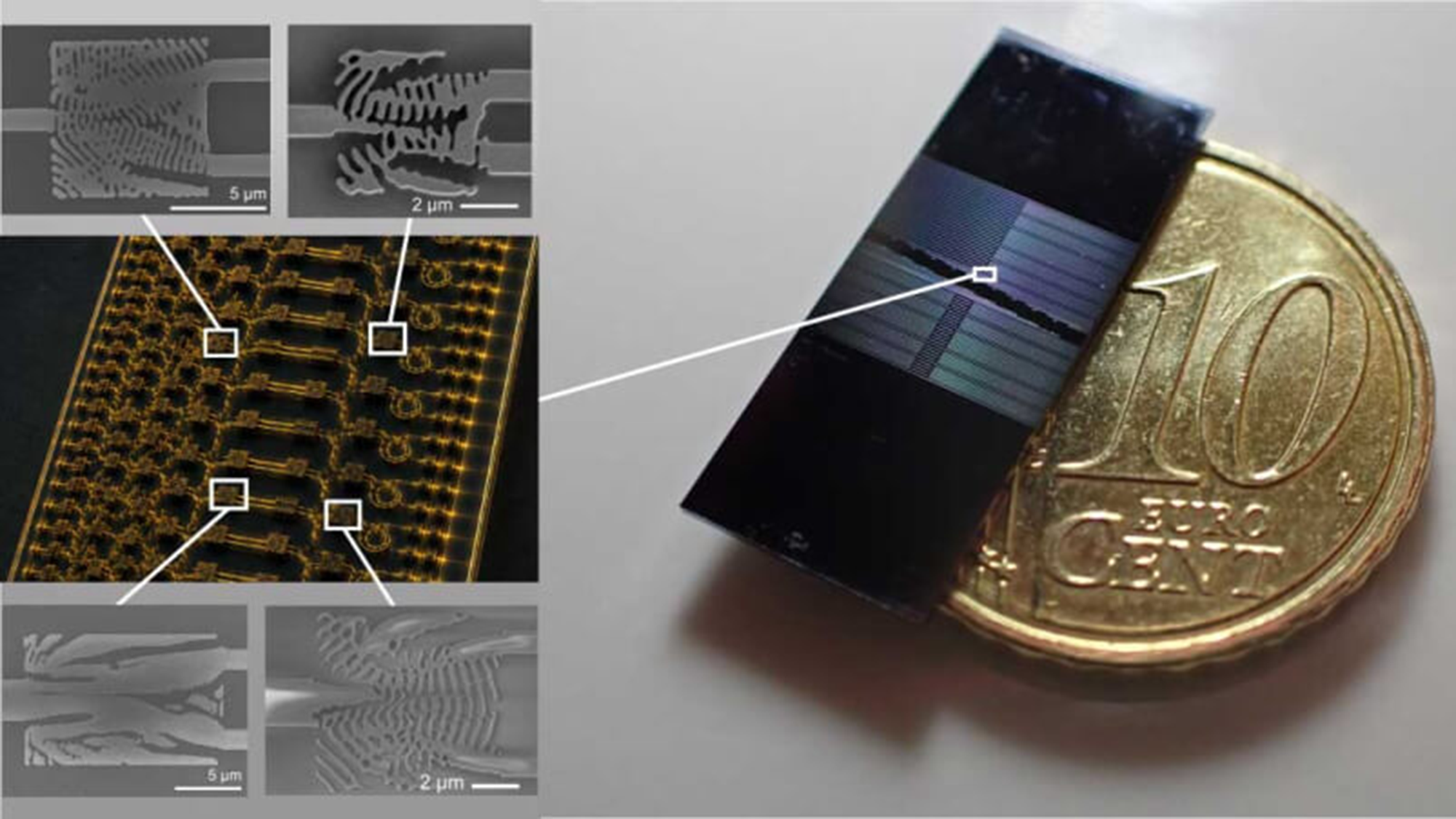
Photonic microchips are around the size of a penny. This close-up shows computer-designed nanostructures, wavelength splitters, mode sorters and mirrors, while the illustrations on the left show how the components could be integrated into photonic circuits.

(Image credit: Tony Bi / MPL)

Scientists have successfully shrunk three components used in photonic microchips by up to 500 times, leaving considerably more space for other on-chip functionality. The achievement was made possible with an artificial intelligence (AI) algorithm that generated these tiny designs, which the researchers described as “beyond human intuition.”

Whereas conventional microchips use electrons to transmit and process information, photonic microchips utilize particles of light (photons). They can therefore process and transmit data much faster than electronic chips can, because photons can carry information at the speed of light. They also offer higher bandwidth, as different wavelengths can carry distinct data streams, and they lose less energy as heat.

As a result, photonic chips are used where fast, high-bandwidth data transmission is essential, such as in fiber-optic communications, data centers, AI, lidar systems for autonomous vehicles, and quantum computing.

Latest Videos FromLive Science

Instead of metal wires, micrometer-wide channels called waveguides direct light across the photonic chip. These chips also contain wavelength splitters, spatial mode sorters and mirrors — all of which are essential for separating and directing different wavelengths and light patterns within a footprint a fraction of the width of a human hair.

In the new study, the scientists used AI-generated designs to fabricate these three components on an ultracompact scale. They published their findings May 28 in the journal Nature Communications.


You may like

The newly available on-chip space could allow engineers to “unlock new functionalities” by packing on more components, the researchers wrote in the study. Notably, the work demonstrates that AI can produce boundary-pushing chip designs that are also practical to manufacture.

AI worked backward to generate the component designs

The researchers started by informing the algorithm exactly what they wanted the components to do to the light and by providing certain manufacturing constraints, such as limits on how sharply the nanostructures could curve

Get the world’s most fascinating discoveries delivered straight to your inbox.

The AI algorithm then worked backward, testing and refining different designs until it found the delicate nanostructures that could achieve the desired result.

“Inverse design lets us define what we want light to do, and the optimization finds a structure that does it, often one no human would have drawn,” study first author Toby Bi, a researcher at the Max Planck Institute for the Science of Light, said in a statement. “What is exciting is that the same framework can do three quite different jobs on the same chip: route light by wavelength, sort it by spatial mode, and act as compact mirrors that form on-chip optical cavities.”

A gif showing wavy yellow and purple lines getting darker.

The components were designed by an AI algorithm that refined their geometry through iterative optimizations for use in photonic circuits.

(Image credit: Aditya Paul)

Components for photonic chips typically have hand-engineered designs. Engineers start with a tried-and-true design and painstakingly optimize it for new performance parameters. On top of being slow, this method limits the range of device geometries that can be explored.


What to read next

To improve their components further, the team also opted to create the components out of relatively thick silicon nitride ‪—‬ roughly 400 to 800 nanometers thick, compared with 150 to 400 nanometers for standard silicon ‪—‬ which wastes less light and offers stronger wavelength confinement.

The resulting mirrors, which are about 11 μm long, reflected up to 98.5% of incoming light while blocking unwanted light patterns. When placed in pairs on each side of a waveguide, the light bounced between them over 100 times before escaping, demonstrating the silicon nitride’s low losses, the scientists explained.

The wavelength splitter is roughly the size of a single bacterium (approximately 5 μm across), and the spatial mode sorter is marginally larger.

AI-designed chips edge closer to real-world use

While the researchers have successfully demonstrated these compact components individually, they have not combined the components into a complete integrated optical circuit yet. Achieving this will be the next step toward building fully functional photonic chips that harness the increased component density enabled by these designs.

“These results demonstrate the feasibility of compact, fabrication-error-robust, customised photonic components and pave the way for scalable, high-performance integration in silicon nitride-based photonic systems,” the researchers wrote in the study.

In recent years, engineers have begun exploring how AI can be integrated into the semiconductor design and fabrication pipeline. In the past, AI-driven approaches have reduced design cycles from weeks to hours while significantly lowering manufacturing costs.

Some systems can even generate effective chip designs from a 200-word prompt. Google’s AlphaChip, a machine learning method that designs chip layouts, has produced “superhuman” floor plans that have been deployed in the tech giant’s production AI chips.

Bi, T., Zhang, S., Bostan, E., Liu, D., Paul, A., Ohletz, O., Harder, I., Zhang, Y., Ghosh, A., Alabbadi, A., Kheyri, M., Zeng, T., Lu, J., Yang, K., & Del’Haye, P. (2026). Inverse-designed silicon nitride nanophotonics. Nature Communications, 17(1). https://doi.org/10.1038/s41467-026-73390-9


Share. Facebook Twitter LinkedIn Telegram WhatsApp Email

Keep Reading

Neanderthals may have trekked through the Saudi Arabian desert 55,000 years ago, farther south than experts thought possible

Neanderthals may have trekked through the Saudi Arabian desert 55,000 years ago, farther south than experts thought possible

The pace of climate change matters more than overall heat in the race to save key Atlantic currents, study finds

The pace of climate change matters more than overall heat in the race to save key Atlantic currents, study finds

Archaeologists discover Etruscan well that was ritually opened with offerings for a goddess — and ‘closed’ with human bodies

Archaeologists discover Etruscan well that was ritually opened with offerings for a goddess — and ‘closed’ with human bodies

Giant underwater plume blasts into swirling cloud ‘street’ in the East China Sea — Earth from space

Giant underwater plume blasts into swirling cloud ‘street’ in the East China Sea — Earth from space

‘They don’t deserve this beauty and this breathtaking fragility’: Former Antarctic tour guides told researchers why they quit the troubling industry

‘They don’t deserve this beauty and this breathtaking fragility’: Former Antarctic tour guides told researchers why they quit the troubling industry

Do you think social media bans will protect children?

Do you think social media bans will protect children?

1,700-year-old church discovered under a lake in Turkey may be the location of the First Council of Nicaea — but other experts disagree

1,700-year-old church discovered under a lake in Turkey may be the location of the First Council of Nicaea — but other experts disagree

Skeleton with 167 fractures discovered at Scottish castle may have been first victim of Edward I’s ‘War Wolf’ trebuchet

Skeleton with 167 fractures discovered at Scottish castle may have been first victim of Edward I’s ‘War Wolf’ trebuchet

Fire-flame vessel: An exquisitely crafted 4,500-year-old pot from a mysterious culture in Japan

Fire-flame vessel: An exquisitely crafted 4,500-year-old pot from a mysterious culture in Japan

Add A Comment
Leave A Reply Cancel Reply

Editors Picks

Nearly 1M Chrysler, Jeep, Dodge and Ram vehicles recalled over camera glitch

Nearly 1M Chrysler, Jeep, Dodge and Ram vehicles recalled over camera glitch

August 18, 2026
Trump says Strait of Hormuz has been de-mined, is ‘open and operating’ after 60-day Iran talks window shuts

Trump says Strait of Hormuz has been de-mined, is ‘open and operating’ after 60-day Iran talks window shuts

August 18, 2026
Penn State fraternity cocaine ring ringleader arrested, denied bail

Penn State fraternity cocaine ring ringleader arrested, denied bail

August 18, 2026
Giants sign Najee Harris in intriguing addition to crowded running back room

Giants sign Najee Harris in intriguing addition to crowded running back room

August 18, 2026

Subscribe to News

Get the latest USA news and updates directly to your inbox.

Latest News
Neanderthals may have trekked through the Saudi Arabian desert 55,000 years ago, farther south than experts thought possible

Neanderthals may have trekked through the Saudi Arabian desert 55,000 years ago, farther south than experts thought possible

August 18, 2026
Taylor Swift, Drake and Kendrick Lamar album releases linked to more deadly car crashes, study finds

Taylor Swift, Drake and Kendrick Lamar album releases linked to more deadly car crashes, study finds

August 18, 2026
New York ranks No. 1 in US as most social media-addicted — find out which platforms your state is scrolling

New York ranks No. 1 in US as most social media-addicted — find out which platforms your state is scrolling

August 18, 2026
Facebook X (Twitter) Pinterest WhatsApp TikTok Instagram
© 2026 USA Times. All Rights Reserved.
  • Privacy Policy
  • Terms
  • Advertise
  • Contact

Type above and press Enter to search. Press Esc to cancel.