



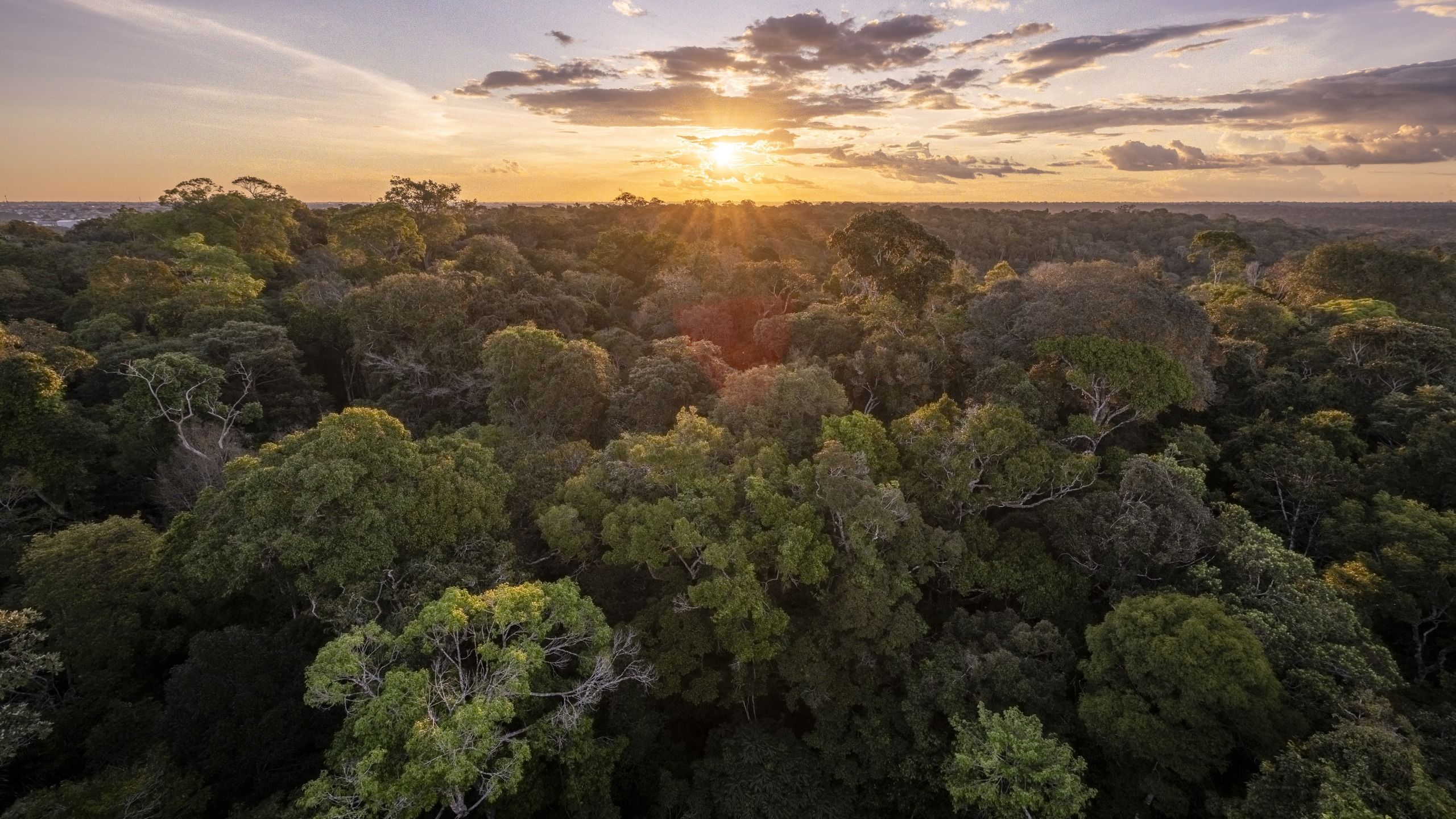

The Amazon, Earth’s largest tropical rainforest, could be on the brink of an irreversible change as the ongoing El Niño strengthens its grip on our climate.
El Niño is the warm phase of a multiyear natural climate cycle that is often marked by rising global temperatures and disruptive weather. This time, scientists monitoring the event are warning that climate change has helped supercharge it to likely the strongest ever recorded.
As temperature records are breached and the risk of a humanitarian crisis looms, already stressed natural systems are coming under unprecedented strain. The Amazon is one such system. Having suffered severe degradation in recent decades, some fear that a historic El Niño could launch a devastating drought that may help force the Amazon beyond a tipping point — transforming the verdant rainforest and vital store of the planet’s carbon into savannah.
Latest Videos FromLive Science
To get to grips with this looming catastrophe, Live Science spoke to Bernardo Flores, a Brazilian ecologist who studies the Amazon and has been sounding the alarm about its fate.
Bernardo Flores is a Brazilian ecologist, currently working in the Equalsea-lab at the University of Santiago de Compostela in Spain. His research includes studying the Amazon, its fire ecology and its potential to cross negative and positive tipping points.
Patrick Pester: How could a strengthening El Niño impact the Amazon?
Bernardo Flores: We have a very high confidence that it is already a strong El Niño and that it will be very strong, possibly the strongest one on record. This is very concerning because during past decades we saw a few very strong El Niños — not as strong as this one, probably — and the consequences were very dramatic, and they became increasingly dramatic.
The Amazon becomes drier during El Niño, and then you have conditions for forest fires. You can have different types of fires, but forest fires are those that penetrate and spread through the moist forest, which is rarely flammable. And during these years, you can have thousands of kilometers of burnt forest that were not disturbed before.
Get the world’s most fascinating discoveries delivered straight to your inbox.
We expect that these burnt areas will increase, possibly exponentially. There will be an acceleration, and that’s a sign of a tipping point.
PP: Could a historic El Niño push the Amazon beyond a tipping point this year or next year?
BR: One of the things that makes the Amazon resilient is the existence of Indigenous people and local communities protecting the forest and managing the forest. But there is an increasing territorial expansion of organized crime syndicates involved in illegal activities that destroy the ecosystem. They’re spreading ignition sources through these remote forests and competing for these territories with the local and Indigenous peoples. They bring violence, and then through violence, people die, people lose livelihoods, and become increasingly less capable of living in that area.
If you add to that these droughts, fires and water and food insecurity caused by these El Niños, then you increase the risk that these regions will be abandoned and become easier for organized crime groups to occupy through methods that involve destruction and fires. So, the tipping point of the Amazon has these mechanisms. You have climate change and El Niño that are disturbances in the climate, but you also have shifts from local and Indigenous management and governance to low governance and destructive organized crime activities, and the spread of wildfires that become increasingly large and recurrent.
Through a model, we pinpointed that with 1.5 degrees [Celsius, or 2.7 degrees Fahrenheit] of global warming, which is what we have now basically, and 22% of deforestation accumulated across the Amazon, there could be a tipping point. Then you have lost so much forest that you lose so much rain that the system becomes trapped in the self-degrading drought-fire loop. But this is not considering all the forest degradation that has occurred over the past decades, which is accumulating. At least 40% of the Amazon has been estimated to be degraded.
I have been saying that we could cross a tipping point. So, the message is we have to be very careful and take precautions to avoid wildfires. This is a very concerning and critical moment to focus on wildfires.

A forest fire in the Amazon in September, 2024, driven by a severe drought.
(Image credit: Michael Dantas/Getty Images)
PP: In your recent paper, you and your colleagues wrote that the Amazon could undergo a “near systemwide transition” with global warming of 1.5 C to 1.9 C and deforestation of 22% to 28%. Most people now think the Paris Agreement’s goal of keeping warming below 1.5 C is dead, so if the degradation is now at 40%, do you think this transition can be avoided, realistically?
BR: Yes. The tipping point is not a collapse. It is just a point beyond which the feedbacks change. The feedbacks that were previously keeping the Amazon resilient, they weaken, and other feedbacks that make the system self degrade gain strength. So, it means that when you cross the tipping point, it becomes more difficult to avoid, but it’s not impossible.
The Amazon is a huge system. Forests, trees, they have long lives, so the dynamics are relatively slow. The collapse of the Amazon, if we did nothing, could take 100 years, centuries; we don’t know. But this means that we have a few decades to act. In the next 10 years, we [need to] invest heavily in large-scale reforestation where rainforests have been cleared and degraded; restore the capacity of these forests to pump moisture into the atmosphere; and also shift the economic activities in the region to legal ones and strengthen the local people’s capacity to persist and govern the landscape. Also, shift the economies of the region into more sustainable ones — not based on clearing for cattle and soy; but based on forest products, agroforestry, medicine, lots of industries that can be developed through forest products.
There are several issues being debated, but there is huge potential to shift. Even within a capitalist economic system, we could do that. Forest restoration will take 20, 30 years, but the time for that is now. And also to control organized crime. That’s probably the most difficult thing; more difficult than shifting the whole economy.
PP: What’s the difference between how the organized crime groups are approaching the landscape and how the local people are managing it?
BR: The local people and Indigenous peoples have been there for thousands of years. They know the forest in so much detail. They have empirical experience of hundreds of El Niños. Of course, the climate is changing, so they are dealing with conditions that are new to everyone, including them, but they have more capacity to adapt because they identify the changes. They have huge potential to help us deal with climate change. They manage the ecosystem in ways that the forest becomes more abundant in food; the forest becomes more resilient.
Organized crime comes from outside with the intention just to extract and destroy, and the methods are based on violence. They involve people working in illegal mining, for instance, and illegal logging and land grabbing. And then there’s laundering of ecological assets. So, there’s timber laundering. They do this with minerals also. When they occupy a region, a territory, the lives of people in the rural areas and Indigenous territory become much more violent and much more degrading. These regions are remote, so it’s difficult. We can have control of these territories, but it depends on lots of international cooperation because they involve politicians. There are very powerful people who are involved with the organized crime system, and they also have a lot of economic power because they have this very diverse economic approach through different activities, legal and illegal, in the urban and rural areas. They accumulate all this wealth and capacity to invest in machines, for instance, in guns.
Ten years ago, we would work in remote parts of the Amazon, and it was fine. These weren’t dangerous places. Now I have a colleague who goes to work, and they are in a river in a canoe with local people, and suddenly a fast boat approaches with very powerful engines, and there are five or six men with machine guns wanting to know what they are doing there. This is something that is increasingly more common, and it didn’t exist before. To me, that’s the most challenging problem to address.
PP: I mean, it sounds challenging. What gives you hope this can be overturned?
BR: I tend to be optimistic, and I have hope because I know how it can be done. It depends on results from elections; it depends on people becoming more aware, but because I work with tipping points, I know how tipping points occur in social systems and behavior. Suddenly, people can understand the importance of something, and then they support ideas. I believe that we are moving towards such tipping points. I don’t know how late [we’ll be], or what will be lost, but at some point we’re going to have to react.
Editor’s note: This interview has been edited and condensed for clarity.