

Close Menu
  • Home
  • United States
  • World
  • Politics
  • Business
  • Lifestyle
  • Entertainment
  • Health
  • Science
  • Tech
  • Sports
  • More
    • Web Stories
    • Editor’s Picks
    • Press Release

Subscribe to Updates

Get the latest USA news and updates directly to your inbox.

What's On
Disgraced Mamdani-loving journo Ross Barkan apologizes — after being caught plagiarizing 67 times

Disgraced Mamdani-loving journo Ross Barkan apologizes — after being caught plagiarizing 67 times

August 19, 2026
Candidates battle it out for former Rep. Eric Swalwell’s seat in race currently too close to call

Candidates battle it out for former Rep. Eric Swalwell’s seat in race currently too close to call

August 19, 2026
Céline Dion reveals 17 years of hidden stiff-person syndrome symptoms

Céline Dion reveals 17 years of hidden stiff-person syndrome symptoms

August 19, 2026
Facebook X (Twitter) Instagram
Trending
  • Disgraced Mamdani-loving journo Ross Barkan apologizes — after being caught plagiarizing 67 times
  • Candidates battle it out for former Rep. Eric Swalwell’s seat in race currently too close to call
  • Céline Dion reveals 17 years of hidden stiff-person syndrome symptoms
  • Anne Hathaway Made This Unexpected Top Trend Look So Chic During Pregnancy
  • Enes Kanter turns trans WNBA protest into $1.35 million recruiting pitch
  • Lab-grown minibrains may not develop like real brains do, posing potential problems for research
  • Very contagious winter disease now has ‘much higher’ spikes in summer — as cases grow across US
  • Chinese humanoid robot maker Unitree jumps 460% in blockbuster Shanghai IPO
  • Privacy
  • Terms
  • Advertise
  • Contact Us
Join Us
USA TimesUSA Times
Newsletter Login
  • Home
  • United States
  • World
  • Politics
  • Business
  • Lifestyle
  • Entertainment
  • Health
  • Science
  • Tech
  • Sports
  • More
    • Web Stories
    • Editor’s Picks
    • Press Release
USA TimesUSA Times
Home » Astronomers spot the closest, fastest star ever seen orbiting our galaxy’s monster black hole
Astronomers spot the closest, fastest star ever seen orbiting our galaxy’s monster black hole
Science

Astronomers spot the closest, fastest star ever seen orbiting our galaxy’s monster black hole

News RoomBy News RoomAugust 19, 20261 ViewsNo Comments

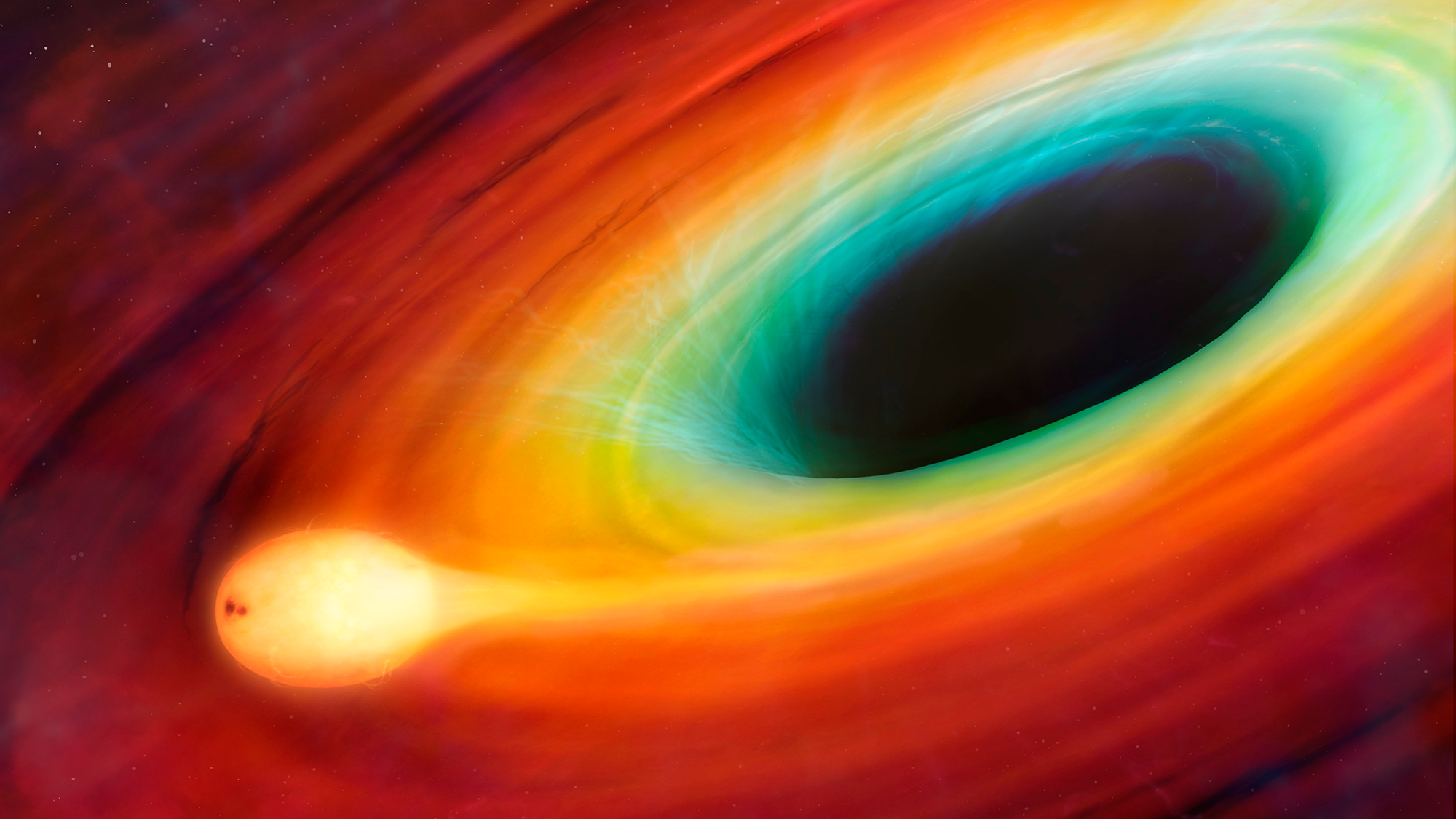
Astronomers have discovered the closest, fastest star ever seen orbiting Sagittarius A* (Sgr A*), the 4.3 million-solar-mass black hole at the heart of our galaxy. The faint star, named S301, completes a lap every 8.7 years and skims past the black hole at roughly 55 million mph (90 million km/h) — about 8% the speed of light. Its orbit is so tight that, within about a decade, researchers should be able to measure its spin rate. The discovery was reported Aug. 19 in the journal Nature.

Stars as lanterns in warped space

The center of the Milky Way, some 27,000 light-years away, is one of the best natural laboratories physicists have. A few dozen stars swarm the galaxy’s central black hole on tight orbits, and because gravity there is far stronger than anywhere else we can watch closely, those stars behave in ways Isaac Newton never anticipated.

“Stars orbiting Sgr A* are very interesting objects, as they serve as luminous probes of the curved spacetime around the black hole,” study co-author Felix Mang, a doctoral student at the Max Planck Institute for Extraterrestrial Physics in Germany, told Live Science via email.

Latest Videos FromLive Science

Until now, the star doing most of that work was S2, a bright star on a 16-year orbit. Astronomers have followed S2 since 1992, through more than two full laps, and that tracking revealed two hallmark predictions of Einstein’s theory of general relativity: light from the star losing energy as it climbs out of the black hole’s gravity well, and the slow rotation of its elliptical orbit, known as Schwarzschild precession.

Those effects depend only on the black hole’s mass. But black holes have a second property: rotation. A spinning black hole drags the fabric of space around with it, like a spoon stirring honey. That effect fades extremely quickly with distance, so measuring rotation requires a star that dives much closer to the black hole than S2 ever does.


You may like

Measurements of black holes’ rotations also matter beyond black hole physics. One leading alternative to general relativity “postulates the existence of a fundamental fifth force that arises, for example, from unifying gravity and quantum physics,” Mang said.

Any deviation from Einstein’s predictions should show up in these stellar orbits. So far, he said, “only an upper limit could be derived, which gets progressively lower” — in other words, there are no cracks in Einstein’s theory yet, but the tests keep tightening.

Get the world’s most fascinating discoveries delivered straight to your inbox.

A record-breaking orbit

That is where S301 comes in. In images captured by the GRAVITY instrument on the European Southern Observatory’s Very Large Telescope in Chile, the astronomers “discovered a new, very faint star in the Galactic Center that is orbiting the central massive black hole Sgr A* so closely that its orbit is sensitive to the spin of the black hole,” Mang said.

VLT images of the S301 star orbiting Sagittarius A*

(Image credit: ESO/GRAVITY collaboration)

The star first showed up in spring 2023 as a faint smudge northwest of the black hole. Once the team had a rough orbit, they went back through archival observations and found it again in data from 2021 and 2017. In total, 19 measured positions spanning eight years trace out a complete, closed ellipse in the sky.

The orbit is extreme by every measure. S301 takes 8.7 years to orbit the black hole, beating the previous record holder — a star on a 12-year orbit — and S301’s path is stretched into a needle-thin ellipse. At its closest approach, it passes within about 12 astronomical units from the black hole ‪—‬ 12 times the distance between Earth and the sun ‪—‬ and around 10 times closer than S2 ever gets.


What to read next

Even at that distance, S301 is safe. It appears to be an ordinary main-sequence star of about 1.5 solar masses — compact enough that the black hole’s tides cannot tear it apart. Its wildly elongated orbit suggests a violent origin; the team proposed that S301 was probably once half of a tight double star that strayed too close, was ripped in two, and had its partner flung out of the galaxy as a hypervelocity star.

The tight orbit is already showing relativity at work. “We found that the orbit of S301 succumbs to strong general relativistic effects, as the so-called Schwarzschild precession — the turning of the orbital ellipse within its own plane — is very apparent,” Mang said. The ellipse swings around by about 2 degrees every lap. “Within the next ten years,” he added, “a measurement of the spin of Sgr A* with S301 is within reach.”

The hard part, and what comes next

Finding S301 was itself a feat. From Earth, the star appears about 2 billion times fainter than Betelgeuse ‪—‬ one of the brightest stars in our sky — and it sits in a crowded field beside far brighter neighbors, making it the observational equivalent of picking out a single fly buzzing over a full orchestra. It took a new image-reconstruction method, plus GRAVITY’s recent upgrade to GRAVITY+, which boosted its sensitivity by a factor of 10 to 100, to pull the signal out.

One piece is still missing: The team can see how S301 moves across the sky, but not toward or away from us, which leaves two mirror-image orbits equally consistent with the data.

Now, they plan to fill in that gap. “We will keep following S301 closely along its orbit,” Mang said, both with GRAVITY and an upcoming instrument that measures how light from the star shifts toward the red or blue end of the spectrum as it moves away from or closer to Earth.

Simulations by the team suggest that a decade of such combined observations could pin down the black hole’s spin well enough to distinguish a rapidly rotating black hole from a stationary one with high confidence. Statistically, S301 should not be alone; roughly 100 similar stars may lurk on comparable orbits, but most of them are too faint to be seen today.


See how much you know about black holes with our black hole quiz!

Share. Facebook Twitter LinkedIn Telegram WhatsApp Email

Keep Reading

Lab-grown minibrains may not develop like real brains do, posing potential problems for research

Lab-grown minibrains may not develop like real brains do, posing potential problems for research

Out-of-control SpaceX rocket carved a 60-foot crater into the moon, NASA images reveal

Out-of-control SpaceX rocket carved a 60-foot crater into the moon, NASA images reveal

Archeologists used to think women in prehistory wielded no power. Genetic data is upending that idea | Rachel Pope

Archeologists used to think women in prehistory wielded no power. Genetic data is upending that idea | Rachel Pope

Diagnostic dilemma: A joyful wedding nearly broke a woman’s heart in a rare case of ‘happy heart syndrome’

Diagnostic dilemma: A joyful wedding nearly broke a woman’s heart in a rare case of ‘happy heart syndrome’

Body found at bottom of Scottish well may be from rare ritual burial performed centuries ago

Body found at bottom of Scottish well may be from rare ritual burial performed centuries ago

The FDA may expand access to unapproved peptides — what are they, and are they safe?

The FDA may expand access to unapproved peptides — what are they, and are they safe?

Neanderthals may have trekked through the Saudi Arabian desert 55,000 years ago, farther south than experts thought possible

Neanderthals may have trekked through the Saudi Arabian desert 55,000 years ago, farther south than experts thought possible

‘Beyond human intuition’: AI designs chip components 500 times smaller than what engineers could ever imagine

‘Beyond human intuition’: AI designs chip components 500 times smaller than what engineers could ever imagine

The pace of climate change matters more than overall heat in the race to save key Atlantic currents, study finds

The pace of climate change matters more than overall heat in the race to save key Atlantic currents, study finds

Add A Comment
Leave A Reply Cancel Reply

Editors Picks

Candidates battle it out for former Rep. Eric Swalwell’s seat in race currently too close to call

Candidates battle it out for former Rep. Eric Swalwell’s seat in race currently too close to call

August 19, 2026
Céline Dion reveals 17 years of hidden stiff-person syndrome symptoms

Céline Dion reveals 17 years of hidden stiff-person syndrome symptoms

August 19, 2026
Anne Hathaway Made This Unexpected Top Trend Look So Chic During Pregnancy

Anne Hathaway Made This Unexpected Top Trend Look So Chic During Pregnancy

August 19, 2026
Enes Kanter turns trans WNBA protest into .35 million recruiting pitch

Enes Kanter turns trans WNBA protest into $1.35 million recruiting pitch

August 19, 2026

Subscribe to News

Get the latest USA news and updates directly to your inbox.

Latest News
Lab-grown minibrains may not develop like real brains do, posing potential problems for research

Lab-grown minibrains may not develop like real brains do, posing potential problems for research

August 19, 2026
Very contagious winter disease now has ‘much higher’ spikes in summer — as cases grow across US

Very contagious winter disease now has ‘much higher’ spikes in summer — as cases grow across US

August 19, 2026
Chinese humanoid robot maker Unitree jumps 460% in blockbuster Shanghai IPO

Chinese humanoid robot maker Unitree jumps 460% in blockbuster Shanghai IPO

August 19, 2026
Facebook X (Twitter) Pinterest WhatsApp TikTok Instagram
© 2026 USA Times. All Rights Reserved.
  • Privacy Policy
  • Terms
  • Advertise
  • Contact

Type above and press Enter to search. Press Esc to cancel.