Close Menu
  • Home
  • United States
  • World
  • Politics
  • Business
  • Lifestyle
  • Entertainment
  • Health
  • Science
  • Tech
  • Sports
  • More
    • Web Stories
    • Editor’s Picks
    • Press Release

Subscribe to Updates

Get the latest USA news and updates directly to your inbox.

What's On
Steph Curry proves he’s still got it matching stunning LeBron James stat in Warriors’ win

Steph Curry proves he’s still got it matching stunning LeBron James stat in Warriors’ win

October 29, 2026
Hegseth fires top Pentagon war planner Brett Sylvia in latest military shake-up

Hegseth fires top Pentagon war planner Brett Sylvia in latest military shake-up

October 29, 2026
Big 12 Conference addresses offensive chants from UCF fans directed at BYU during upset win

Big 12 Conference addresses offensive chants from UCF fans directed at BYU during upset win

October 29, 2026
Facebook X (Twitter) Instagram
Trending
  • Steph Curry proves he’s still got it matching stunning LeBron James stat in Warriors’ win
  • Hegseth fires top Pentagon war planner Brett Sylvia in latest military shake-up
  • Big 12 Conference addresses offensive chants from UCF fans directed at BYU during upset win
  • Famed Director Quentin Tarantino Refuses to Give a ‘Penny’ of Reported $150 Million Net Worth to Mom
  • Mikal Bridges gets benched as reserves come up big in Knicks’ comeback win
  • Trump calls for Alaska Dem candidate Mary Peltola to drop out, face prosecution days before midterm election
  • Sen Sullivan calls alleged ballot scandal ‘corruption at the highest level’
  • Dyson! Solawave! Lemme! 17 Best Beauty Gifts for Every Type of Woman, From Skincare to Hair
  • Privacy
  • Terms
  • Advertise
  • Contact Us
Join Us
USA TimesUSA Times
Newsletter Login
  • Home
  • United States
  • World
  • Politics
  • Business
  • Lifestyle
  • Entertainment
  • Health
  • Science
  • Tech
  • Sports
  • More
    • Web Stories
    • Editor’s Picks
    • Press Release
USA TimesUSA Times
Home » Astronomers detected radio signals coming from an exoplanet for the first time. Spoiler alert: It’s not aliens.
Astronomers detected radio signals coming from an exoplanet for the first time. Spoiler alert: It’s not aliens.
Science

Astronomers detected radio signals coming from an exoplanet for the first time. Spoiler alert: It’s not aliens.

News RoomBy News RoomSeptember 23, 20264 ViewsNo Comments

For the first time, astronomers have detected radio signals coming directly from a planet outside our solar system, according to a new preprint study. Spoiler alert: It’s not aliens. But astrophysicists are still very excited about this discovery.

“Astronomers have been looking for radio signals from exoplanets for some time,” Suzanne Aigrain, a professor of astrophysics at the University of Oxford who was not involved in the study, told Live Science in an email. “There have been tentative, indirect detections before, but this is the first truly convincing direct detection, and it hopefully paves the way for many more.”

Artificial radio signals are a key focus in the search for extraterrestrial intelligence (SETI), which involves scanning the cosmos for signs of alien life. Such “technosignatures” could suggest advanced technologies built by intelligent extraterrestrial civilizations. However, radio signals can be emitted by natural sources, too.

Latest Videos FromLive Science

“There are two natural processes that can produce radio emission in exoplanets,” Aigrain said. “One is magnetic reconnection, when the planet orbits really close to the star and its magnetic field interacts directly with that of the star. The other is aurorae (like those we have on Earth and on other solar system planets like Saturn, but much stronger), when energetic charged particles streaming from the star interact with the upper atmosphere of the planet.”

“This second effect is what the authors of the paper believe they have detected,” Aigrain added.


You may like

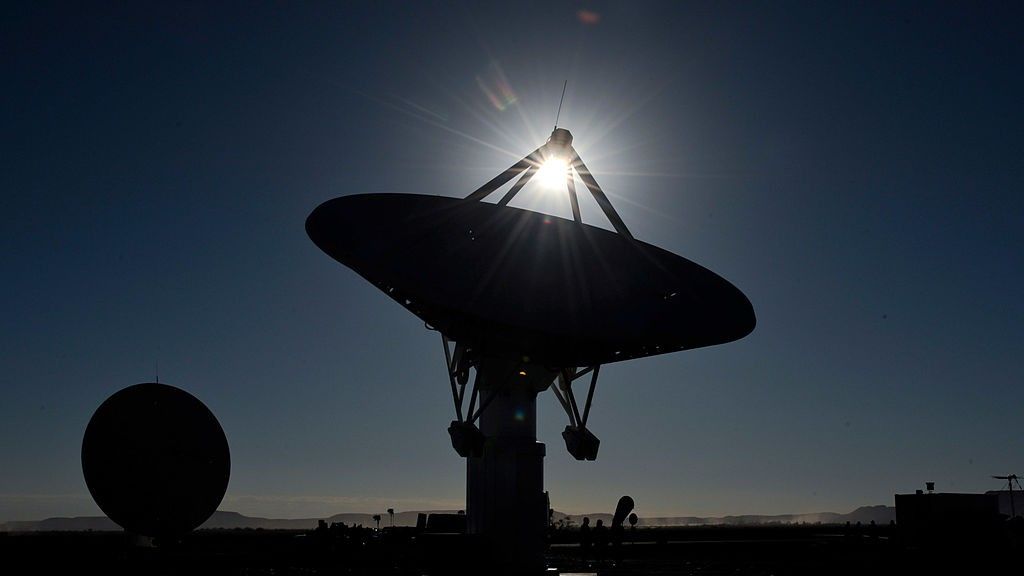
In the study, a research group led by Kevin Ortiz Ceballos, a graduate student at the Harvard and Smithsonian Center for Astrophysics, turned MeerKAT, a radio telescope array in South Africa, toward a massive gas giant called Beta Pictoris b, an exoplanet that’s 64 light-years from Earth and has a mass roughly 10 times that of Jupiter, according to NASA. They picked up rapid, repeating bursts of radio signals coming from the planet.

At first, it wasn’t clear whether the signal was coming from the planet or the star it orbits (named simply Beta Pictoris). However, after comparing the radio images of both the planet and the star with the positions of distant background quasars (bright, active galaxies that act as fixed reference points), the team confirmed that the radio bursts were indeed emanating from the gas giant.

Get the world’s most fascinating discoveries delivered straight to your inbox.

“No radio detection has previously been unambiguously localized to an extrasolar planet rather than its host star,” they wrote in the study, which has not been peer-reviewed yet.

Aigrain emphasized that “this is definitely not aliens!” The signals are consistent with what would be expected from auroras, and this finding offers insight into the planet itself. From these measurements, the team calculated the planet’s magnetic-field strength, which they estimated to be roughly 1,250 gauss. For comparison, Jupiter’s magnetic-field strength is only about 4.3 gauss and Earth’s is a measly 0.5 gauss, according to Live Science’s sister site Space.com.

Magnetic-field measurements like these are important because we don’t fully understand how planets’ magnetospheres are generated and what controls how strong they are, Aigrain said. The ability to measure a planet’s magnetic field could also help in our search for potentially habitable exoplanets.

“[A] planet’s magnetic field shields its atmosphere from the ‘wind’ of charged particles from [its] star, which might otherwise carry material away from the atmosphere,” Aigrain said. “On Earth, for example, the magnetic field has played a key role in retaining the atmosphere and shielding life on the planet from harmful high-energy radiation.

“The planet in this paper is quite massive and has a thick atmosphere, so even without a strong magnetic field it could probably hold on to its atmosphere, and it is not expected to host life,” Aigrain added. “But in the future we might be able to make similar measurements for smaller planets, for which this shielding effect would be more important.”

MeerKAT is a pathfinder instrument for a new large telescope called the Square Kilometre Array, which is expected to come online in the next few years. This observatory “will be significantly more powerful,” Aigrain said, “so there will be many more systems where we can look for this type of signal.”

Share. Facebook Twitter LinkedIn Telegram WhatsApp Email

Keep Reading

Bronze Age sword discovered in an Italian lake is still sharp after 3,300 years

Bronze Age sword discovered in an Italian lake is still sharp after 3,300 years

US intelligence report reveals first clear look at China’s top-secret Shenlong spaceplane that’s been dumping unidentified objects above Earth

US intelligence report reveals first clear look at China’s top-secret Shenlong spaceplane that’s been dumping unidentified objects above Earth

Scientists discover ‘chain reaction’ that leads to pain in ulcerative colitis

Scientists discover ‘chain reaction’ that leads to pain in ulcerative colitis

Our extinct cousins the Denisovans had a ‘distinctive’ appearance, new analysis reveals

Our extinct cousins the Denisovans had a ‘distinctive’ appearance, new analysis reveals

A woman carried a ‘stone baby’ in her abdomen for 3 years — Diagnostic dilemma

A woman carried a ‘stone baby’ in her abdomen for 3 years — Diagnostic dilemma

Universities should not be adopting AI to automate their own absurdities | Akhil Bhardwaj

Universities should not be adopting AI to automate their own absurdities | Akhil Bhardwaj

James Webb Space Telescope discovers most distant ring galaxy ever, hinting at ultra-rare early universe collision

James Webb Space Telescope discovers most distant ring galaxy ever, hinting at ultra-rare early universe collision

Native Hawaiians and Easter Islanders came from same ‘ultravoyager’ group

Native Hawaiians and Easter Islanders came from same ‘ultravoyager’ group

Is AI making you lazier?

Is AI making you lazier?

Add A Comment
Leave A Reply Cancel Reply

Editors Picks

Hegseth fires top Pentagon war planner Brett Sylvia in latest military shake-up

Hegseth fires top Pentagon war planner Brett Sylvia in latest military shake-up

October 29, 2026
Big 12 Conference addresses offensive chants from UCF fans directed at BYU during upset win

Big 12 Conference addresses offensive chants from UCF fans directed at BYU during upset win

October 29, 2026
Famed Director Quentin Tarantino Refuses to Give a ‘Penny’ of Reported 0 Million Net Worth to Mom

Famed Director Quentin Tarantino Refuses to Give a ‘Penny’ of Reported $150 Million Net Worth to Mom

October 29, 2026
Mikal Bridges gets benched as reserves come up big in Knicks’ comeback win

Mikal Bridges gets benched as reserves come up big in Knicks’ comeback win

October 29, 2026

Subscribe to News

Get the latest USA news and updates directly to your inbox.

Latest News
Trump calls for Alaska Dem candidate Mary Peltola to drop out, face prosecution days before midterm election

Trump calls for Alaska Dem candidate Mary Peltola to drop out, face prosecution days before midterm election

October 29, 2026
Sen Sullivan calls alleged ballot scandal ‘corruption at the highest level’

Sen Sullivan calls alleged ballot scandal ‘corruption at the highest level’

October 29, 2026
Dyson! Solawave! Lemme! 17 Best Beauty Gifts for Every Type of Woman, From Skincare to Hair

Dyson! Solawave! Lemme! 17 Best Beauty Gifts for Every Type of Woman, From Skincare to Hair

October 29, 2026
Facebook X (Twitter) Pinterest WhatsApp TikTok Instagram
© 2026 USA Times. All Rights Reserved.
  • Privacy Policy
  • Terms
  • Advertise
  • Contact

Type above and press Enter to search. Press Esc to cancel.