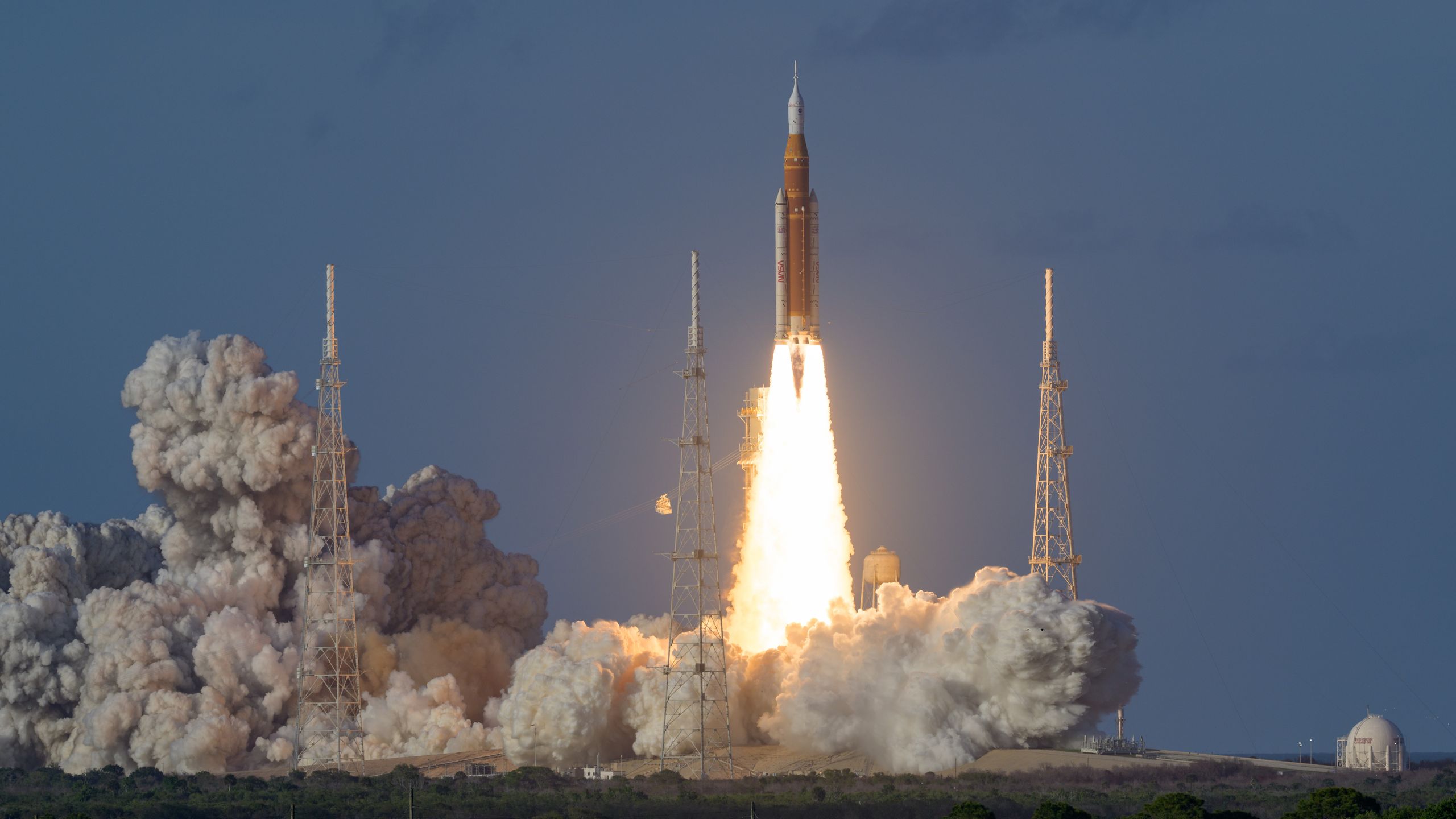

The Artemis II crew has blasted off for the moon on a historic rocket launch at NASA’s Kennedy Space Center in Florida.
Commander Reid Wiseman, pilot Victor Glover, mission specialist Christina Koch and mission specialist Jeremy Hansen are now riding high in the Orion spacecraft as the first humans to head back to the moon in more than 50 years.
The rocket lifted off at 6:35 p.m. EDT on April 1 — one of the final launch windows available to meet NASA’s April 30 mission deadline.
Artemis II has been fraught with delays in recent months, but on April Fool’s Day, NASA’s gigantic Space Launch System (SLS) rocket and Orion capsule took off without any significant issues. Hundreds of thousands of people flocked to Florida’s Space Coast to watch the launch in person, while millions more tuned in around the world to watch NASA’s live broadcast.
A record-setting mission
The Artemis II crew is now embarking on a 10-day spaceflight, which will take them around the far side of the moon, travelling farther and faster than any humans in history, before they return home to Earth.
The record-breaking mission is set to establish a number of historic firsts. NASA’s Koch is on her way to becoming the first woman in history to go beyond low Earth orbit and the first woman to visit the lunar environment, while NASA’s Glover is on his way to becoming the first Black astronaut to venture beyond low Earth orbit and visit the lunar environment.
Hansen, of the Canadian Space Agency, is on his way to becoming the first non-American to visit the moon. Finally, Wiseman is on his way to becoming the oldest astronaut to visit the moon, having turned 50 in November.
In recent months, the Artemis II mission staff has grappled with hydrogen leaks, which were a problem during the first Artemis II fueling rehearsal on Feb. 3, and helium flow issues, which forced NASA to take its rocket back to the shop for urgent repairs a few weeks later. However, there were no such issues during today’s tanking.
A smooth countdown
The launch team didn’t encounter any significant technical issues while filling the SLS with more than 700,000 gallons of super-cold liquid oxygen and liquid hydrogen, and the countdown proceeded smoothly and on schedule.
The crew walked out at about 2 p.m. EDT, suiting up at Launch Complex 39B, before entering the Orion spacecraft at 2:31 p.m.
Artemis II’s launch team did have to work through an unusual range issue. NASA clears an airspace launch corridor along the rocket’s flight path, but part of this system, specifically the Flight Termination System (FTS) that sends a destruct signal to a rocket if it goes off course, had some kind of problem.
Engineers ended up fetching “a piece of heritage equipment” that was used during the Space Shuttle Program, and ultimately worked through the issue to clear the range and work the FTS system.
Clouds and rain showers hovered over the Kennedy Space Center at times, but these didn’t disrupt the launch, and wind speeds remained within acceptable levels.
The launch is only the beginning of NASA’s historic flight around the moon, which is all about testing systems and building capacity ahead of planned lunar surface missions in 2028 at the earliest. Sending astronauts into space also gives NASA a rare opportunity to study how deep spaceflight affects the human body.
NASA will provide live, real-time coverage of the mission on its YouTube channel as well as live conversations with the astronauts and daily mission briefings.
Live Science will share key information from NASA’s coverage on our dedicated Artemis II live blog.