

Close Menu
  • Home
  • United States
  • World
  • Politics
  • Business
  • Lifestyle
  • Entertainment
  • Health
  • Science
  • Tech
  • Sports
  • More
    • Web Stories
    • Editor’s Picks
    • Press Release

Subscribe to Updates

Get the latest USA news and updates directly to your inbox.

What's On
Can’t Get Comfortable? This Full-Body Pregnancy Pillow Offers A+ Support for Growing Bellies

Can’t Get Comfortable? This Full-Body Pregnancy Pillow Offers A+ Support for Growing Bellies

June 5, 2026
Yankees call up Spencer Jones in first attempt to fill Aaron Judge void

Yankees call up Spencer Jones in first attempt to fill Aaron Judge void

June 5, 2026
‘Survivor’ star, 43, reveals he has cancer — and the 3 symptoms he ignored

‘Survivor’ star, 43, reveals he has cancer — and the 3 symptoms he ignored

June 5, 2026
Facebook X (Twitter) Instagram
Trending
  • Can’t Get Comfortable? This Full-Body Pregnancy Pillow Offers A+ Support for Growing Bellies
  • Yankees call up Spencer Jones in first attempt to fill Aaron Judge void
  • ‘Survivor’ star, 43, reveals he has cancer — and the 3 symptoms he ignored
  • The big acquisitions Jamie Dimon rumored to be eyeing after revealing $20B war chest
  • Graham Platner, Susan Collins tied in Maine Senate race post-sexting scandal, new poll shows
  • Scooter Braun, Sydney Sweeney bike to Times Square on late-night date
  • Taylor Swift Shares Rare Childhood Footage Dressed as a Cowgirl to Mark New ‘Toy Story 5’ Song
  • FIFA World Cup 2026 fans racing to buy $150 soccer-themed LABUBU from POP MART
  • Privacy
  • Terms
  • Advertise
  • Contact Us
Join Us
USA TimesUSA Times
Newsletter Login
  • Home
  • United States
  • World
  • Politics
  • Business
  • Lifestyle
  • Entertainment
  • Health
  • Science
  • Tech
  • Sports
  • More
    • Web Stories
    • Editor’s Picks
    • Press Release
USA TimesUSA Times
Home » All 5 ‘letters’ of DNA found on an asteroid speeding through our solar system. What do they tell us about the origins of life?
All 5 ‘letters’ of DNA found on an asteroid speeding through our solar system. What do they tell us about the origins of life?
Science

All 5 ‘letters’ of DNA found on an asteroid speeding through our solar system. What do they tell us about the origins of life?

News RoomBy News RoomMarch 19, 20262 ViewsNo Comments

A “potentially hazardous” asteroid contains all of the “letters” that make up DNA, suggesting that these key ingredients for life may be common in the solar system.

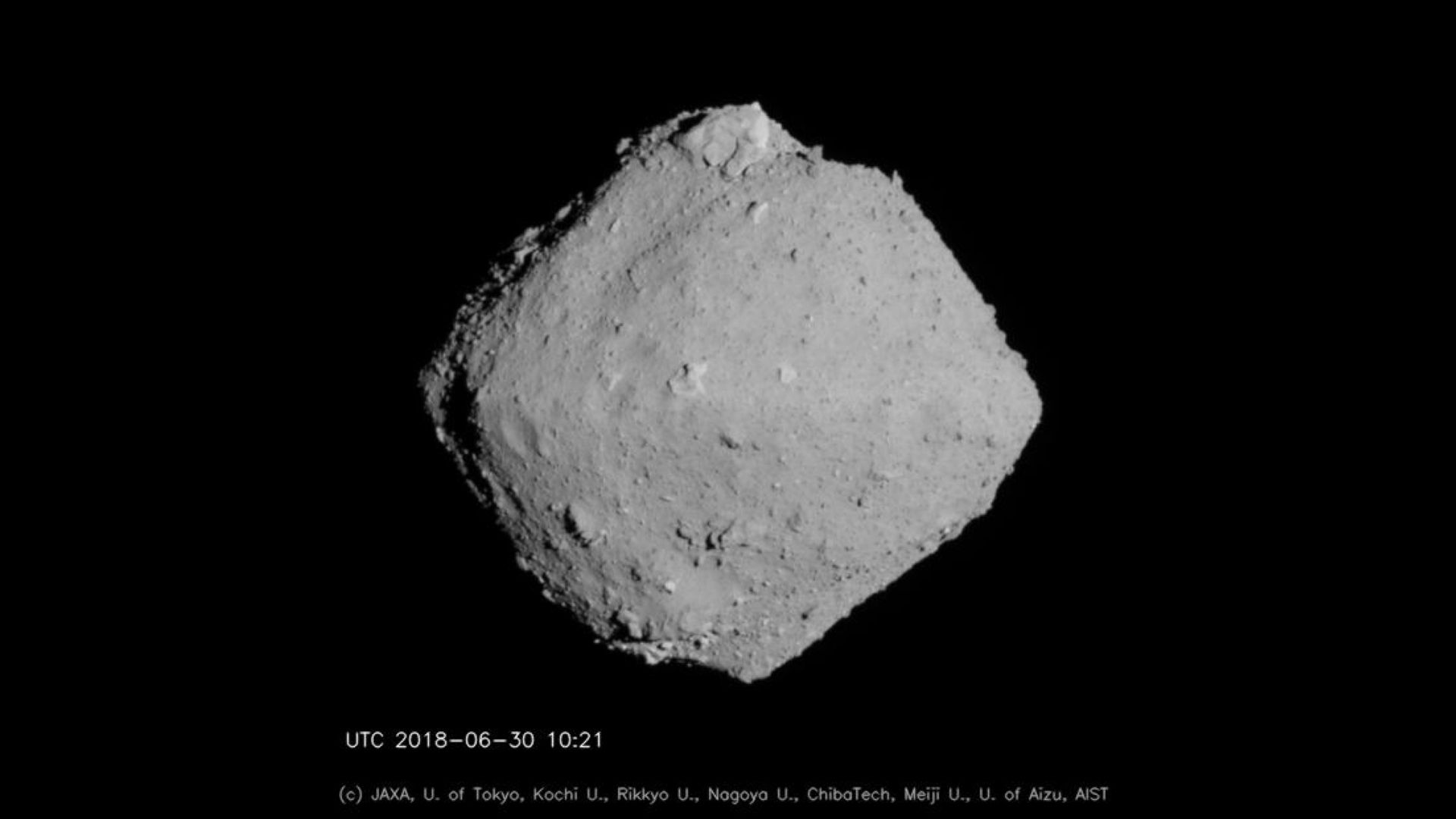
Researchers made the discovery after analyzing samples collected from asteroid Ryugu, a 3,000-foot-wide (900 meters) space rock shaped like a spinning top.

The scientists detected a complete set of canonical nucleobases, which are the building blocks for DNA — the genetic foundation for all life on Earth — and its lesser-known cousin RNA, according to a new study published Monday (March 16) in the journal Nature Astronomy.

Article continues below


You may like

This “does not mean that life existed on Ryugu,” study lead author Toshiki Koga, a biogeochemist at the Japan Agency for Marine-Earth Science and Technology, told AFP, per Phys.org. “Instead, their presence indicates that primitive asteroids could produce and preserve molecules that are important for the chemistry related to the origin of life.”

This isn’t the first time an asteroid has been found to be carrying all five nucleobases. NASA recovered the same set of nucleobases from asteroid Bennu in 2023, courtesy of the OSIRIS-REx spacecraft. Researchers have also detected the nucleobases on meteorites. Taken together, these findings suggest that nucleobases could be widespread in the solar system.

Cosmic origins of life?

Scientists aren’t sure how life got started on Earth. Some theories posit that it originated here, such as in deep-sea vents. However, there’s also a possibility that life — or the building blocks of life — didn’t form on Earth at all but were carried here on comets or asteroids.

César Menor Salván, an astrobiologist at the University of Alcalá in Spain who was not involved in the study, emphasized in an interview with AFP that the new results “do not suggest that the origin of life took place in space.”

Get the world’s most fascinating discoveries delivered straight to your inbox.

However, “with this and the results from Bennu, we have a very clear idea of which organic materials can form under prebiotic conditions anywhere in the universe,” Salván added.

The Japan Aerospace Exploration Agency (JAXA) collected the Ryugu samples as part of its Hayabusa2 mission, which launched in 2014. The uncrewed Hayabusa2 spacecraft landed on the asteroid in 2019, before collecting two dust samples from the asteroid’s surface and returning them to Earth in 2020.

The samples weigh just 5.4 grams (0.19 ounces) each, less than the weight of a quarter, but have excited scientists for years. Preliminary analysis of a tiny fraction of the sampled material in 2023 revealed that the asteroid contained many of the building blocks for life, including one nucleobase (uracil) and numerous other organic materials, including 15 amino acids, which are the foundation of proteins. These are prebiotic molecules, and although they’re not life, they’re found in all life.


What to read next

One study also revealed microorganisms crawling all over one asteroid Ryugu sample. But these microorganisms closely matched Earth’s bacteria, and their presence was almost certainly the result of contamination after the sample returned to Earth. (Even NASA has had trouble keeping Earth bacteria off its interplanetary spacecraft in ostensibly sterile rooms).

The Japan Aerospace Exploration Agency (JAXA) collected samples from Ryugu by landing a spacecraft on the asteroid. (Image credit: (left) JAXA, University of Tokyo, Kochi University, Rikkyo University, Nagoya University, Chiba Institute of Technology, Meiji University, University of Aizu, AIST. (right) MASCOT/DLR/JAXA)

The closest look yet

For the new study, researchers did a much more comprehensive analysis of nucleobases than was done during the preliminary research, using more sample material and optimized analytical techniques.

This time, the researchers found all of the nucleobases — adenine, guanine, cytosine, thymine and uracil. These natural compounds mix with ribose and phosphate to form DNA and RNA. The researchers also looked at the ratio of nucleobases and compared them to those discovered on Bennu and on two meteorites (Murchison and Orgueil) that had fallen to Earth.

Nucleobases are split into two groups based on their chemical structure. Adenine and guanine are purines, which are known for their double-ring structure, while cytosine, thymine and uracil belong to the single-ring-structured pyrimidines.

The researchers found that Ryugu had equal amounts of purines and pyrimidines, while Bennu and Orgueil were more enriched in pyrimidines and Murchison was more enriched in purines. Notably, the researchers also identified a strong correlation between the purine-pyrimidine ratio and the concentrations of ammonia in Ryugu, Bennu and Orgueil, suggesting that ammonia, another life-friendly molecule, may have been a key factor driving similar nucleobase formation pathways in the rocks’ distinct environments, according to the study.

“Because no known formation mechanism predicts such a relationship, this finding may point to a previously unrecognized pathway for nucleobase formation in early solar system materials,” Koga said.

Ryugu and Bennu are a common type of asteroid known as carbonaceous asteroids, which make up 75% of all asteroids in our solar system. James Webb Space Telescope (JWST) observations suggest that both asteroids may originate from the same parent asteroid that broke apart billions of years ago. The Orgueil meteorite also derived from a carbonaceous asteroid.

These ancient rocks are left over from when the solar system was still forming around 4.5 billion years ago, when the Earth was also forming. The detection of nucleobases, therefore, suggests that carbonaceous asteroids may have helped Earth get its life-forming chemicals.

“The detection of diverse nucleobases in asteroid and meteorite materials demonstrates their widespread presence throughout the Solar System and reinforces the hypothesis that carbonaceous asteroids contributed to the prebiotic chemical inventory of early Earth,” the researchers wrote in the study.


Share. Facebook Twitter LinkedIn Telegram WhatsApp Email

Keep Reading

Scientists race to collect the last seeds from a critically endangered tree before it goes extinct

Scientists race to collect the last seeds from a critically endangered tree before it goes extinct

AI models are teaching each other ‘violent and antisocial’ traits through hidden data signals, study finds — and scientists can’t figure out why

AI models are teaching each other ‘violent and antisocial’ traits through hidden data signals, study finds — and scientists can’t figure out why

‘Cannibal’ CME from rare ‘anti-Hale’ sunspot will slam into Earth today, bringing auroras to 23 US states

‘Cannibal’ CME from rare ‘anti-Hale’ sunspot will slam into Earth today, bringing auroras to 23 US states

New Velociraptor cousin was a ‘4-winged’ dragon that hunted prey from the trees of ancient China, fossil find hints

New Velociraptor cousin was a ‘4-winged’ dragon that hunted prey from the trees of ancient China, fossil find hints

Mysterious repeating radio signal traced to ‘vampire’ star that’s slowly eating its companion

Mysterious repeating radio signal traced to ‘vampire’ star that’s slowly eating its companion

Flesh-eating screwworm found in Texas cow. Are humans at risk?

Flesh-eating screwworm found in Texas cow. Are humans at risk?

Satellite images reveals mangroves rebounding worldwide — but here’s why they could still ‘drown’

Satellite images reveals mangroves rebounding worldwide — but here’s why they could still ‘drown’

Italian teenagers discover 1,800-year-old Roman luxury house underneath their high school gym

Italian teenagers discover 1,800-year-old Roman luxury house underneath their high school gym

James Webb telescope detects most distant dormant black hole, invisible in all wavelengths and weighing as much as 6 billion suns

James Webb telescope detects most distant dormant black hole, invisible in all wavelengths and weighing as much as 6 billion suns

Add A Comment
Leave A Reply Cancel Reply

Editors Picks

Yankees call up Spencer Jones in first attempt to fill Aaron Judge void

Yankees call up Spencer Jones in first attempt to fill Aaron Judge void

June 5, 2026
‘Survivor’ star, 43, reveals he has cancer — and the 3 symptoms he ignored

‘Survivor’ star, 43, reveals he has cancer — and the 3 symptoms he ignored

June 5, 2026
The big acquisitions Jamie Dimon rumored to be eyeing after revealing B war chest

The big acquisitions Jamie Dimon rumored to be eyeing after revealing $20B war chest

June 5, 2026
Graham Platner, Susan Collins tied in Maine Senate race post-sexting scandal, new poll shows

Graham Platner, Susan Collins tied in Maine Senate race post-sexting scandal, new poll shows

June 5, 2026

Subscribe to News

Get the latest USA news and updates directly to your inbox.

Latest News
Scooter Braun, Sydney Sweeney bike to Times Square on late-night date

Scooter Braun, Sydney Sweeney bike to Times Square on late-night date

June 5, 2026
Taylor Swift Shares Rare Childhood Footage Dressed as a Cowgirl to Mark New ‘Toy Story 5’ Song

Taylor Swift Shares Rare Childhood Footage Dressed as a Cowgirl to Mark New ‘Toy Story 5’ Song

June 5, 2026
FIFA World Cup 2026 fans racing to buy 0 soccer-themed LABUBU from POP MART

FIFA World Cup 2026 fans racing to buy $150 soccer-themed LABUBU from POP MART

June 5, 2026
Facebook X (Twitter) Pinterest WhatsApp TikTok Instagram
© 2026 USA Times. All Rights Reserved.
  • Privacy Policy
  • Terms
  • Advertise
  • Contact

Type above and press Enter to search. Press Esc to cancel.