




In July 2025, a large, bright cosmic object visited from beyond our solar system. Only the third interstellar object ever discovered, the comet — named 3I/ATLAS — swooped through the inner solar system for about four months, briefly making it one of the biggest science celebrities in the world.
The interstellar object’s fame stemmed in large part from controversial (and unsubstantiated) claims that it could be a source of intelligent alien technology, even though 3I/ATLAS behaved like a natural comet. However, according to the astronomers who are studying its mysteries in the data collected by dozens of telescopes and spacecraft, the ancient object may still have lessons to teach us about life in the cosmos.
3I/ATLAS is likely a preserved fragment of a planetesimal — a building block of a planet — from a distant system, Martin Cordiner, a researcher in astrochemistry and planetary science at NASA’s Goddard Space Flight Center, told Live Science. Therefore, the comet’s composition could offer clues to the prevalence of life’s building blocks around distant stars. Some astronomers even hope this cosmic interloper will help constrain how likely life is elsewhere in our galaxy.
Blast from the past
Comets like 3I/ATLAS are important because scientists think they help “seed” planets with carbon-containing chemicals, Darryl Seligman, an assistant professor of astronomy at Michigan State University, told Live Science in an email. Some of these chemicals, like methanol, have simple structures. Others, like amino acids, are more complex. Together, these carbon-containing, or organic, compounds form the basis for biomolecules, like proteins and nucleic acids, that interact to produce life.
Samples returned from space rocks in our neighborhood strongly support the idea that they transported such molecules within the solar system. For instance, fragments from the solar system asteroid Bennu obtained during NASA’s OSIRIS-REx mission contain all five nucleotide bases, the building blocks of nucleic acids. Matthew Belyakov, a postdoctoral researcher in planetary science at Caltech, noted that the Bennu samples also contained 14 of the 20 amino acids that form naturally on Earth.
3I/ATLAS, in its nearest close-up, taken by the Mars Reconnaissance Orbiter. Observations with space- and ground-based telescopes have found that the comet contains tons of organic molecules. But what does this mean for the prospect of life elsewhere in our galaxy?
(Image credit: NASA/JPL-Caltech/University of Arizona)
Inferences about such deliveries are possible only because the rocks are like time capsules: They emerge from the same swirling disk of gas and dust from which planets are born, and the chemical compositions of asteroids and comets don’t change much after that. So, by studying space rocks that originate in other exoplanetary systems, “we can learn if they also contain the building blocks of life and could have helped to start life in exoplanetary systems,” Seligman said.
Simulations suggest that comets that circle one planet before moving to another could similarly deliver such prebiotic molecules to baby exoplanets. However, there was no supporting observational data to back up this claim.
A chemical potpourri
To figure out which chemicals 3I/ATLAS contains, astronomers have been recording the comet’s light intensity across a range of frequencies, using more than a dozen instruments on Earth and around the solar system. This was possible because the comet spewed tons of gas and dust to create a fuzzy bright halo, or coma, after the sun warmed it. Observations of this coma have turned up an eclectic group of chemicals essential for life as we know it.
One is hydrogen cyanide (HCN), which was detected by the Atacama Large Millimeter/submillimeter Array (ALMA). Despite its notorious reputation as a poisonous gas, HCN is important for creating life. A commentary noted that laboratory experiments dating back to the 1950s — including the famous Miller-Urey experiment, which attempted to recreate the conditions of primordial Earth — have found that HCN is involved in building molecules like amino acids.
The list of ingredients goes on. ALMA data also revealed that 3I/ATLAS released gigantic amounts of formaldehyde and methanol. Additionally, observations from the James Webb Space Telescope showed 3I/ATLAS spewing the greenhouse gas methane. This is important because, assuming the methane formed on planets in the comet’s home system, it could have trapped heat on those planets, thus warming them and making them more hospitable to life.

Unlike other interstellar comets, 3I/ATLAS is rich in organic compounds, which NASA’s SPHEREx telescope detected in early 2026.
(Image credit: NASA/JPL-Caltech)
The presence of all these molecules is significant, Cordiner said, because they are “heavily implicated in terrestrial prebiotic chemistry studies as key carbon and nitrogen feedstocks [raw materials] for helping build life’s molecular precursors,” he said. 3I/ATLAS is proof that these “feedstocks” also exist in pastures far beyond our solar system’s fences.
These findings are especially important because astronomers couldn’t study the previous two interstellar objects to the same extent, Seligman said. He noted that 1I/’Oumuamua, the first interstellar object ever detected in the solar system, was observable for only a few weeks.
“The second interstellar comet 2I/Borisov was discovered right before COVID, so a lot of observations were canceled because of that,” Seligman added. (Cordiner noted that the few observations conducted on 2I/Borisov showed that it, too, appears to contain HCN.) In comparison, researchers had almost a year to study 3I/ATLAS with telescopes. These observations have shown that “3I/ATLAS is unique in terms of the *measured* chemical inventory,” Cordiner said.
Not indicative of life
All of the chemicals that 3I/ATLAS appears to possess give us data about just one planetary system. But when combined with observations of other astronomical phenomena, 3I/ATLAS shows that the chemical building blocks of life are abundant across our galaxy. For instance, giant molecular clouds — dense regions of gas and dust that give rise to stars — contain nitriles and sugar acids that can form amino acids. The stuff of life, it seems, is plentiful in space.

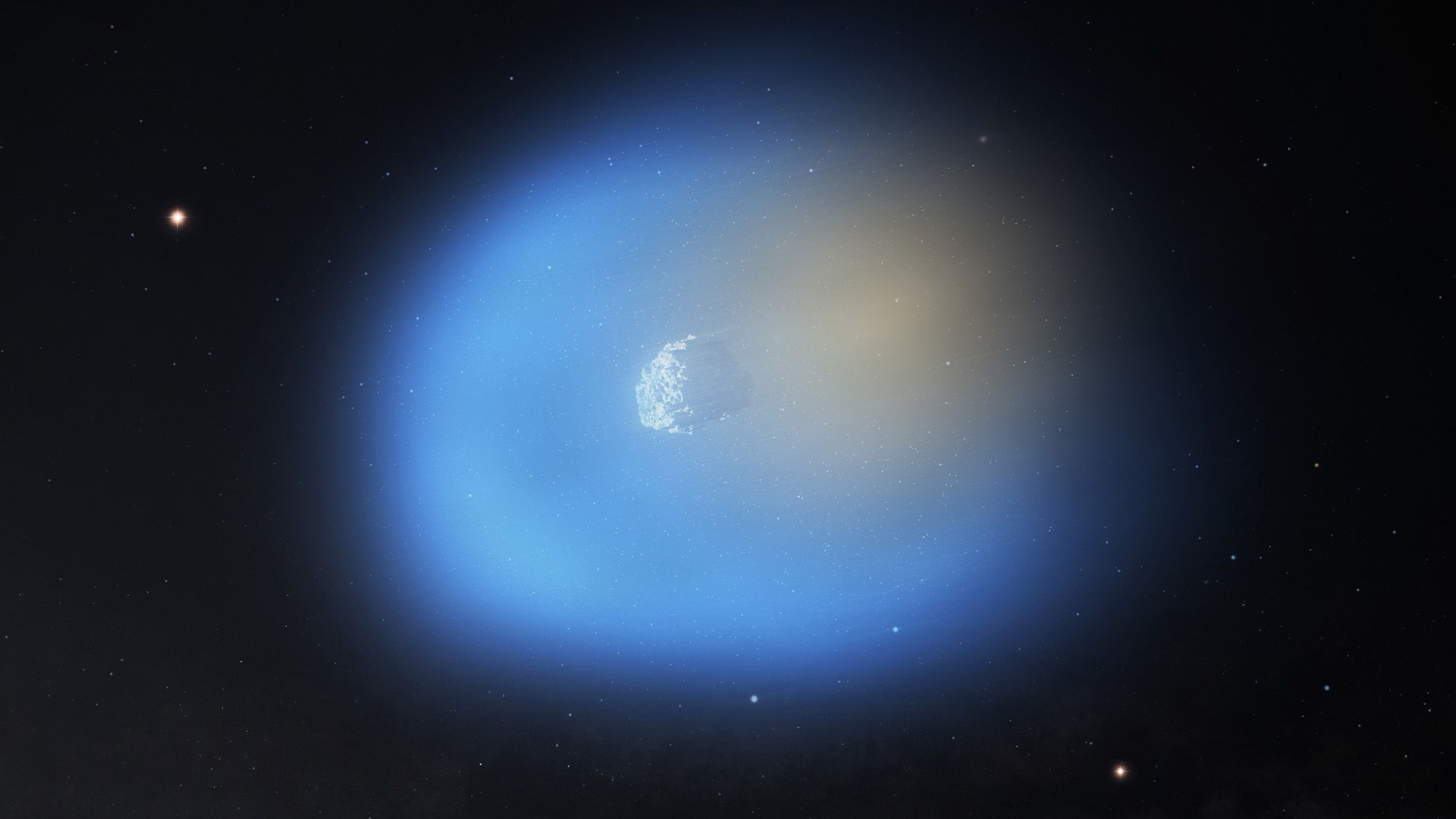
James Webb telescope observations showed that 3I/ATLAS has a lot of methane. If its home system’s planets contained similar amounts of methane, they may have warmed sufficiently to support liquid water and, possibly, life.
(Image credit: NASA, ESA, CSA, STScI, M. Belyakov (Caltech), I. Wong (STScI), Image Processing: A. Pagan (STScI))
Ingredients aside, these findings don’t prove that life itself has developed in 3I/ATLAS’ home system (or anywhere else). All of the organic molecules that 3I/ATLAS appears to contain have simple chemical structures. Cordiner said mixtures of such molecules in the lab have transformed into more complex ones via processes like ice irradiation. However, such compounds have not been found on 3I/ATLAS, despite the billions of years the comet likely spent exposed to the unabated radiation of interstellar space.
Most of the chemicals 3I/ATLAS released while zipping past the sun come from the comet’s radiation-exposed upper layers and not from its pristine interior, a January study found. This would mean that what astronomers have measured may not be present in the comet’s home system.
Nonetheless, many astronomers, including Seligman’s group, are continuing to study 3I/ATLAS’ composition. There is also the exciting possibility of future interstellar visitors, which are all but guaranteed to make an appearance, thanks to the Vera C. Rubin Observatory in Chile, which is expected to spot dozens more. The elements and isotopes found in these objects will help in “building a map of where bio-precursors reside, across the history of the Galaxy,” Cordiner said.
Help us improve Live Science Pro: We’re always trying to make our content better. Leave us feedback about Pro here.
TOPICS