




QUICK FACTS
Name: Lençóis Maranhenses National Park
Location: State of Maranhão, Brazil
Coordinates: -2.5299, -43.0250
Why it’s incredible: Lençóis Maranhenses looks like a desert, yet it hosts thousands of temporary lagoons.
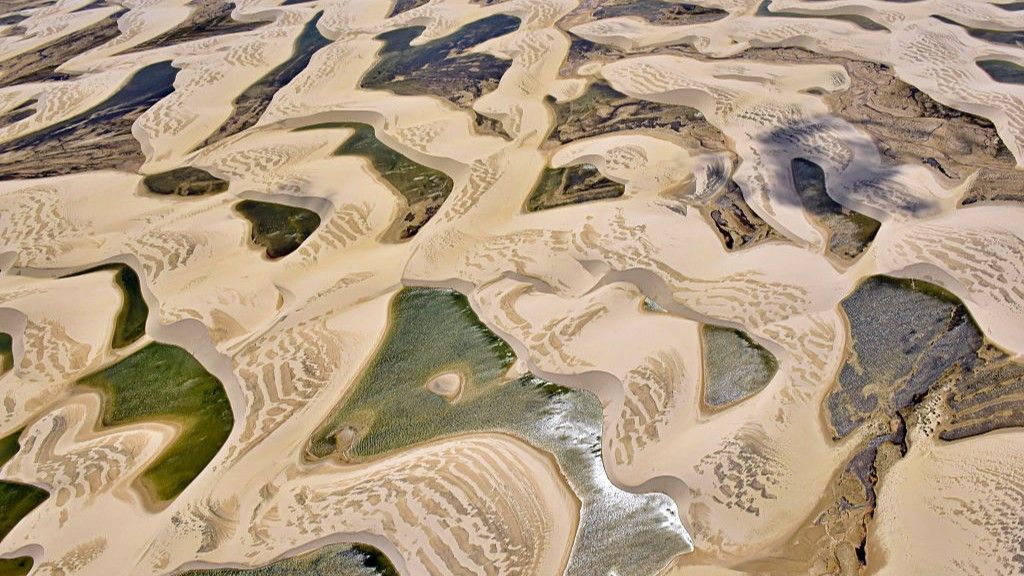
Lençóis Maranhenses is a national park on Brazil’s northeast coast that is famous for its white sand dunes peppered with thousands of temporary, crystal-clear lagoons.
The lagoons form every year during the wet season, between January and June, when rainwater collects in natural basins between the dunes. A compact, impermeable sediment layer prevents the water from draining, thereby creating freshwater pools that vary in shape, size, depth and color, according to UNESCO, which designated Lençóis Maranhenses National Park as a World Heritage Site in 2024.
Sand dunes cover about two-thirds of Lençóis Maranhenses, which spans 580 square miles (1,500 square kilometers) within a transition area between the Brazilian Amazon, the Cerrado ecoregion and the Caatinga ecoregion. The Cerrado features tropical savannas, wetlands and abundant biodiversity, and it’s one of the best carbon sinks in the world. The Caatinga, meanwhile, is a semiarid landscape covered in dry forests with thorny shrubs and stunted trees. The name Caatinga comes from the term “ka’atinga,” which means “white forest” or “white vegetation” in the Tupi language.
Article continues below
Lençóis Maranhenses does not belong to any of those ecoregions. Instead, it forms its own unique landscape that, in some places, looks like a desert but isn’t one.
The remaining third of Lençóis Maranhenses is home to mangrove swamps and lush vegetation. Rare and endangered species live these ecosystems, including the neotropical otter (Lontra longicaudis); the West Indian manatee (Trichechus manatus); the scarlet ibis (Eudocimus ruber); and the oncilla (Leopardus tigrinus), a type of small, spotted cat.
The national park includes 50 miles (80 kilometers) of coastline, with a dry plain separating the beach from the sand dunes. Sand is dumped ashore by the tides and then eroded by winds and transported across the plain to the dunes. This action shapes the dunes into huge crescents, also known as barchans, that grow taller the farther inland they are, because the farthest dunes from the beach are those that have been around the longest and accumulated the most sand via wind deposition. The dunes that hug the plain are up to 3.3 feet (1 meter) high, while those farthest inland can measure up to 100 feet (30 m) tall, according to UNESCO.
Lençóis Maranhenses is surrounded by a large buffer zone to protect it from human activities. The best time to visit the national park is between June and September, when the lagoons are full. Lagoa da Gaivota, Lagoa Azul and Lagoa Bonita are some of the largest lagoons in the national park.
Discover more incredible places, where we highlight the fantastic history and science behind some of the most dramatic landscapes on Earth.