



Antarctica could heat up 1.4 times faster than the rest of the Southern Hemisphere over the coming decades, which would lock in extreme sea-level rise and ravage polar ecosystems, a new modeling study shows.
This acceleration of warming in Antarctica relative to other regions, known as Antarctic amplification, would likely occur if global temperatures reached 3.6 degrees Fahrenheit (2 degrees Celsius) above preindustrial levels, according to the study. The world has already warmed by 2 F (1.1 C), and the pace at which new temperature records are being set is intensifying. If emissions stay around current levels, we will likely reach 3.6 F of warming around 2050 — but if emissions keep rising, we could hit that threshold around 2040.
Article continues below
“For many years, Antarctica seemed isolated from the effects of increasing global temperatures,” Ariaan Purich, a senior lecturer and climatologist at Monash University in Australia who was not involved in the research, told Live Science in an email. “In this new study, the authors propose that long-term surface warming of the ocean around Antarctica, projected by climate models over the coming century, leads to Antarctic amplification.”
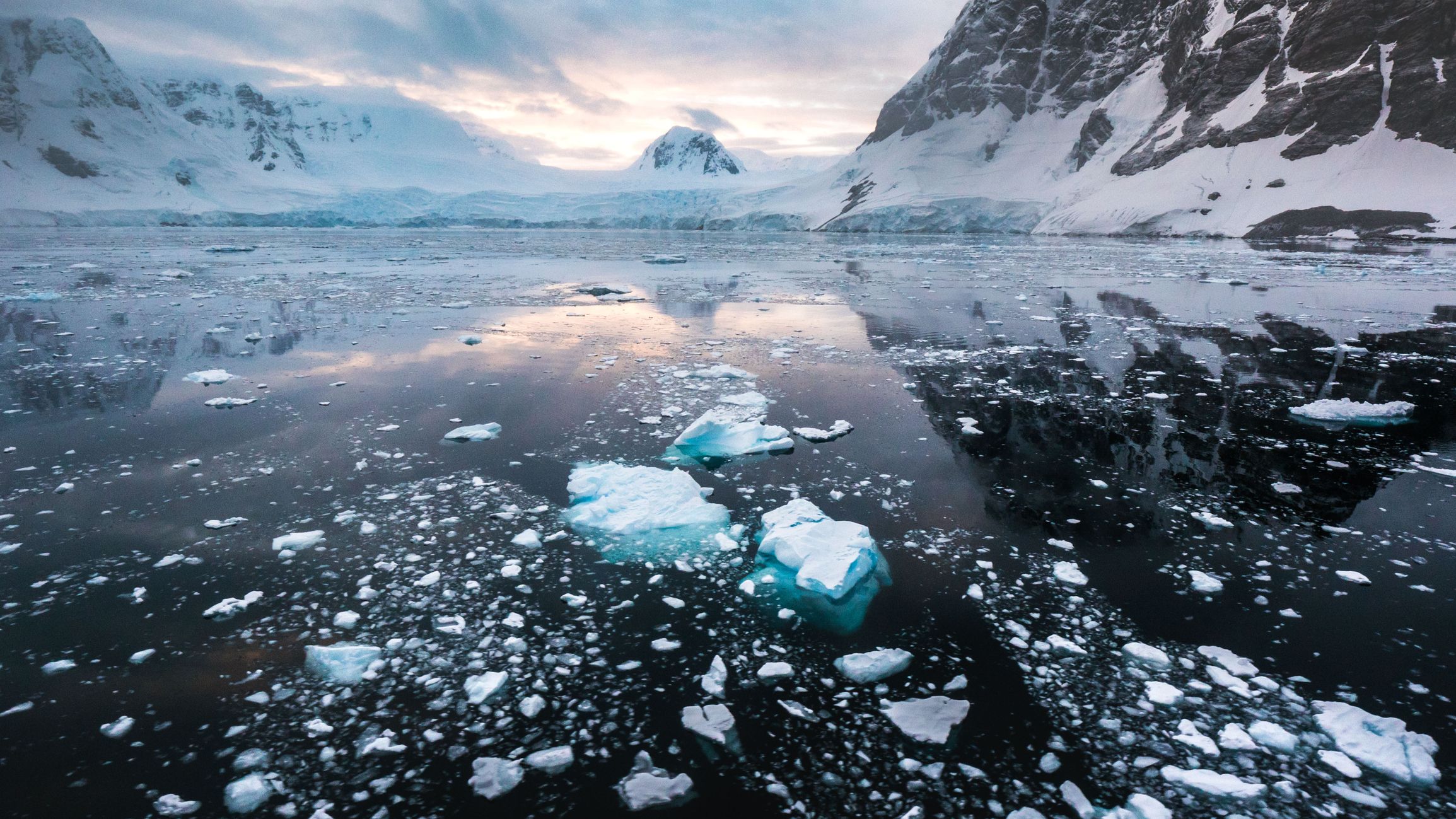
Arctic amplification has been documented for years, with temperatures in this region climbing about four times faster than the global average increase over the past five decades. The main mechanism driving Arctic amplification is the ice-albedo feedback, where the melting of snow and ice accelerates warming because water reflects less heat back to space. Where there once used to be reflective sea ice, there is now an ocean that absorbs more heat from sunlight. This causes more ice and snow to melt, in turn exposing even more heat-absorbing water.
Antarctica behaves differently, partly because swirling ocean and wind currents shield the continent from rising air and sea temperatures elsewhere in the world. Contrary to the Arctic, most of Antarctica experienced only gradual warming and no declines in sea ice until about a decade ago, Purich said.
But then, between 2014 and 2016, Antarctica lost as much sea ice as the Arctic had lost in four decades. The continent hasn’t bounced back since, Purich said, with exceptionally low winter sea ice extent recorded in 2023, in particular.
“We’re now seeing abrupt changes occurring in Antarctica, at very rapid rates,” Purich said. “With low Antarctic sea ice coverage, there is now the potential for the ice-albedo feedback to start exacerbating warming of the southern high latitudes.”
But scientists haven’t observed this amplification signal directly yet. So, for the new study, researchers in China analyzed data from climate models to investigate whether Antarctic amplification could occur under a 3.6 F warming scenario. Using polar amplification simulations, along with models developed for the latest Intergovernmental Panel on Climate Change (IPCC) report, the researchers explored the impact of continued global warming on Antarctic temperatures.
Their findings — published Dec. 22, 2025, in the journal Geophysical Research Letters — suggest Antarctica will warm faster than the Southern Hemisphere as a whole under future climate conditions.
The researchers also discovered the main driver of Antarctic amplification: Unlike in the Arctic, where the ice-albedo feedback is a key driving force, Antarctica will warm mainly through accelerating heat release from the surrounding ocean.
Antarctic amplification may not have set in yet, but the effects of climate change have already arrived, Purich said. Over the past decade, scientists have observed drastic declines in Antarctic sea ice and catastrophic breeding failures in emperor penguins (Aptenodytes forsteri) due to melting.
“These things are happening now, and every fraction of warming that we can avoid matters,” Purich said.
The new study is based on models, which, in the case of Antarctica, means the results may underplay future amplification, Purich said. Climate models are limited in their ability to predict certain warming mechanisms, and it’s still unclear exactly how Antarctica’s circumpolar currents will affect temperature changes.
“Together, this raises the possibility that the climate models may underestimate the potential and magnitude of Antarctic amplification to emerge over coming decades and centuries,” Purich said.
Zhang, Z., Wang, S., Chen, D., Li, X., Dou, T., Xiao, C., Chen, W., Qin, D., & Ding, M. (2025). Future sea surface temperature as a key driver of Antarctic warming. Geophysical Research Letters, 52(24). https://doi.org/10.1029/2025gl118958