


Close Menu
  • Home
  • United States
  • World
  • Politics
  • Business
  • Lifestyle
  • Entertainment
  • Health
  • Science
  • Tech
  • Sports
  • More
    • Web Stories
    • Editor’s Picks
    • Press Release

Subscribe to Updates

Get the latest USA news and updates directly to your inbox.

What's On
Dr. Oz helps older woman who collapsed during Trump’s speech at Kentucky event

Dr. Oz helps older woman who collapsed during Trump’s speech at Kentucky event

March 12, 2026
TSA agent says morale is suffering as officers work without pay during DHS shutdown

TSA agent says morale is suffering as officers work without pay during DHS shutdown

March 12, 2026
We’ll Take Any Excuse to Wear Ali Larter’s Strapless Mini Dress This Summer — Get the Look for

We’ll Take Any Excuse to Wear Ali Larter’s Strapless Mini Dress This Summer — Get the Look for $24

March 12, 2026
Facebook X (Twitter) Instagram
Trending
  • Dr. Oz helps older woman who collapsed during Trump’s speech at Kentucky event
  • TSA agent says morale is suffering as officers work without pay during DHS shutdown
  • We’ll Take Any Excuse to Wear Ali Larter’s Strapless Mini Dress This Summer — Get the Look for $24
  • Caitlin Clark shines in USA basketball senior team debut
  • Alabama teen knocks stepfather out during alleged attempted strangulation of mom
  • Love Is Blind’s Bri and Connor Are Back Together After Calling Off Season 10 Wedding
  • Knicks come up big after ‘get our s–t together’ halftime challenge
  • Trump backs Jake Paul for possible future political office run
  • Privacy
  • Terms
  • Advertise
  • Contact Us
Join Us
USA TimesUSA Times
Newsletter Login
  • Home
  • United States
  • World
  • Politics
  • Business
  • Lifestyle
  • Entertainment
  • Health
  • Science
  • Tech
  • Sports
  • More
    • Web Stories
    • Editor’s Picks
    • Press Release
USA TimesUSA Times
Home » Pre-Inca culture acquired Amazonian parrots from hundreds of miles away to use their feathers to decorate the dead, new analysis reveals
Pre-Inca culture acquired Amazonian parrots from hundreds of miles away to use their feathers to decorate the dead, new analysis reveals
Science

Pre-Inca culture acquired Amazonian parrots from hundreds of miles away to use their feathers to decorate the dead, new analysis reveals

News RoomBy News RoomMarch 10, 20260 ViewsNo Comments

Around 1,000 years ago, a pre-Inca culture acquired wild parrots from hundreds of miles away in the Amazon rainforest and then kept them captive in what is now coastal Peru, all so people could access the birds’ vibrant feathers, which were “prestigious symbols of status,” a new study finds.

Researchers found some of these feathers in a 1,000-year-old tomb about 20 years ago. Now, a new analysis reveals the “complete journey of these feathers,” including where the birds originated, what they ate, and which routes the live birds were likely carried on before being traded to the Yschma, a pre-Inca society that flourished from about A.D. 1000 to 1470.

While it’s long been known that the Inca and other pre-Hispanic cultures traded and valued parrot feathers, the new study is one of the first to reveal that the “Ychsma culture, long before the Inca Empire, participated in a sophisticated trade network that spanned the Andes,” the authors wrote in the study.

Article continues below


You may like

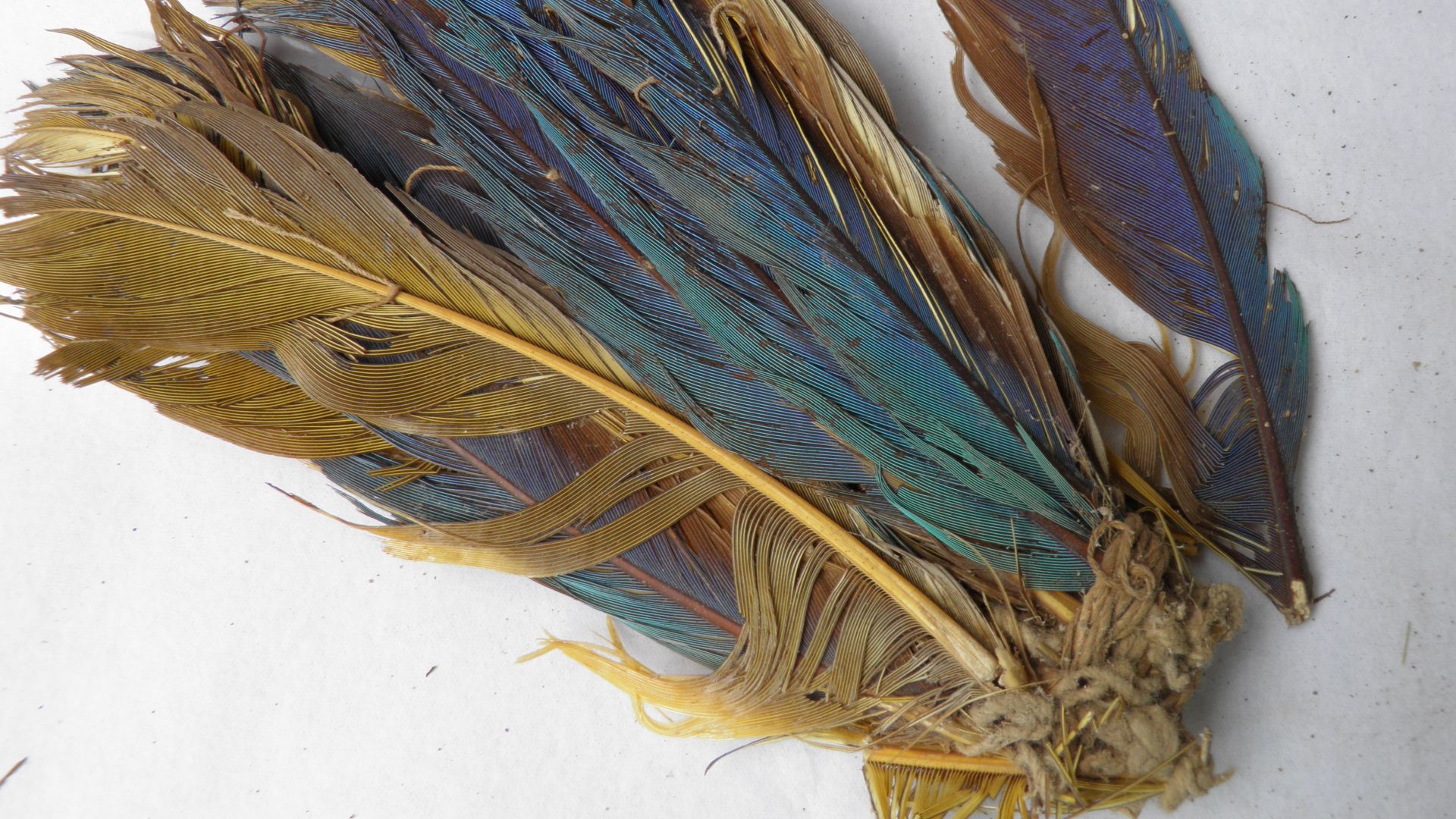
Researchers first discovered the burial in 2005 after a survey with ground-penetrating radar and a later excavation revealed two large, stone-lined tombs near the Temple of Pachacamac, 20 miles (32 kilometers) south of Lima. In one of the two Yschma tombs, the archaeologists found parrot feather ornaments with vivid colors that had been preserved for centuries.

Now, an international team of researchers has analyzed the feathers’ DNA and chemical composition, and concluded that the feathers came from live Amazonian parrots that had been transported, and likely traded, across the mountains, before being kept in captivity on the Peruvian coast. Their new study was published Tuesday (March 10) in the journal Nature Communications.

“Our study proves that centuries before the Inca, societies like the Ychsma, the Chimú, and others were already managing sophisticated, organised, long-distance trade networks,” study co-author Izumi Shimada, co-director of the Pachacamac Archaeological Project that originally found the tombs and a professor of anthropology at Southern Illinois University, told Live Science in an email. “They possessed profound ecological knowledge and negotiated trade agreements that connected the Amazon with the coastal deserts, revealing that these states [were] more interconnected.”

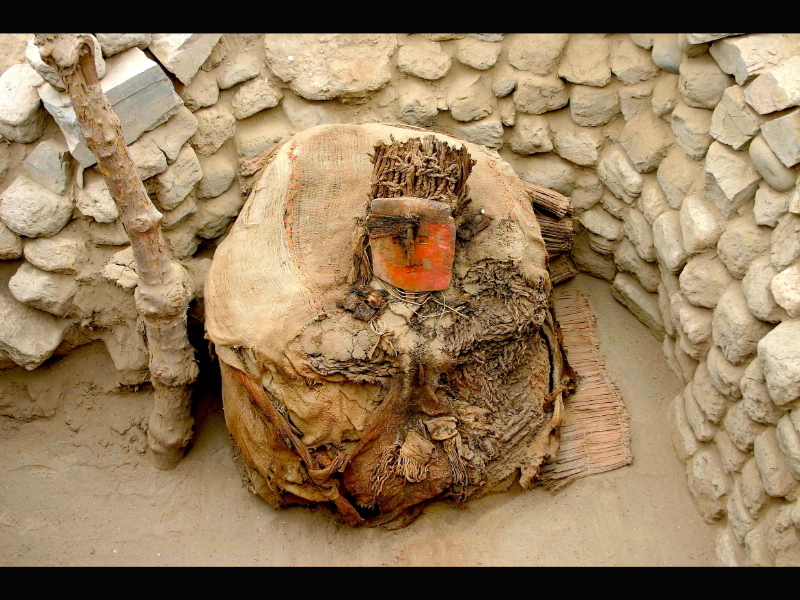
The discovery shows how much effort these societies invested in what they deemed prestigious objects. At Pachacamac, these feathers were found adorning false heads — cloths filled with reeds and other plants — attached to 34 funerary bundles of deceased individuals who were also decorated with small cinnabar masks, suggesting that the feathers were used in ceremonial activities such as burial rites.

Get the world’s most fascinating discoveries delivered straight to your inbox.

Image 1 of 4

(Image credit: Izumi Shimada)

A view of the Temple of Pachacamac (or Painted Temple) near Lima, Peru, where the feathers were discovered.

Images of the Pachacamac site near Lima Peru, with various funerary bundles and their corresponding feathers.
(Image credit: Izumi Shimada)

One of the 34 funerary bundles with the feather ornaments attached found in one of the tombs.

Images of the Pachacamac site near Lima Peru, with various funerary bundles and their corresponding feathers.
(Image credit: Izumi Shimada)

Another of the funerary bundles with preserved parrot feathers.

Images of the Pachacamac site near Lima Peru, with various funerary bundles and their corresponding feathers.
(Image credit: Izumi Shimada)

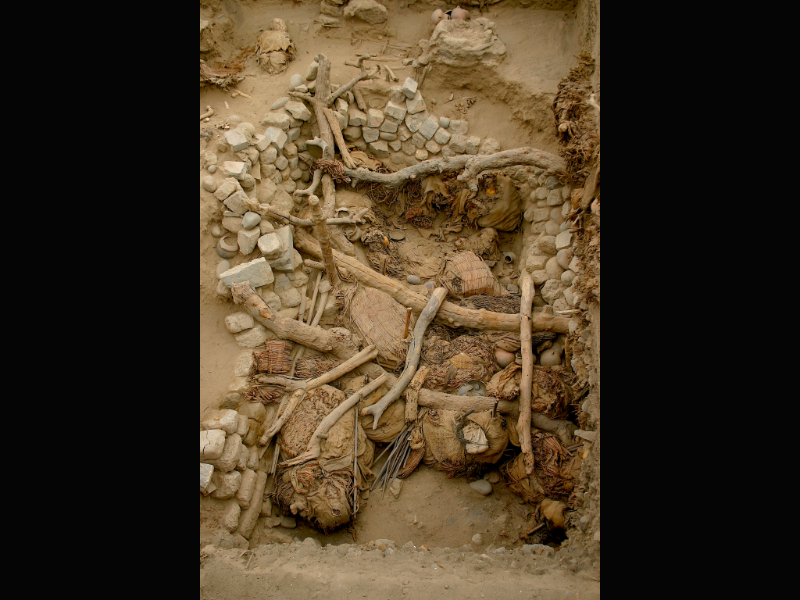
Another view into one of the intact tombs found near the Pachacamac temple.


However, it appears that the captive birds weren’t living at the temple.

“Our research actually suggests that the large-scale rearing of these captive birds may not have happened at Pachacamac itself (no parrot skeletons, eggshells, or signs of breeding houses were found), but further north maybe in the Chimú Empire, who then traded the harvested feathers south to the Ychsma,” study first author George Olah, a research fellow at The Australian National University, told Live Science in an email. The proposed Chimú breeding site is based on the new paper’s computer models, he added.

A sacred site

The Pachacamac temple and its oracle served as the heart of the Yschma society, which controlled the valleys around Lima before the Inca conquest around 1470. “Because of the widespread and longstanding reputation of Pachacamac, elites of diverse cultures in ancient Peru sought the privilege of being buried close to the temple,” Shimada said. “It is believed that the site contained tens of thousands of burials of elites of different cultures and regions.”


What to read next

After the Spanish conquest in 1533, looters ransacked graves at Pachacamac for centuries, stealing and destroying countless Yschma artifacts. By the time the Pachacamac Archaeological Project began its work in the early 2000s, many researchers believed no intact elite tombs were left by the temple — so the discovery of the two tombs was an “exceptional event,” the researchers wrote in the study.

Feather quest

In their investigation, the team looked at the mitochondrial DNA of 25 feathers found in the tombs and determined that the ornaments attached to the funeral bundles came from at least four tropical parrot species: scarlet macaws (Ara macao), red-and-green macaws (Ara chloropterus), blue-and-yellow macaws (Ara ararauna) and mealy Amazons (Amazona farinosa). All of these birds are native to lowland tropical forests east of the Andes, not to the Peruvian coast.

These birds lived hundreds of miles from the Ychsma, which suggests the society traded with others to acquire the birds.

“The fact that they ended up more than 500 kilometres [310 miles] away, on the other side of South America’s highest mountain range, proves human intervention,” Olah said in a statement. “They do not naturally fly over the Andes.”

An analysis of the feathers’ isotopes (variations of elements with varying numbers of neutrons in their nuclei) shed light on the birds’ diets.

Unlike modern wild parrots’ diets, which are rich in fruits and seeds, the ancient feathers from Pachacamac showed diets rich in plants like maize and possibly food linked to coastal agriculture enriched by seabird feces.

“Because they showed a coastal diet, it proves the birds were brought to somewhere along the coast alive and kept in captivity long enough to moult and grow new feathers with the isotopic signature we detected,” Olah told Live Science in an email.

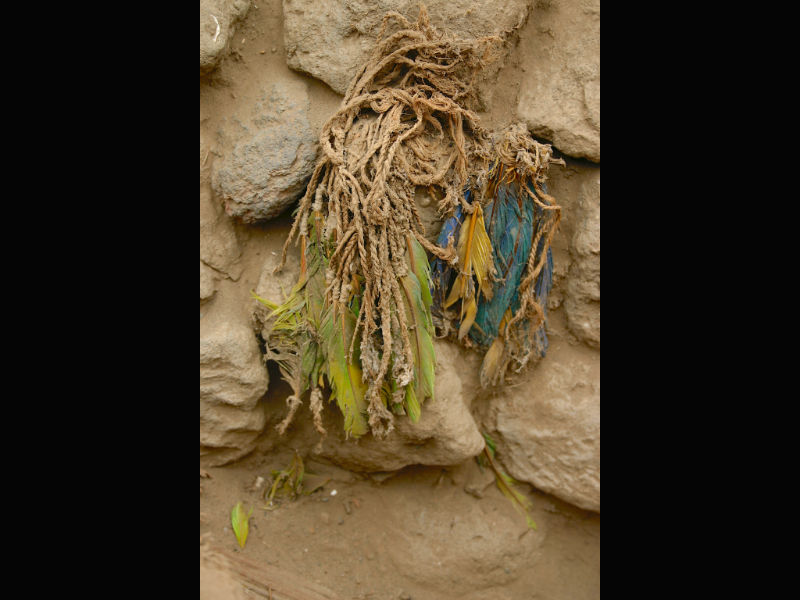
A bundle of red, yellow and blue feathers tied together with ancient rope and held by a gloved hand

Some of the colorful feathers found in the Ychsma tomb in Pachacamac. (Image credit: George Olah)

The macaw feathers also showed a higher genetic diversity in their DNA, unlike the low diversity expected from a small captive breeding colony. This suggested that local breeding was happening near Pachacamac and birds were being repeatedly sourced from Amazonian populations and moved through trade routes in the mountains.

“While it is tempting to think of them as pets, the archaeological evidence suggests they were maintained primarily for their feathers, which were valuable prestige items used in elite tunics, headdresses, and funerary bundles,” Olah said.

Finding the routes across the Andes

To determine how these birds moved across the Andes, the team turned to computational models. They plugged in ancient topography, river systems and ocean conditions, and then ran a “least cost” path analysis to determine which routes would have demanded the least energy from human caravans.

The more efficient routes pointed to two likely corridors: one through northern networks tied to coastal regions where the Chimú Empire was located and another through central Andean passages connecting the coast to eastern lowlands.

“The recommended best paths actually made good sense and also aligned well with historical and archaeological evidence,” Olah said.

Olah, G., Bover, P., Llamas, B., Heiniger, H., Rafael, S. L., & Shimada, I. (2026). Ancient DNA and spatial modeling reveal a pre-Inca trans-Andean parrot trade. Nature. https://doi.org/10.1038/s41467-026-69167-9



Bird quiz: How much do you know about our feathered friends?

Share. Facebook Twitter LinkedIn Telegram WhatsApp Email

Keep Reading

Man in Czech Republic accidentally finds Bronze Age spearhead mold in his backyard

Man in Czech Republic accidentally finds Bronze Age spearhead mold in his backyard

‘Rectal garlic insertion for immune support’: Medical chatbots confidently give disastrously misguided advice, experts say

‘Rectal garlic insertion for immune support’: Medical chatbots confidently give disastrously misguided advice, experts say

Russian Revolution gold coin hoard worth over 0,000 discovered during house construction

Russian Revolution gold coin hoard worth over $500,000 discovered during house construction

The world is being held hostage by its reliance on oil. How can we break free from the fossil fuel?

The world is being held hostage by its reliance on oil. How can we break free from the fossil fuel?

Scientists squished microbes into a steel ‘sandwich’ — and made a profound discovery about life in space

Scientists squished microbes into a steel ‘sandwich’ — and made a profound discovery about life in space

Europe’s oldest handgun may date to 14th-century siege at German castle

Europe’s oldest handgun may date to 14th-century siege at German castle

‘It’s nature calling to humans, and humans deciding whether or not to reply’: Why we need to start paying attention to our mutually beneficial relationships with other species

‘It’s nature calling to humans, and humans deciding whether or not to reply’: Why we need to start paying attention to our mutually beneficial relationships with other species

Diagnostic dilemma: Woman born without a vagina or cervix went on to conceive a son naturally

Diagnostic dilemma: Woman born without a vagina or cervix went on to conceive a son naturally

Universe-shaking collision of black hole and neutron star could upend our understanding of monster cosmic mergers

Universe-shaking collision of black hole and neutron star could upend our understanding of monster cosmic mergers

Add A Comment
Leave A Reply Cancel Reply

Editors Picks

TSA agent says morale is suffering as officers work without pay during DHS shutdown

TSA agent says morale is suffering as officers work without pay during DHS shutdown

March 12, 2026
We’ll Take Any Excuse to Wear Ali Larter’s Strapless Mini Dress This Summer — Get the Look for

We’ll Take Any Excuse to Wear Ali Larter’s Strapless Mini Dress This Summer — Get the Look for $24

March 12, 2026
Caitlin Clark shines in USA basketball senior team debut

Caitlin Clark shines in USA basketball senior team debut

March 12, 2026
Alabama teen knocks stepfather out during alleged attempted strangulation of mom

Alabama teen knocks stepfather out during alleged attempted strangulation of mom

March 12, 2026

Subscribe to News

Get the latest USA news and updates directly to your inbox.

Latest News
Love Is Blind’s Bri and Connor Are Back Together After Calling Off Season 10 Wedding

Love Is Blind’s Bri and Connor Are Back Together After Calling Off Season 10 Wedding

March 12, 2026
Knicks come up big after ‘get our s–t together’ halftime challenge

Knicks come up big after ‘get our s–t together’ halftime challenge

March 12, 2026
Trump backs Jake Paul for possible future political office run

Trump backs Jake Paul for possible future political office run

March 12, 2026
Facebook X (Twitter) Pinterest WhatsApp TikTok Instagram
© 2026 USA Times. All Rights Reserved.
  • Privacy Policy
  • Terms
  • Advertise
  • Contact

Type above and press Enter to search. Press Esc to cancel.