
When ancient DNA studies began to gain attention, little more than a decade ago, the view took hold among geneticists that everything we thought we knew about the peopling of Europe by modern humans was wrong. The story was simpler than anyone was expecting: Europe was settled in just three massive migrations from the east.
First came the hunter-gatherers, more than 40,000 years ago. Then, after 9,000 years ago, there was an expansion of farming people from Anatolia during the Neolithic age.
This was always an over-simplification, however. Our new paper, produced with colleagues from the U.S. and across Europe, has highlighted some of the more complex interactions between ancient populations that took place in north-west Europe.
Our research untangles the origins of prehistoric populations across Belgium and the Netherlands, as well as identifying the source population for a migration into Britain during the late Neolithic that seems to have led to a 90% replacement of Britain’s Neolithic farmers.
Ancient DNA research already suggested a much more nuanced picture. For example, when early Neolithic farmers first moved into Europe, they interacted little with the local hunter-gatherer people. As a result, although they now lived far from their homeland, their genomes still resembled those of their ancestors from Anatolia.
But by 1,000–2,000 years later, they had absorbed significant local ancestry. Their hunter-gatherer ancestry swelled from only 10% to 30–40% in some regions. Clearly the hunter-gatherers had not vanished as the farmers expanded.
Northern wetlands
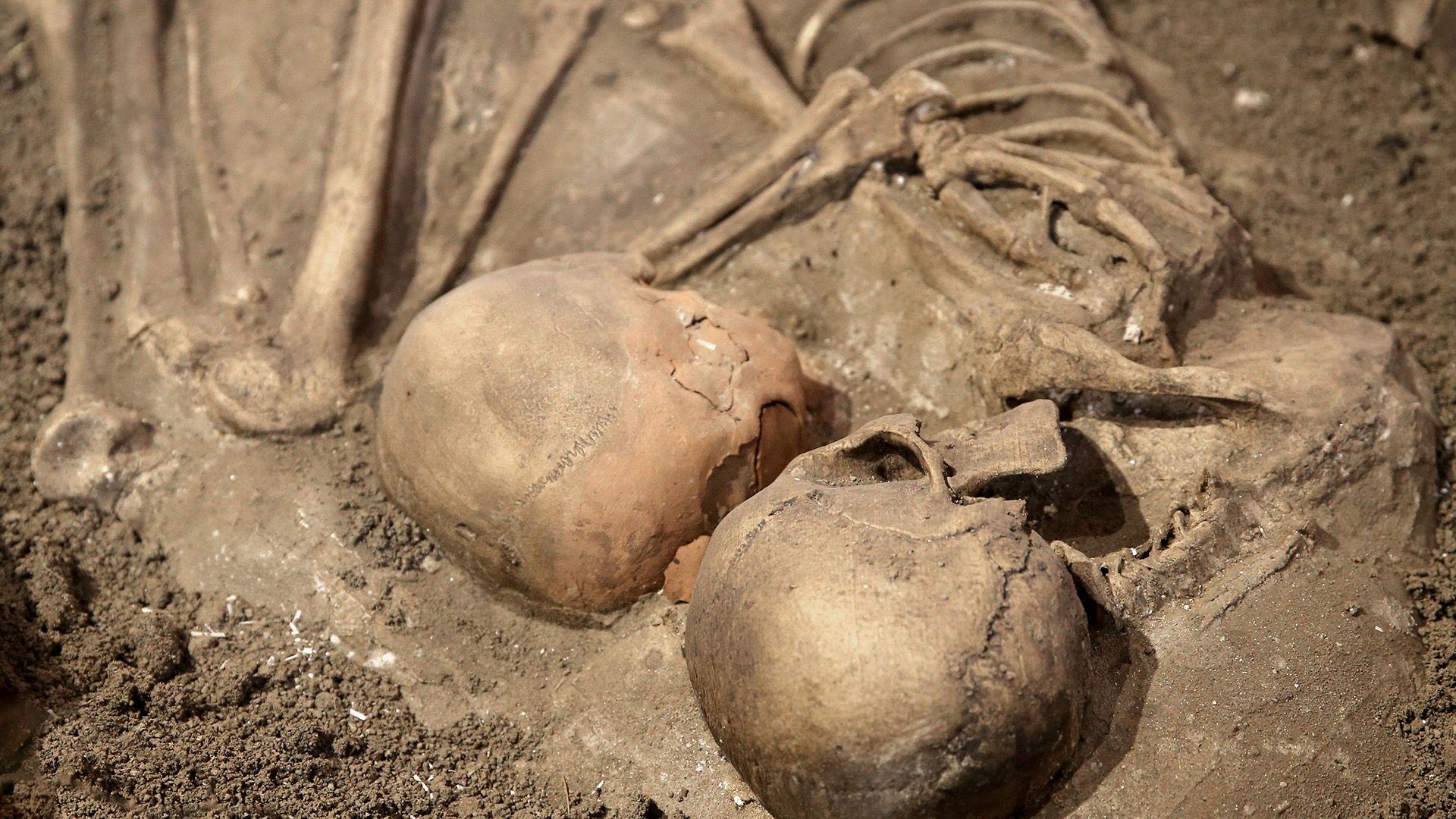
The new research takes us even further from the simple picture. Almost a decade ago, our research group at the University of Huddersfield began a collaboration with palaeoecologist Professor John Stewart from Bournemouth University and archaeologists at the Université de Liège, Belgium. We analyzed the genomes of Neolithic human remains excavated along the River Meuse in Belgium, dating to around 5,000 years ago.
This work became part of a larger project, led by Professor David Reich and Dr Iñigo Olalde at Harvard University, involving geneticists and archaeologists from across western Europe. This widened the focus to further sites around the Lower Rhine–Meuse area — wetlands and coastal areas as well as rivers — spanning the late hunter-gatherer cultures to the Bronze Age.
The fertile soils south of the Rhine-Meuse wetlands had attracted pioneer Neolithic farmer-colonists as early as 5,500 B.C. However, the rich resources of the northern wetlands were more suited to the lifestyle practiced by hunter-gatherers. Even so, the results, generated by our research student, Alessandro Fichera, in collaboration with Harvard, came as a big surprise.
The genomes of people from later Neolithic times in Belgium carried at least 50% local hunter-gatherer ancestry, alongside the expected Anatolian farmer ancestry. Discussing these results with our collaborators led to a “eureka” moment: the same pattern appeared at other sites situated in similarly water-rich environments across the region.
Notably, many of the earlier Neolithic Dutch samples from further north — such as the Swifterbant culture, well-known for maintaining a hunter-gatherer economy alongside some adoption of agriculture — carried close to 100% hunter-gatherer ancestry.
Women’s role in the spread of farming
We then compared the Y-chromosome and mitochondrial DNA, which track the male and female lines of descent, respectively. The Y chromosomes in the Belgian remains were all characteristic of hunter-gatherers, but three-quarters of the mitochondrial DNA lineages had come from Neolithic farmers living further south. The implication was clear: farming know-how had been imported into the “waterworld” hunter-gatherer communities by women.
Our findings support a version of the “frontier mobility” or “availability” model for the spread of the Neolithic, proposed by archaeologists Marek Zvelebil and Peter Rowley-Conwy in the 1980s. They envisioned a contact zone between pioneer farming groups arriving by “leapfrog colonization” and hunter-gatherer areas.

In the model, the “availability” phase entailed contact and small-scale movements across the frontier, with trading relationships and marriage alliances, for example, forming gradually. This would be followed by a “substitution” phase where farming develops alongside foraging in the hunter-gatherer area, and eventually a “consolidation” phase, when farming predominates.
Our results suggest that the frontier was much more permeable to women than it was to men, and that it may have been marriage of Neolithic women into the forager communities that eventually helped the hunter-gatherers to adopt farming full time. After all, because of the predominance of farming across Europe, the likely alternative long-term was extinction.
Perhaps this kind of model might also apply to other parts of Europe where we lack evidence for how the increased hunter-gatherer ancestry in the later Neolithic came about. In any case, the fact that, here, the “more advanced” farming women married into hunter-gatherer groups, contrary to many archaeologists’ expectations that hunter-gatherer women would “marry up”, suggests that perceptions need to change.
Beakers, Bronze Age and Britain
Around 4,600 years ago, though, people were on the move again. A new wave of settlers — pastoralist-farmers hailing ultimately from the Russian steppe — began to infiltrate the Rhine area in the form of the Corded Ware culture. As growing numbers moved in from the east, they were transformed — we still don’t understand exactly how — into what is known as the Bell Beaker culture.
Within a few centuries, the genetic landscape of the Rhine-Meuse region, including the wetlands, was completely reshaped. Our colleagues found that, 4,400 years ago, less than 20% of the ancestry of the people living there traced back to the earlier farmers and hunter-gatherers. At least 80% of their ancestry was now from the steppe.
The Bell Beaker people rapidly expanded and rippled out further in all directions, creating the Bronze Age of Central Europe. And not only Central Europe — they also spread across the English Channel and throughout Britain, extending as far north as Orkney.
It looks as if the British farmers who had been building Stonehenge over the preceding centuries all but disappeared — again, for reasons which remain unclear.
But did they actually vanish? Perhaps this rather blunt picture might become more nuanced too, as we learn more fine-grained details of what happened from archaeology and ancient DNA.
This edited article is republished from The Conversation under a Creative Commons license. Read the original article.