

Close Menu
  • Home
  • United States
  • World
  • Politics
  • Business
  • Lifestyle
  • Entertainment
  • Health
  • Science
  • Tech
  • Sports
  • More
    • Web Stories
    • Editor’s Picks
    • Press Release

Subscribe to Updates

Get the latest USA news and updates directly to your inbox.

What's On
DAN GAINOR: With Iran in the crosshairs, press return to their favorite Trump smear

DAN GAINOR: With Iran in the crosshairs, press return to their favorite Trump smear

March 7, 2026
Mikayla Nogueira Goes on Date Less Than 1 Month After Announcing Divorce From Cody Hawken

Mikayla Nogueira Goes on Date Less Than 1 Month After Announcing Divorce From Cody Hawken

March 7, 2026
How to watch South Korea vs. Japan in the World Baseball Classic for free: Start time, livestream

How to watch South Korea vs. Japan in the World Baseball Classic for free: Start time, livestream

March 7, 2026
Facebook X (Twitter) Instagram
Trending
  • DAN GAINOR: With Iran in the crosshairs, press return to their favorite Trump smear
  • Mikayla Nogueira Goes on Date Less Than 1 Month After Announcing Divorce From Cody Hawken
  • How to watch South Korea vs. Japan in the World Baseball Classic for free: Start time, livestream
  • Trump warns Iran will be ‘hit very hard’ on Saturday, says regime ‘apologized’ to Middle East neighbors
  • Pelosi defends contrasting stances on Trump Iran strikes vs Obama Libya
  • Dry, Frizzy Hair? Professional Hairstylists Love This Glossy Top Coat That Makes Hair ‘Smooth Like Glass’
  • Ruben Prey gives St. John’s big lift off bench in win
  • Why is mercury a liquid?
  • Privacy
  • Terms
  • Advertise
  • Contact Us
Join Us
USA TimesUSA Times
Newsletter Login
  • Home
  • United States
  • World
  • Politics
  • Business
  • Lifestyle
  • Entertainment
  • Health
  • Science
  • Tech
  • Sports
  • More
    • Web Stories
    • Editor’s Picks
    • Press Release
USA TimesUSA Times
Home » Why is mercury a liquid?
Why is mercury a liquid?
Science

Why is mercury a liquid?

News RoomBy News RoomMarch 7, 20260 ViewsNo Comments

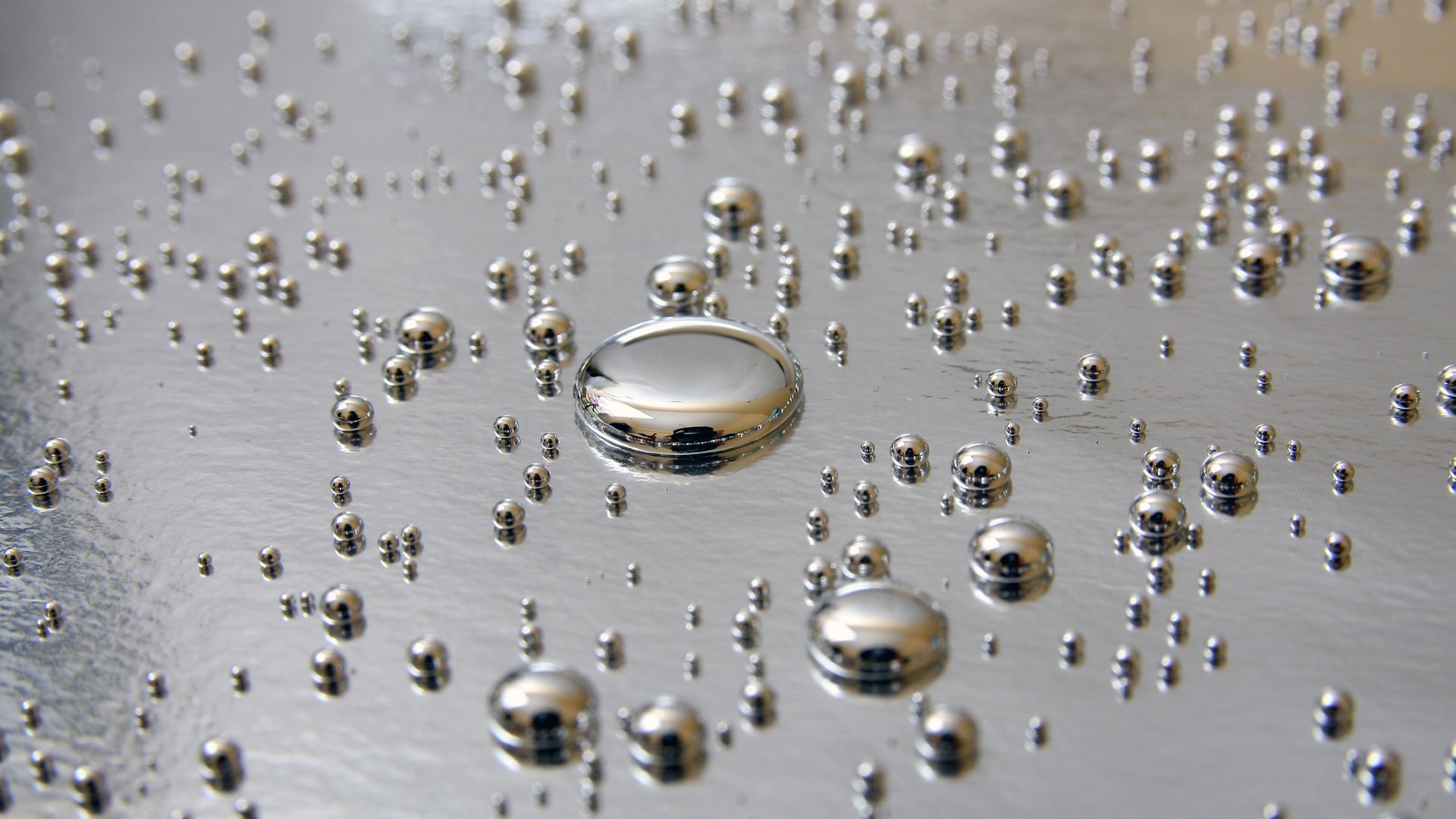
​​We tend to think of metals as hard, strong and resistant to high temperatures — just look at iron, aluminum and steel. While this is generally true, there’s one key exception: mercury. With a melting point of minus 37.9 degrees Fahrenheit (minus 38.8 degrees Celsius), mercury is one of only two elements that are liquid at room temperature. (The other is bromine, which is not a metal.)

But why is mercury so different from its fellow metals?

The answer comes down to mercury’s position in the periodic table and its knock-on effect on how the metal bonds together.


You may like

Sign up for our newsletter

(Image credit: Marilyn Perkins / Future)

Sign up for our weekly Life’s Little Mysteries newsletter to get the latest mysteries before they appear online.

Melting point is directly correlated with bond strength — “the stronger the bonds, the more energy, in the form of heat, is required to break them,” Zoe Ashbridge, a senior lecturer in chemistry for the U.K. Ministry of Defence, told Live Science.

Atoms of mercury, like atoms of all other metals, bind together through metallic bonding — a lattice of positively charged metal particles known as ions, is surrounded by a sea of delocalized (freed) electrons, and electrostatic attraction between these oppositely charged particles acts as the glue that holds the metal together. This structure explains many of the other signature properties of metals, such as electrical conductivity, as the electrons can move freely through the material, and mouldability, as the layers of positive particles can slide over one another to adopt a new shape, lubricated by the free electrons. But it is specifically the strength of the electrostatic attraction that governs the melting point.

The availability of outer electrons to create this delocalized sea is therefore a key factor. “The more positive the metal center is and the more delocalized valence electrons on the outside, the greater the attraction is, and generally this tracks from left to right in the periodic table,” Ashbridge explained.

As a group 12 metal, mercury theoretically has 12 outer electrons it could contribute to metallic bonding. “However, all of those electrons are in “filled subshells,” she added. “When they are full, that makes them more stable and less likely to delocalize, and this makes mercury particularly reluctant to share its electrons, even with other mercury atoms.”

Yet this filled-subshell effect isn’t big enough to explain mercury’s unusually low melting point. The strength of metallic bonding — and, therefore, the melting point — also decreases from the top to the bottom of the periodic table, as the atoms get larger. But extrapolating from these established trends, mercury should still have a melting point of around 266 F (130 C), which would make it solid at room temperature.

A close up of a chart of the periodic table of elements, with most of the elements blurred out except the column including silver and gold, which have the symbols Ag and Au respectfully.

Gold and mercury’s position at the bottom of Groups 11 and 12 on the periodic table gives rise to some bizarre physical properties, thanks to mysterious quantum relativistic effects. (Image credit: Connect Images via Getty Images)

So what causes this giant disparity?

Mercury’s liquid state results almost entirely from relativistic effects, said Peter Schwerdtfeger, a quantum physicist at Massey University in New Zealand. Toward the bottom of the periodic table, the electrons in the heaviest elements experience such strong attraction to the atomic nucleus that they move close to the speed of light. At this point, they no longer obey the laws of classical physics, and the resulting quantum phenomena — known as relativistic effects — lead to surprising physical properties. How these manifest depends on the element.


What to read next

“Relativistic effects become extremely important for the group 11 and group 12 elements, where gold and mercury are,” he told Live Science. Consequently, the weird physical properties arising from these quantum effects are most observable in these elements. Gold has an extremely unusual yellowish hue and mercury is a liquid at room temperature.

“They show us a so-called maximum of relativistic effects, and the outer shell of these atoms contract as a result. It’s enormous. For mercury, it’s about 20%,” Schwerdtfeger said. In chemistry terms, this relativity-induced contraction is most easily explained by once again considering mercury’s electron configuration.

The full 4f subshell, which contains the electrons associated with the rare earth, or lanthanide elements, is extremely poor at shielding the other electrons from the nuclear charge. This means the outermost electrons are held much closer to the nucleus than usual — a phenomenon called lanthanide contraction. These contracted electrons move close to the speed of light and therefore experience relativistic effects.

“This increases their mass, and when they have an increased mass due to this high speed, it pulls those electrons even closer to the nucleus,” Ashbridge said. Consequently, the relativistic effects reduce the availability of the electrons to contribute to metallic bonding, thus lowering the melting point of the metal below room temperature.

At a quantum mechanical level, though, this qualitative explanation is extremely challenging to back up with calculations.

“The Schrödinger equation” — which usually describes the possible positions of particles such as electrons — “doesn’t fulfill the relativity principle of Albert Einstein,” Schwerdtfeger explained. As a result, this equation doesn’t work for high-speed particles such as the electrons in mercury. Scientists must instead turn to the significantly more complicated Dirac equation, making any simulations extremely computationally demanding.

Eventually, though, advances in computing enabled Schwerdtfeger to devise a model that could accurately simulate mercury melting and provide a quantum theoretical explanation for the anomalous melting point.

“Using what we call density functional theory, we were able to establish that the melting point is lowered by over 200 degrees Celsius [360 F] by the relativistic effects,” he said. These quantum contributions dominate, so while periodic trends predict a low melting point for mercury, the relativistic effects make the element a liquid at room temperature.



Share. Facebook Twitter LinkedIn Telegram WhatsApp Email

Keep Reading

‘Striking’ footage captures the moment a red fox preys on a wolf pup — a behavior never seen on film before

‘Striking’ footage captures the moment a red fox preys on a wolf pup — a behavior never seen on film before

Scientists find 2 marsupial species, thought to have gone extinct 6,000 years ago, living in the forests of New Guinea

Scientists find 2 marsupial species, thought to have gone extinct 6,000 years ago, living in the forests of New Guinea

Planting trees in the sea could act as a huge carbon sink and save millions of dollars in storm damage every year. What is stopping us from doing it?

Planting trees in the sea could act as a huge carbon sink and save millions of dollars in storm damage every year. What is stopping us from doing it?

‘Cikai Korran came here and saw’: Visitors from India graffitied dozens of Egyptian tombs 2,000 years ago

‘Cikai Korran came here and saw’: Visitors from India graffitied dozens of Egyptian tombs 2,000 years ago

People around the world deformed their babies’ heads — and scientists think they know why

People around the world deformed their babies’ heads — and scientists think they know why

The Renpho MorphoScan Nova smart scale has dropped to its lowest-ever price

The Renpho MorphoScan Nova smart scale has dropped to its lowest-ever price

First sodium-ion battery car in general production holds the potential to revolutionize EVs forever

First sodium-ion battery car in general production holds the potential to revolutionize EVs forever

Could gut microbes hold the secret to aging well? A researcher unpacks the emerging science

Could gut microbes hold the secret to aging well? A researcher unpacks the emerging science

Find out what you need to begin yoga — these are our must-haves

Find out what you need to begin yoga — these are our must-haves

Add A Comment
Leave A Reply Cancel Reply

Editors Picks

Mikayla Nogueira Goes on Date Less Than 1 Month After Announcing Divorce From Cody Hawken

Mikayla Nogueira Goes on Date Less Than 1 Month After Announcing Divorce From Cody Hawken

March 7, 2026
How to watch South Korea vs. Japan in the World Baseball Classic for free: Start time, livestream

How to watch South Korea vs. Japan in the World Baseball Classic for free: Start time, livestream

March 7, 2026
Trump warns Iran will be ‘hit very hard’ on Saturday, says regime ‘apologized’ to Middle East neighbors

Trump warns Iran will be ‘hit very hard’ on Saturday, says regime ‘apologized’ to Middle East neighbors

March 7, 2026
Pelosi defends contrasting stances on Trump Iran strikes vs Obama Libya

Pelosi defends contrasting stances on Trump Iran strikes vs Obama Libya

March 7, 2026

Subscribe to News

Get the latest USA news and updates directly to your inbox.

Latest News
Dry, Frizzy Hair? Professional Hairstylists Love This Glossy Top Coat That Makes Hair ‘Smooth Like Glass’

Dry, Frizzy Hair? Professional Hairstylists Love This Glossy Top Coat That Makes Hair ‘Smooth Like Glass’

March 7, 2026
Ruben Prey gives St. John’s big lift off bench in win

Ruben Prey gives St. John’s big lift off bench in win

March 7, 2026
Why is mercury a liquid?

Why is mercury a liquid?

March 7, 2026
Facebook X (Twitter) Pinterest WhatsApp TikTok Instagram
© 2026 USA Times. All Rights Reserved.
  • Privacy Policy
  • Terms
  • Advertise
  • Contact

Type above and press Enter to search. Press Esc to cancel.