







Most long-distance travelers have felt the discombobulation of changing time zones: being excessively tired during the daytime but struggling to sleep at night.
Jet lag often emerges when people hop several time zones. The majority struggle more when flying east because our body clock is typically just over 24 hours. “It’s a little bit harder to shift earlier,” Helen Burgess, a professor at the University of Michigan’s Sleep and Circadian Research Laboratory, told Live Science.
So what’s going on in our bodies when we have jet lag, and is there a way to prevent it?
What is jetlag?
Jet lag is a mismatch between our internal body clock and our time zone.
The term “jet lag” was coined in a 1966 Los Angeles Times article, in which journalist Horace Sutton described the symptoms experienced by long-haul jet-setters as “not unakin to a hangover.”
“He said, at the time, that jet lag derives from the simple fact that jets travel so fast they leave your body rhythms behind,” Dr. Charles Czeisler, a professor of sleep medicine at Harvard Medical School, told Live Science. Before flights, people traveled overland or via ship so slowly that their circadian clock didn’t get out of alignment.
Jet lag is the body’s normal response to skipping time zones. “If the circadian system is working correctly, you should have a problem with jet lag,” Czeisler said.
But some populations — such as older people, frequent fliers or those with mood or sleep disorders — are more likely to feel symptoms.
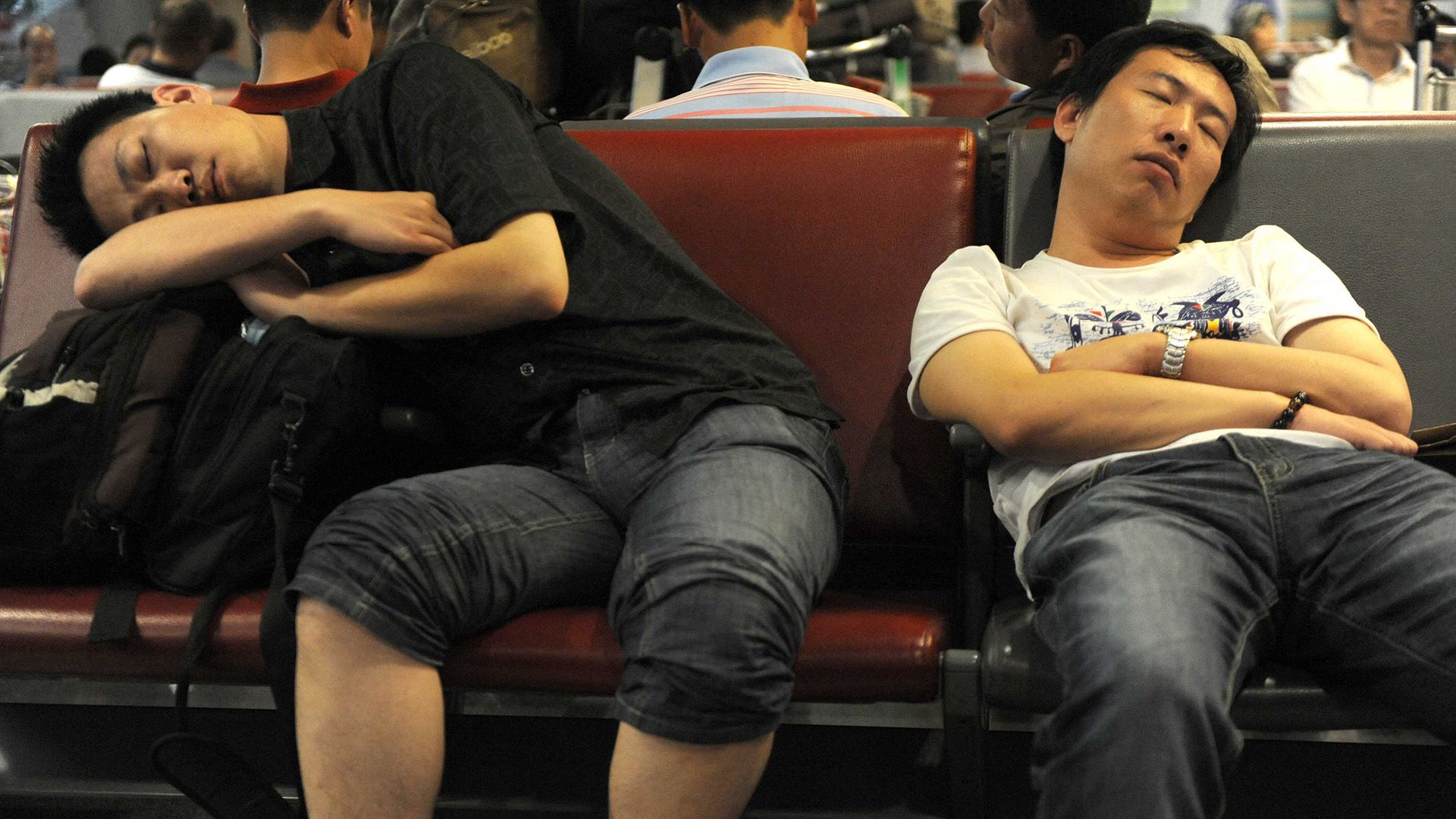
Two holiday-makers sleeping in the passenger lounge at Heathrow airport, London.
(Image credit: Malcolm Clarke / Stringer via Getty Images)
Jet lag might seem trivial, but even a small dose can have serious health implications. When the clocks move forward — essentially causing an hour’s jet lag — there’s an increase in fatal car accidents, Czeisler said. Getting behind the wheel straight after a long-haul flight is dangerous because a lack of sleep is a known cause of car crashes. In fact, road accidents are the leading cause of non-natural death among U.S. citizens traveling abroad.
And shifting circadian rhythms can even “flip people into mania or depression,” Czeisler said. According to one study, 186 people over two years were admitted to a psychiatric hospital from Heathrow Airport with jet-lag-related mental health conditions, such as depression and hypomania (a shorter, milder form of mania), while another study has shown that chronic jet lag could increase the risk of neurological disorders.
Minimizing jet lag
The best way to adjust to your new time zone is through light exposure. “Light is the strongest signal that shifts the timing of the clock,” Burgess said.
But the timing has to be right: exposure to light at the wrong time can push your clock in the wrong direction, making jet lag last longer.
Sign up for our newsletter


(Image credit: Marilyn Perkins / Future)
Sign up for our weekly Life’s Little Mysteries newsletter to get the latest mysteries before they appear online.
Around two or three hours before your usual wake-up time, your body clock switches from interpreting light as evening light, making you sleepy, to morning light — which wakes you up.
“Light before the crossover point will shift you later, and light after the crossover point will shift you earlier,” Burgess said. This is why napping isn’t always the right solution.
If you usually wake up at 6 a.m., your crossover point will be around 3 a.m. This means that if you travel to a time zone six hours ahead and land at 7 a.m., this would be around 1 a.m. for your internal clock, which is still on your original time zone. So, your body interprets all the morning light you take in while landing and going through security as evening light and it wakes you up again, pushing your clock later.
Knowing when to expose yourself to light requires planning. To get light when you need it, go outside, use light boxes, or put on wearable light therapy devices. To avoid light when it will push you in the wrong direction, nap, stay inside, or wear sunglasses or glasses that block blue light within a specific wavelength range (460 to 480 nanometers).
To minimize the effects of jet lag, stay hydrated, avoid alcohol, be mindful of not drinking too much caffeine — “maybe just one cup of coffee” at strategic times, Burgess said, adding that caffeine has a long half life so will stay in your body and make it harder to sleep — and adjust to local mealtimes as soon as possible. Some people may also speak to medical professionals about whether melatonin is suitable for them.
You can prevent jet lag by shifting your body clock to the new time zone before you arrive. “On average, we can only shift the clock earlier by about an hour and a half a day,” Burgess said.
For instance, to adjust to a time zone 10 hours ahead, you would need to start shifting your light exposure timings a week before the flight. For example, if you usually sleep between 11 p.m. and 6 a.m., you’d be aiming to shift toward going to bed at 9 a.m. and waking up at 4 p.m — something not feasible for most people.
It works, Burgess said, but when she tried it, she felt disconnected from the world around her because everyone was asleep during her waking hours. “I just felt really, really isolated,” she said.
Although it’s impractical for most people, you wouldn’t experience the symptoms of jetlag because of how gradually you’d be moving your sleep schedule toward the new time zone. “People do not experience jetlag symptoms because everything is being moved slowly together,” Burgess said, not “yanked apart” in one flight.
If you don’t want to become nocturnal before you leave, nudge yourself in the right direction by shifting your schedule earlier by around an hour each day for just a few days. In essence, if fully switching to the new time zone before you depart is too challenging, nudging closer to it before arrival will still be beneficial. “It can make a huge difference,” especially for those flying east, Burgess said. “Take the five or 10 minutes to plan it out, and that’s going to really help.”
This article is for informational purposes only and is not meant to offer medical advice.
TOPICS