





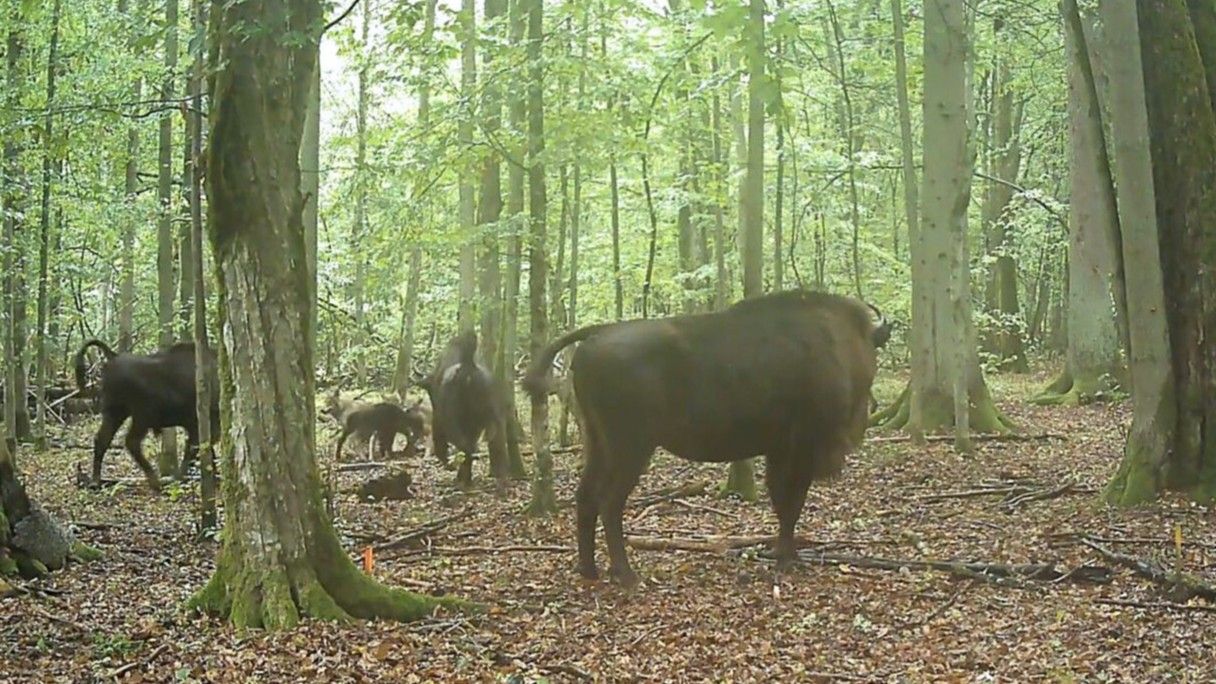


A camera trap in an ancient Polish forest has captured extremely rare and unexpected footage of wolves attacking a bison herd made up of adults, youngsters and a newborn calf, a new study shows.
The event took place on Sept. 15, 2025. Five wolves (Canis lupus) enter the camera frame, closely followed by three bison cows and the newborn calf. In the footage, the cows chase after the wolves, leaving the calf alone and exposed. The wolves then surround the calf, bite its neck and try to drag it away, but two cows come to its rescue. The wolves return and seize the calf a second time in the background of the video — however, this time the entire bison herd comes to its defense to end the attack.
The clip is from the Bialowieza Primeval Forest, the oldest and best-preserved temperate lowland forest in Europe, which hosts the world’s biggest population of European bison (Bison bonasus). The forest covers 350,600 acres (141,900 hectares) on the border between Poland and Belarus. There are more than 870 bison on the Polish side, according to the new study, while the Belarussian side has roughly 730 bison.
Also known as “the king of the forest,” the European bison is typically considered a non-prey species, meaning it has no predators except humans. But the footage calls this into question.
These still images from the video show (a) the wolves grabbing the newborn calf for the first time; (b) the wolves seizing the newborn calf for the second time; and (c) the bison herd forming a protective circle around the newborn calf after both attacks.
“To our knowledge, we present the first video-recorded evidence of wolves attacking a European bison herd in the Białowieża Primaeval Forest,” researchers wrote in the study, published May 29 in the journal Ecology and Evolution. “Although the video did not capture a direct kill, it suggests that other attacks on European bison could potentially be successful.”
Historical documents show that wolf attacks on European bison used to be more common, with about 8 kills recorded annually in the Bialowieza Primeval Forest between 1840 and 1849. The forest was a popular hunting ground for monarchs from the 14th century onward, explaining why such detailed records exist.
European bison went extinct in the wild in 1919, but they were reintroduced in the Bialowieza Primeval Forest in 1952. The first confirmed bison kill since then dates to the mid 1990s, and after that, it seems as though wolves stuck to a diet of roe deer (Capreolus capreolus), red deer (Cervus elaphus) and wild boar (Sus scrofa), likely because these are much easier prey than bison, the researchers wrote in the study.
Get the world’s most fascinating discoveries delivered straight to your inbox.
But now, “our observation demonstrated that the European bison is in fact a potential prey for wolves,” they wrote. “This raises questions about why predation attempts are so rare, whether the bison can still be described as a non-prey species, and what this could mean for conservation and management of the species.”
An intriguing trend in the Bialowieza Primeval Forest is that wolf packs are growing in size, possibly thanks to a late 1980s hunting ban. This shift could increase wolf predation on bison in the future, because bigger packs can handle bigger prey.
“If predation on European bison, specifically young animals, occurs more frequently than previously assumed, wolves could play a small but potentially important role in the natural regulation of bison numbers,” the researchers wrote in the study. “In turn, such regulation could possibly lead to mitigation of human-bison conflicts.”
Wijnands, R. R., & Borowik, T. (2026). The King in the Crosshairs: Evidence of a predation attempt on European bison by Wolves. Ecology and Evolution, 16(6), e73752. https://doi.org/10.1002/ece3.73752