

Close Menu
  • Home
  • United States
  • World
  • Politics
  • Business
  • Lifestyle
  • Entertainment
  • Health
  • Science
  • Tech
  • Sports
  • More
    • Web Stories
    • Editor’s Picks
    • Press Release

Subscribe to Updates

Get the latest USA news and updates directly to your inbox.

What's On
US lost 92,000 jobs in February in surprisingly weak report

US lost 92,000 jobs in February in surprisingly weak report

March 6, 2026
Trump vows no peace with Iran before ‘unconditional surrender’

Trump vows no peace with Iran before ‘unconditional surrender’

March 6, 2026
JD Vance says he should have worded Catholic bishops criticism ‘more carefully’

JD Vance says he should have worded Catholic bishops criticism ‘more carefully’

March 6, 2026
Facebook X (Twitter) Instagram
Trending
  • US lost 92,000 jobs in February in surprisingly weak report
  • Trump vows no peace with Iran before ‘unconditional surrender’
  • JD Vance says he should have worded Catholic bishops criticism ‘more carefully’
  • Britney Spears’ 1st Husband Jason Alexander Defends Her After She Was Arrested for DUI
  • Lakers star LeBron James talks emotions of looming retirement and importance of legacy
  • Could gut microbes hold the secret to aging well? A researcher unpacks the emerging science
  • Hochul slaps down being labeled Mamdani’s ‘fall man’ in tax-the-rich scheme: ‘I am not frustrated’
  • High-risk parolee accused in Denver area killing spree across several counties
  • Privacy
  • Terms
  • Advertise
  • Contact Us
Join Us
USA TimesUSA Times
Newsletter Login
  • Home
  • United States
  • World
  • Politics
  • Business
  • Lifestyle
  • Entertainment
  • Health
  • Science
  • Tech
  • Sports
  • More
    • Web Stories
    • Editor’s Picks
    • Press Release
USA TimesUSA Times
Home » Time moves faster on Mars — proving Einstein right and posing new challenges for crewed missions
Time moves faster on Mars — proving Einstein right and posing new challenges for crewed missions
Science

Time moves faster on Mars — proving Einstein right and posing new challenges for crewed missions

News RoomBy News RoomDecember 11, 20252 ViewsNo Comments

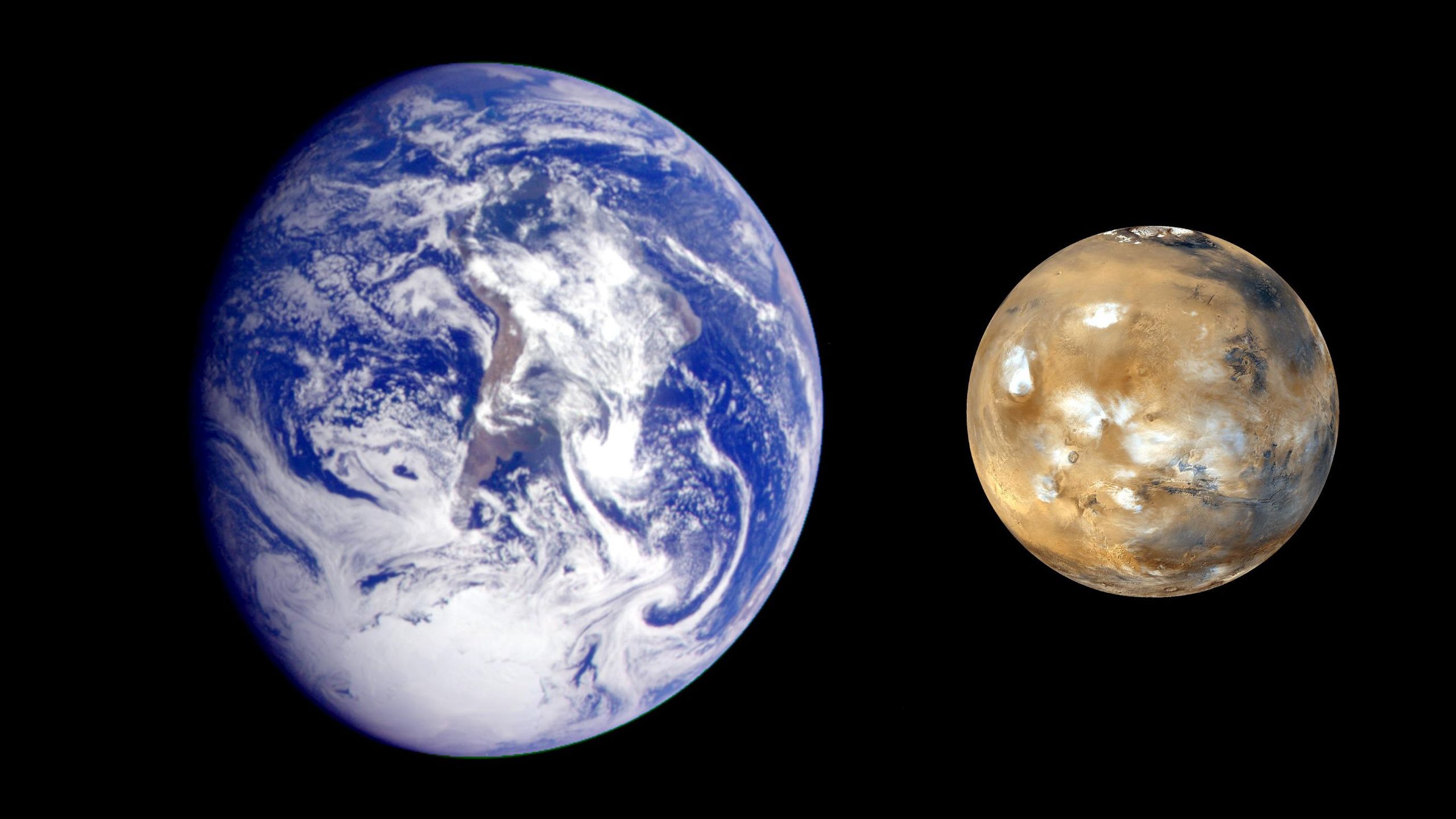
Scientists have found that time moves slightly faster on the Red Planet than it does on Earth. Clocks on Mars tick, on average, 0.477 milliseconds (477 microseconds) faster over 24 hours when measured from Earth compared with time recorded on our planet, a new study finds. Knowing this difference may help in establishing an “internet” across the solar system.

Over the next few decades, humanity’s presence in the solar system is set to boom, with missions like those in NASA’s Artemis program expected to pave the way for permanent settlements on the moon and beyond. Developing a standard clock for each cosmic locale would help astronauts navigate these worlds while coordinating communications with Earth.

But there’s a catch: Time doesn’t run at the same pace everywhere. Albert Einstein’s theory of general relativity shows that time in a given area depends on how strong the gravity is there. Clocks in areas of high gravity tick more slowly than those where gravity is weaker, which is why people residing atop mountains age a fraction of a millisecond faster than sea-level dwellers. (Time appears to move faster at high altitudes, where Earth’s gravitational tug is reduced.)


You may like

Additionally, time on a planet depends on its velocity around its parent star; the faster the orbital rate, the faster the passage of time.

Time keeps on slippin’

Together, velocity and gravity cause time on different solar system bodies to tick at different rates when measured from Earth. A 2024 study calculated that clocks on the moon would run an average of 56 microseconds (millionths of a second) faster than Earth-based ones. Having established this, the researchers — Neil Ashby and Bijunath Patla, both physicists at the National Institute of Standards and Technology in Boulder, Colorado — turned their attention to Mars.

First, they chose a reference level on Mars — an equivalent to Earth’s sea level called the areoid. Then, they used physics-based formulas to calculate how, at the areoid, Mars’ and Earth’s gravities and velocities would influence Martian time. Although Mars’ slower orbital speed relative to Earth slows down Mars-based clocks, the planet’s weaker surface gravity — five times lesser at the areoid than Earth’s sea-level gravity — speeds them up much more.

A gravity map of Mars taken by NASA’s Mars Global Surveyor (MGS). For the new study, researchers had to find a region of Mars akin to Earth’s sea level, then compare the gravity and velocity of the region with Earth. (Image credit: NASA/JPL)

But this analysis neglected the orbits’ shapes. Mars’ orbit is more egg-shaped than Earth’s, having been contorted by the gravitational tugs of Earth and its moon. (Mars’ moons, Deimos and Phobos, have a negligible impact, Patla told Live Science in an email, because of their puny size. They’re just a few miles wide, compared with 2,159 miles, or 3,475 kilometers, for Earth’s moon.) So, Ashby and Patla factored Mars’ orbital shape, the sun’s gravity and Earth moon’s gravity into their equations.

Get the world’s most fascinating discoveries delivered straight to your inbox.

Setting clocks on Mars

The analysis showed that Martian clocks tick faster, when measured from Earth, than Earth-based ones by an average of 477 microseconds per Earth day. Strikingly, though, this value varies daily by 226 microseconds (about half the offset’s value itself) over a Martian year. The variation stems from the egg-like shape of Mars’ orbit and changes in the gravitational tugs of its celestial neighbors as they approach and twirl away from Mars.

Additionally, the researchers found that the clocks change by an extra 40 microseconds over seven of Mars’ synodic periods, with a synodic period being how long the planet takes to reappear in the same position of the sky.

“The fluctuation and the Earth-Mars planetary dance (synodic period) variation was a surprise,” Patla said, because their magnitudes were larger than he expected.

The findings, published Dec. 1 in The Astronomical Journal, will help scientists synchronize time across the solar system, allowing them to establish rapid communications channels in an interplanetary internet in the distant future, although the large fluctuations will complicate this effort, Patla said. He added that the study “provides a baseline for future tests of general relativity and fundamental physics, which explore the nature of spacetime.”

But the calculations were still inaccurate by about 100 nanoseconds (0.1 microseconds) per day over long timescales, because tiny shifts in the planets’ movements weren’t factored in. Although this imprecision is minuscule, it would mean resetting Martian clocks every 100 days.

The study also didn’t account for factors like how the planets’ orbits precess, or gradually wobble, and the effects of Earth’s and Mars’ gravitational quadrupole moments, which is a measure of how their mass is arranged within their structures. Taken together, these limitations may make it more challenging to obtain more precise time calculations, the researchers said.


Share. Facebook Twitter LinkedIn Telegram WhatsApp Email

Keep Reading

Could gut microbes hold the secret to aging well? A researcher unpacks the emerging science

Could gut microbes hold the secret to aging well? A researcher unpacks the emerging science

Find out what you need to begin yoga — these are our must-haves

Find out what you need to begin yoga — these are our must-haves

James Webb Telescope updates odds that ‘city killer’ asteroid 2024 YR4 will hit the moon

James Webb Telescope updates odds that ‘city killer’ asteroid 2024 YR4 will hit the moon

Groundbreaking new drug shows promise for treating children with a devastating form of epilepsy

Groundbreaking new drug shows promise for treating children with a devastating form of epilepsy

Can you tie a knot in four dimensions? A mathematician explains.

Can you tie a knot in four dimensions? A mathematician explains.

Microscopic swimming robots navigate ‘artificial space-time’ mazes using Einstein’s relativity

Microscopic swimming robots navigate ‘artificial space-time’ mazes using Einstein’s relativity

The sword in the sea: How one lucky graduate student found his second Crusader sword while taking a swim off Israel’s coast

The sword in the sea: How one lucky graduate student found his second Crusader sword while taking a swim off Israel’s coast

Na-ion vs Li-ion batteries: What are the benefits of sodium-ion batteries for EVs?

Na-ion vs Li-ion batteries: What are the benefits of sodium-ion batteries for EVs?

Chinese EV maker claims it’s engineered the world’s first semi-solid-state EV battery with huge 620-mile range

Chinese EV maker claims it’s engineered the world’s first semi-solid-state EV battery with huge 620-mile range

Add A Comment
Leave A Reply Cancel Reply

Editors Picks

Trump vows no peace with Iran before ‘unconditional surrender’

Trump vows no peace with Iran before ‘unconditional surrender’

March 6, 2026
JD Vance says he should have worded Catholic bishops criticism ‘more carefully’

JD Vance says he should have worded Catholic bishops criticism ‘more carefully’

March 6, 2026
Britney Spears’ 1st Husband Jason Alexander Defends Her After She Was Arrested for DUI

Britney Spears’ 1st Husband Jason Alexander Defends Her After She Was Arrested for DUI

March 6, 2026
Lakers star LeBron James talks emotions of looming retirement and importance of legacy

Lakers star LeBron James talks emotions of looming retirement and importance of legacy

March 6, 2026

Subscribe to News

Get the latest USA news and updates directly to your inbox.

Latest News
Could gut microbes hold the secret to aging well? A researcher unpacks the emerging science

Could gut microbes hold the secret to aging well? A researcher unpacks the emerging science

March 6, 2026
Hochul slaps down being labeled Mamdani’s ‘fall man’ in tax-the-rich scheme: ‘I am not frustrated’

Hochul slaps down being labeled Mamdani’s ‘fall man’ in tax-the-rich scheme: ‘I am not frustrated’

March 6, 2026
High-risk parolee accused in Denver area killing spree across several counties

High-risk parolee accused in Denver area killing spree across several counties

March 6, 2026
Facebook X (Twitter) Pinterest WhatsApp TikTok Instagram
© 2026 USA Times. All Rights Reserved.
  • Privacy Policy
  • Terms
  • Advertise
  • Contact

Type above and press Enter to search. Press Esc to cancel.