






Physicists have coaxed a black hole’s most famous glow out of a strand of optical fiber and, for the first time, watched that light react back on the simulated black hole that produced it.
The result gives researchers a rare, hands-on look at Hawking radiation — the faint thermal emission that Stephen Hawking predicted should leak out of black holes — and offers a first clue about the tiny push that could, in principle, make a real black hole slowly evaporate, the research team said in a new study.
Working with a tabletop experiment in optical fibers, the international team detected both the radiation and its long-sought “back reaction” — the way the radiation feeds energy back and reshapes the object that created it.


According to the new study, published July 1 in the journal Nature, the light behaved exactly as Hawking predicted it should: like the glow of a warm object, with a definite temperature and a spectrum that fades away steadily toward higher frequencies. It did so even in a regime where the usual textbook description of a black hole should break down.

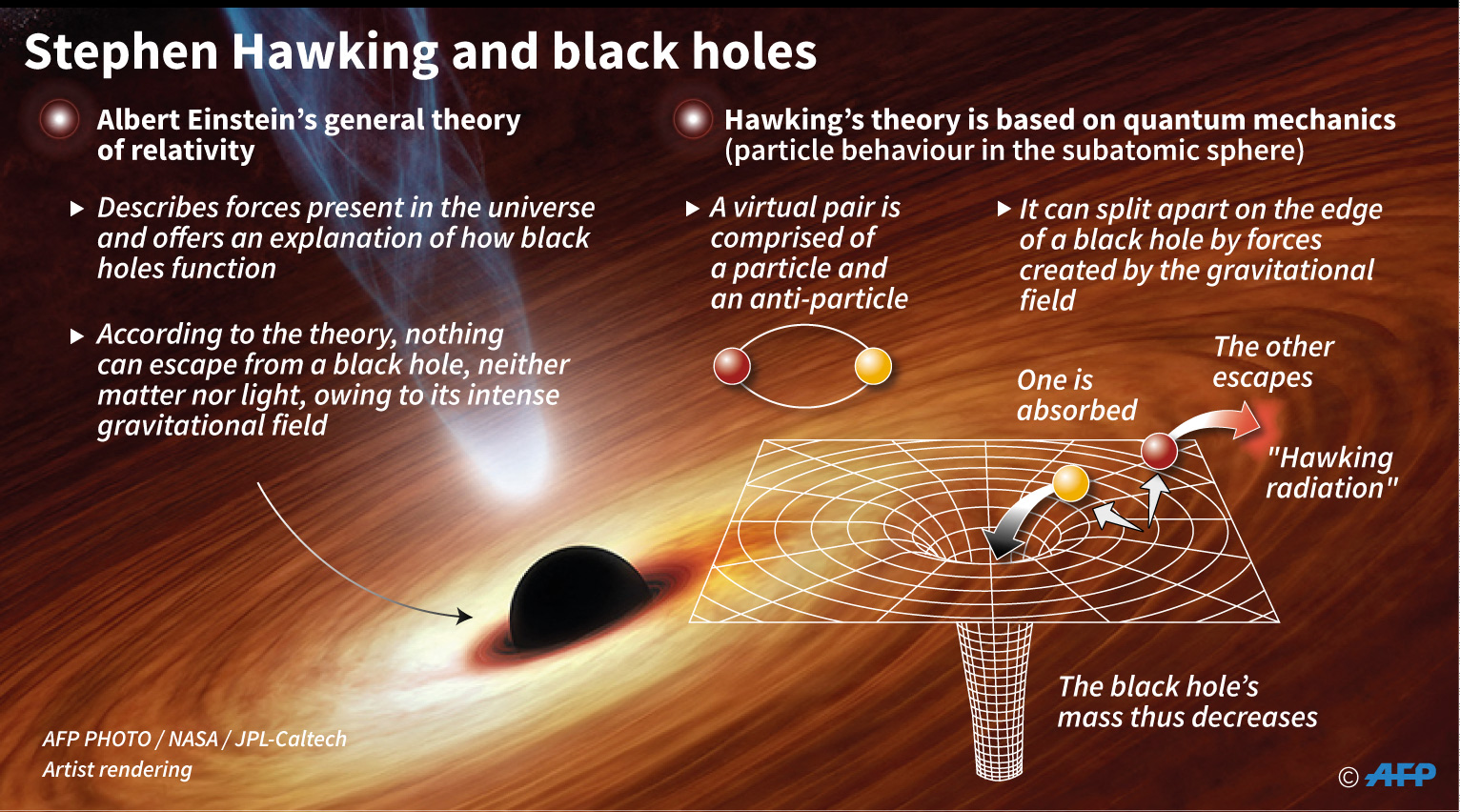
An infographic explaining how Hawking radiation works, contrary to the predictions of general relativity.
(Image credit: ALAIN BOMMENEL,VALENTINA BRESCHI,WILLIAM ICKES via Getty Images)
Where three great theories collide
Hawking radiation is famous because it sits at the crossroads of physics‘ biggest ideas.
“Jacob Bekenstein predicted that black holes have an entropy and a temperature, and Hawking calculated the thermal radiation of the black hole,” study co-author Ulf Leonhardt, a physicist at the Weizmann Institute of Science in Israel, told Live Science via email. “In Hawking-Bekenstein radiation, quantum physics, general relativity and thermodynamics come together — subjects that are normally in conflict with each other.”
The conflict runs deep: General relativity pictures space and time as smooth and continuous, while quantum mechanics describes a world of discrete, unpredictable jumps — and no one has managed to fully reconcile the two.
Get the world’s most fascinating discoveries delivered straight to your inbox.
That combination is exactly what makes Hawking radiation so hard to study. Astronomers have never seen Hawking radiation from a real black hole and probably never will; the glow is far too faint to pick out across the cosmos. So physicists have turned to laboratory stand-ins that obey the same equations, building black hole analogues out of flowing water, ultracold atoms and, as in this study, light.

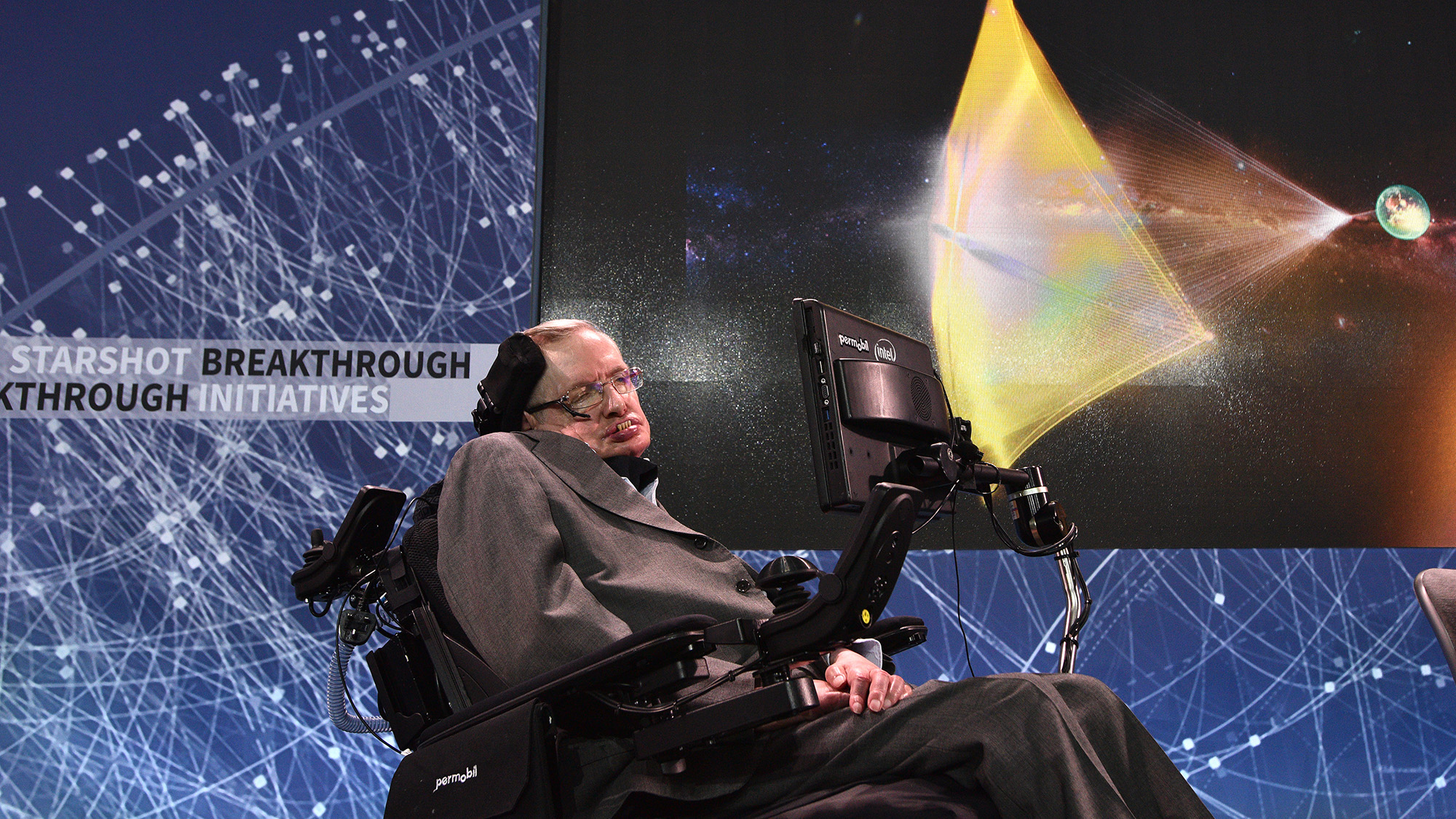
Physicist Stephen Hawking that black holes should be able to lose information through an elusive type of radiation. New research zooms in on the mechanism that makes it possible.
(Image credit: Bryan Bedder / Stringer via Getty Images)
Building a black hole from light
The trick behind every black hole analogue is a moving medium. “Imagine a swimmer in the sea with a current faster than he can swim,” Leonhardt explained. “He is swept away. This is what happens beyond the [event] horizon, and this is why normally nothing can escape the black hole.”
A black hole’s event horizon is the boundary where that current — space itself, in real life — starts moving faster than anything can travel. To recreate it, the team needed a material that appears to rush along at the speed of light. Their solution was elegant: use light to make the “material.”
“In optics we need a material that appears to move at the speed of light,” Leonhardt said. “For this we use light itself — in nonlinear optics, light acts like a material.”
In practice, the researchers fired an intense, ultrashort “pump” pulse into a thin photonic-crystal fiber — a strand of glass threaded with a pattern of tiny air channels running along its length, which lets researchers fine-tune how light moves through it. As it traveled, the pulse slightly changed how the glass bent light, creating a moving speed bump that raced along with it. A second, much weaker “probe” pulse then ran into this moving front. Where the probe could no longer keep up, an artificial horizon formed — and the black hole analogue was born.
Catching the glow and its pushback
The payoff came in the ultraviolet. According to theory, Hawking radiation is created in pairs: One partner escapes, while the other, carrying “negative” energy, is the mirror image that would fall into a real black hole. In the fiber, that partner showed up as ultraviolet light.
“We counted photons in the ultraviolet that correspond to the Hawking partners beyond the horizon,” Leonhardt explained. “They have a wavelength around 233 nanometers. This was our signal.”
Just as important as seeing the glow was understanding how it was made. For years, researchers assumed the fiber built up its Hawking radiation through a cascade — a chain of separate steps in which the light is converted first into one intermediate form, and then another, each feeding the next before the radiation finally emerges. The team found that, instead, a single, direct interaction does the job, with the pump and probe light producing the Hawking pair in one clean step. It is a much simpler picture that the researchers said may carry over to other analogues and perhaps even to real black holes.
Because energy has to come from somewhere, making Hawking radiation should nudge the source that created it. For a real black hole, that nudge is how it loses mass and, over unimaginable timescales, evaporates entirely — the process Hawking described in his landmark 1974 paper. No experiment had ever captured that recoil.
Here, the team saw it. Producing the radiation shifted a small fraction of the pump pulse’s own light to a slightly different color, leaving a telltale lopsided pattern in the spectrum. That asymmetry, absent in earlier experiments, is the fingerprint of the back reaction, or recoil — the black hole analogue quietly paying the energetic price for its own glow.
The road to a quantum experiment
The result also speaks to one of the thorniest puzzles in black hole physics: the trans-Planckian problem. Trace Hawking’s radiation back to where it was born and the calculation runs into territory no physicist can vouch for — the Planck scale, the vanishingly small size at which space and time are thought to lose their familiar meaning and all known physics gives out. Hawking’s prediction, in other words, appears to rest on a foundation that may not exist.
“Any light getting away from the horizon is stretched out enormously,” Leonhardt said. “So it must come from waves smaller than the tiniest scale in nature, where the physics is unknown. Would that still give Hawking radiation? That was the question, and we have answered it in our experiment.” Remarkably, the glow stayed perfectly thermal even in this extreme regime.
The team’s next step is concrete. So far, they have used ordinary laser light, which reproduces the spectrum of Hawking radiation but not its deepest quantum weirdness. Next, the team plans to “go quantum,” Leonhardt said. “We will explore how to get into the quantum regime and observe quantum features such as entanglement” — the ghostly link that should tie each escaping Hawking particle to its lost partner.
Procopio, L. M., Aguero-Santacruz, R., Bermudez, D., & Leonhardt, U. (2026). Backreaction of stimulated Hawking radiation in an optical analogue. Nature, 655(8122), 336–341. https://doi.org/10.1038/s41586-026-10720-3
See how much you know about black holes with our black hole quiz!