





Whether using family records, DNA tests or genealogy websites, many people can trace their family histories back generations. The world-record holder for the longest family tree is Chinese philosopher Confucius (551 to 479 B.C.), whose family tree extends more than 80 generations from his ancestors in the eighth century B.C. to his living descendants. That’s almost 3,000 years.
But our species has been around for 300,000 years, based on scientific dates of the oldest known fossils. So how many generations do we go back as a species?
To find out, you need to know how long modern humans (Homo sapiens) have existed and the length of a generation, according to Matthew Hahn, a population geneticist at Indiana University Bloomington. The number of human generations that have lived would be equal to the time since H. sapiens emerged as a species divided by the length of a generation, also called the generation interval.
Sign up for our newsletter
(Image credit: Marilyn Perkins / Future)
Sign up for our weekly Life’s Little Mysteries newsletter to get the latest mysteries before they appear online.
The generation interval is typically defined as the average age at which humans have children, Hahn said. It tends to be longer for men than for women because men can have children later in life, Hahn explained.
There are many estimates of our species’ generation interval, each of which produces a different answer to the question of how many human generations have come before us.
For example, a 2003 study of Icelanders published in the American Journal of Human Genetics based generation interval estimates on the country’s extensive records from churches and other sources. Using these records, researchers at the company deCODE Genetics created a genealogical database of the country’s entire population. They found that the average generation interval in Iceland over the past 300 years was 30.3 years.
A 2005 study used data about the average age at which European women had children between 1960 and 2000 and estimated the generation intervals for men to arrive at an average generation interval of 29.1 years.

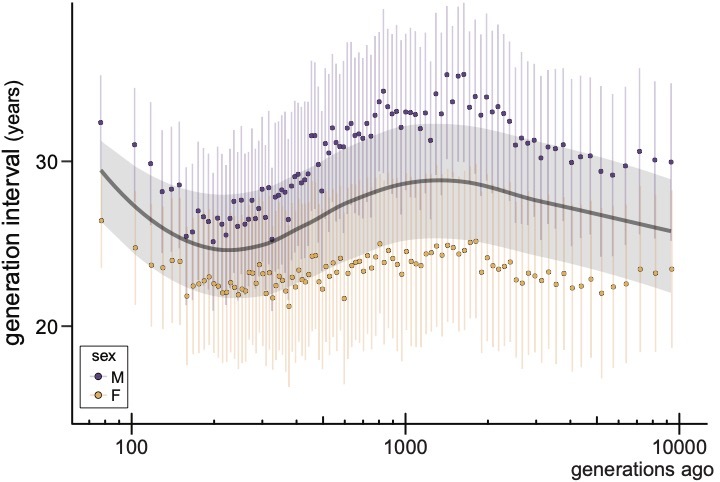
Over the past 250,000 years, the length of a human generation has gone up and down, according to research led by Matthew Hahn. The researchers estimated that our generation time was 26.9 years, on average.
(Image credit: Courtesy of Matthew Hahn and Richard Wang)
But those are estimates of the generation interval in the recent past. A study led by Hahn and published in the journal Science Advances in 2023 estimated the generation interval over the past 250,000 years. Hahn’s study put together data from two others. A 2017 study of Icelanders, also led by deCODE Genetics and published in the journal Nature, found that as parents age, the blend of mutations that arise in their children changes. Using this data, Hahn and colleagues built a model of the mix of new mutations that you would expect to find in a group of people according to the generation interval at the time.
“If you know the types of mutations that individuals leave to their children according to their age, if you have a collection of mutations, you can try to estimate how old the mixture of individuals was,” Hahn said.
A 2020 study in the journal PLOS Biology estimated when millions of mutations found in humans today first arose. Hahn and colleagues grouped the mutations from the 2020 paper according to when they arose and then determined the blend of new mutations that popped up during each time period. With that information, they could estimate the generation interval for each time span. While the generation interval varied over the course of an estimated 250,000 years, it was an estimated 26.9 years, on average. Using that generation interval, there would have been an estimated 11,152 generations of humans over 300,000 years, Hahn said.

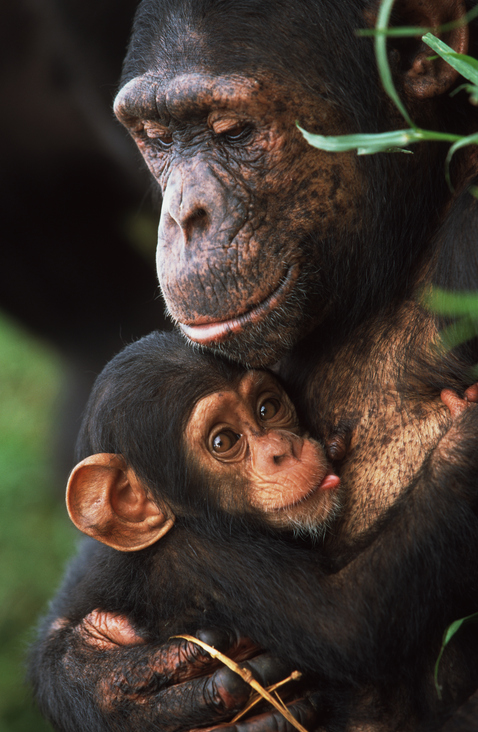
One of our closest living relatives, chimpanzees, has a generation time of about 25 years.
(Image credit: Gallo Images via Getty Images)
Moisès Coll Macià, an evolutionary biologist and population geneticist who works as a postdoctoral researcher at the Institute of Evolutionary Biology in Barcelona, Spain, told Live Science that while a generation interval of 26.9 years is “not unimaginable,” he prefers to give a range of possible generation intervals.
In Coll Macià’s view, the lower bound would be the generation interval for one of our closest living relatives, chimpanzees (Pan troglodytes). Because humans and chimps share a common ancestor that lived during the Miocene epoch (23 million to 5 million years ago), you would expect that past human generations would have had a generation interval somewhere between that of contemporary humans and that of contemporary chimps, Coll Macià said. Chimpanzees have an estimated generation time of about 24.6 years, according to a 2012 paper in the journal PNAS.
As for the upper bound in modern humans, Coll Macià suggested 26 to 30 years. That’s based on a 2016 PNAS study that analyzed fragments of Neanderthal DNA found in ancient and contemporary human genomes to estimate the human generation interval across the past 45,000 years.
Based on Coll Macià’s upper-bound generation interval of about 30 years, there have been at least 10,000 generations of humans. Based on the lower-bound generation interval of 24.6 years, there have been at most 12,195 generations. These numbers attest that the human family tree is pretty tall, however you look at it.
See how much you know about early humans with our human evolution quiz!
TOPICS