







Follow us
Add us as a preferred source on Google
Subscribe to our newsletter
Each year, Earth’s Northern and Southern hemispheres cycle through four seasons, including summer.
Given that the hemispheres are symmetric about the equator, you may think that, on both sides of the world, summers should be similar – both in terms of their climate and factors like their length. But are Northern and Southern hemisphere summers really the same?
Climate experts tell Live Science that they differ quite a bit — and that comes with a clear recommendation for sun enthusiasts.
Latest Videos FromLive Science
The most obvious difference is that Northern and Southern summers happen at different times. According to NASA, this arises because Earth’s axis is tilted 23.4 degrees relative to the plane of our planet’s orbit around the sun.
This tilt causes the Northern and Southern hemispheres to be oriented toward the sun at different times throughout the year. Between the Northern Hemisphere’s summer solstice and autumnal equinox, the Northern Hemisphere is oriented toward the sun, resulting in summer, and vice versa in the Southern Hemisphere.
This means that summers between the Northern and Southern hemispheres sit six months out of sync with each other — with Northern summers spanning late June to late September and Southern ones going from late December to late March. (Summers are also defined meteorologically, or relative to changes in weather phenomena, as being the hottest months of the year. Under this definition, Northern summers run from June to August, and Southern ones go from December to February.)
Watch On
Northern summers are longer
Another difference between Northern and Southern summers is their duration. According to NASA, Northern Hemisphere summers are, on average, 4.5 days longer than Southern Hemisphere summers. (This is with respect to the astronomical definition; meteorologically, Northern summers are longer than Southern ones by two days in non-leap years, but this is due to February being the calendar’s shortest month.)
Feed your curiosity with an exclusive mystery every week, solved with science and delivered direct to your inbox before it’s seen anywhere else.
The 4.5-day difference occurs because Earth’s orbit around the sun is slightly elliptical instead of perfectly circular, according to NASA. Consequently, Earth’s orbital velocity (the speed at which our planet hurtles around the sun) isn’t constant.

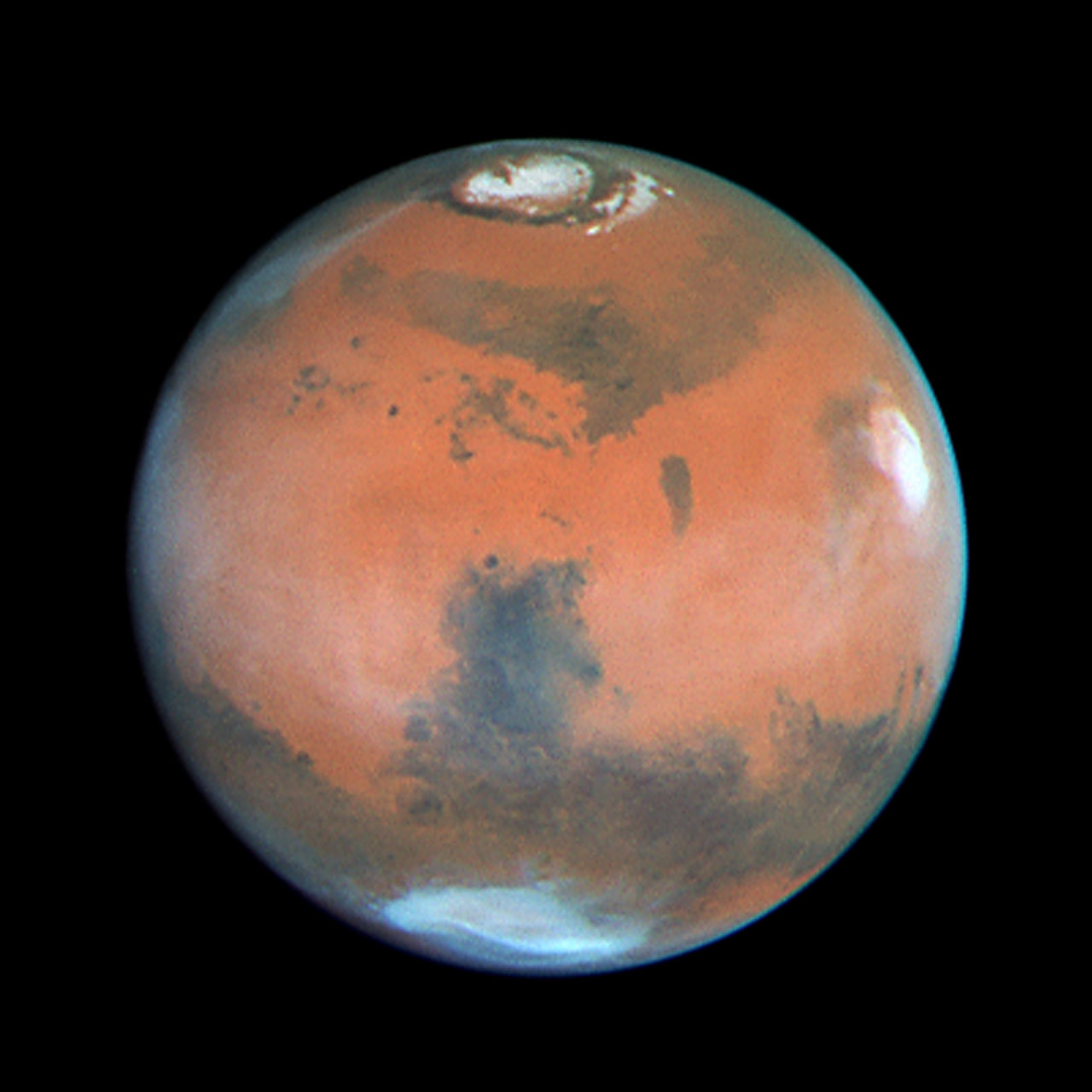
Earth isn’t the only planet that experiences such a dichotomy in the duration of seasons. According to NASA, Mars does too: Northern summers on the Red Planet are 24 Martian days — 24.66 Earth days — longer than the planet’s Southern Hemisphere’s summers. This greater difference is because Mars’s orbit is much more oval-shaped than Earth’s.
(Image credit: NASA/ESA)
During the Northern Hemisphere’s summer, Earth is farther away from the sun and thus moving more slowly, said Georg Feulner, a senior researcher at the Potsdam Institute for Climate Impact Research in Germany. This is due to Kepler’s second law of planetary motion, he added.
This means that at aphelion (the point at which our planet is farthest from the sun) Earth is traveling at 18.2 miles per second (29.3 kilometers per second). This jumps to 18.82 miles per second (30.29 km/s) at perihelion (the point when Earth is closest to the sun ) which occurs during Southern summers.
While this may seem like a tiny difference in speed, it causes our planet’s path around the sun to be 53,686 miles (86,400 kilometers) shorter in a 24-hour-interval at aphelion compared with at perihelion. In other words, Earth covers more “ground” at aphelion than at perihelion over a 24-hour-interval. “Therefore, the time between the Northern Hemisphere spring and autumn equinoxes is longer than the time between the Southern Hemisphere spring and autumn equinoxes, Feulner told Live Science in an email.
Northern summers are hotter
A third point of difference is that Northern summers are typically hotter than Southern ones. A 2015 study in the journal Climate Dynamics showed the precise value of this depends on whether temperatures are measured on the surface air, land or ocean, and the latitude at which they’re taken. Nonetheless, when averaged over all domains and latitudes, Northern summers are 7.83 degrees Fahrenheit (4.35 degrees Celsius) hotter than Southern ones.
So what’s behind this? Earth’s changing distance from the sun isn’t important. If it were, Earth’s aphelion crossing during Northern summers should make them cooler than Southern summers during the perihelion crossing. Instead, several other factors are responsible.
One is the Northern Hemisphere’s bigger fraction of land compared to its large water bodies like oceans. “Land has a lower heat capacity than water and so increases temperature more for a given heating than water does,” Richard Seager, a professor at Columbia University’s Lamont-Doherty Earth Observatory, told Live Science in an email. As a result, the many inland sites in the Northern Hemisphere heat up rapidly and have higher summer temperatures, according to the UCAR Center for Science Education.
Additionally, Seager said, another difference lies in the way heat is distributed through air and water. The solar heat that land receives warms only the first few feet of the atmosphere, while the heat water absorbs gets mixed throughout its depths. This makes the Southern Hemisphere — with its larger fraction of water — cooler over summer.
The second factor for the North Hemisphere’s higher summer temperatures are cross-equatorial ocean currents. Such currents cross the equator, transferring water and heat between the hemispheres. The primary current is the Atlantic Meridional Overturning Current (AMOC). “The AMOC transports heat from the SH [Southern Hemisphere] to the NH in the Atlantic,” Feulner said. This warms Northern oceans and seas, which, in turn, heats up adjacent land-masses.
So, Northern Hemisphere summers are longer and hotter than Southern ones. If you want to stretch out your summer, you now know where to go.
How much do you know about our blue planet? Test your terran knowledge with our Earth quiz!
TOPICS