In most areas of archaeology, excavators painstakingly dig layer by layer to reveal not just buried artifacts but also charred seeds, broken bones and microscopic grains of ancient pollen. This delicate process is followed by months of intensive lab work to study the newfound remains. But there is one kind of archaeologist that takes a different approach to understanding the past. Experimental archaeologists replicate how people did things in the past, using techniques they recreate from archaeological information and modern knowledge.
In his new book, “Dinner with King Tut: How Rogue Archaeologists Are Re-creating the Sights, Sounds, Smells, and Tastes of Lost Civilizations” (Little, Brown and Co., 2025), science writer Sam Kean explores the experimental side of archaeology. Through a series of ancient and modern vignettes, Kean discovers how Stone Age city dwellers kept their houses cool 9,000 years ago, how the Romans used needle and thread to style hair, and how bog bodies were formed in Iron Age Europe.
In this excerpt, Kean meets two men who used ancient techniques to diligently mummify a human body in an effort to understand how ancient Egyptians took care of their dead.
Related: Read our interview with Sam Kean on ‘Dinner with King Tut’
Cultures throughout history have mummified their dead, and a handful still do today, but Egyptian mummies remain the most iconic. Unfortunately, the Egyptians wrote down virtually nothing about their embalming process. This leaves experimental archaeology as one of the few avenues available for understanding mummification, and several practitioners have indeed re-created mummies in modern times. In most cases, they work with animals, but a few intrepid souls have mummified human beings, most famously when Bob Brier and Ronn Wade did so in 1994.
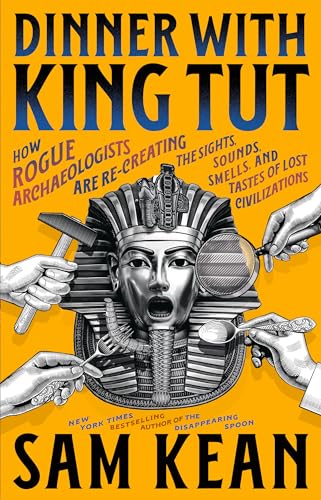
The cover of “Dinner with King Tut: How Rogue Archaeologists Are Re-creating the Sights, Sounds, Smells, and Tastes of Lost Civilizations.”
(Image credit: Little, Brown & Company / Hachette Book Group)
Wade grew up wanting to be a mortician like his father. After a stint as a medic in the Vietnam War, he became an anatomist and eventually the head of Maryland’s state anatomy board. Brier also has training in anatomy, but is an Egyptologist by training and passion. He’s accumulated so many books on Egypt over his life that he rents a second apartment just to accommodate them. Brier and Wade selected their mummy from the pool of people in Baltimore who donated their bodies to science. Ultimately, they settled on a seventy-six-year-old Caucasian man who died of a heart attack. His identity remains secret, but a bit crassly, Wade nicknamed him E. M. Balm.
For authenticity’s sake, Brier and Wade used replicas of pharaonic-era tools and materials, including linen wraps, an oddly wide wooden embalming table, and copper and obsidian blades — although they quickly abandoned the copper ones, which couldn’t cut flesh well. Before starting on their mummy, they practiced one important step on other cadavers: extracting the brain. Instead of using full cadavers for this, they obtained some decapitated heads leftover from a medical school’s plastic surgery class. (“They were looking a little weird,” Brier recalls. “They’d had facelifts and such.”)
From some scant references, Brier knew that Egyptian embalmers removed the brain by inserting a hooked rod through the nostrils, but the details were vague. Brier and Wade first tried scooping the brain out with such a rod, but the tissue proved too soft and wouldn’t come out. They finally took to squirting water up the cadaver’s nose, then used the rod to whisk the brain into a slurry. After that, it poured right out. “Like a milkshake,” Brier says. “A strawberry milkshake to be exact.”
Get the world’s most fascinating discoveries delivered straight to your inbox.
Skills honed, the duo began making their mummy in May 1994. The first step involved removing his organs.
Different organs met different fates in Egypt. Unclear about the purpose of the brain, embalmers typically threw it away. The heart, in contrast, was left in situ [in place]; it was considered the seat of all thinking, emotion, and intelligence. Abdominal organs were carefully extracted and preserved. Following this protocol, Brier and Wade made a 3½-inch [9 centimeters] incision in their cadaver’s abdomen and removed the spleen, liver, gallbladder, lungs, and twenty-two feet [6.7 meters] of intestines. Given their size, extracting the liver and lungs required some creative geometry and determined squeezing. The most difficult part involved detaching the lungs from the heart while working blind inside such a tiny hole.
With the organs removed, the pair cleaned the abdomen with palm wine and myrrh, then stuffed frankincense into the skull. This was an important ritual step to prepare the body for the afterlife, and also helped kill microbes and mask bad smells. Ancient embalmers used other sacred substances as well, often imported from Europe and Asia at great cost — pistachio resin, beeswax, castor oil. Ramses the Great’s mummy had peppercorns from India shoved up his nose.
Next, Brier and Wade dehydrated the body using natron, a mineral of equal parts salt and baking soda that forms naturally in Egyptian wadis, or dry gullies. Like a sponge, natron sucks the moisture out of flesh, leaving it too dry to support bacteria, maggots, beetles, and other putrefying agents; the leftover tissue is essentially jerky. (Fully committed to authenticity, Brier dug the natron himself in Egypt, and recalls that sneaking hundreds of pounds of unidentified white powder through customs at JFK Airport was one of the more ticklish aspects of the project. Luckily, he was traveling with a film crew, and could hide the powder in suitcases amid their equipment.)
In their lab, Brier and Wade placed the mummy’s spleen, lungs, liver, and intestines into bowls and covered them with natron. They also packed 29 linen bags of the powder into the body’s empty torso, laid the body on top of 211 more pounds [96 kilograms], and dumped 583 additional pounds [264 kg] over it. They kept the body in Wade’s old office, with the heat cranked up to 104 degrees F [Fahrenheit, or 40 degrees Celsius] and dehumidifiers running night and day to simulate Egyptian air.
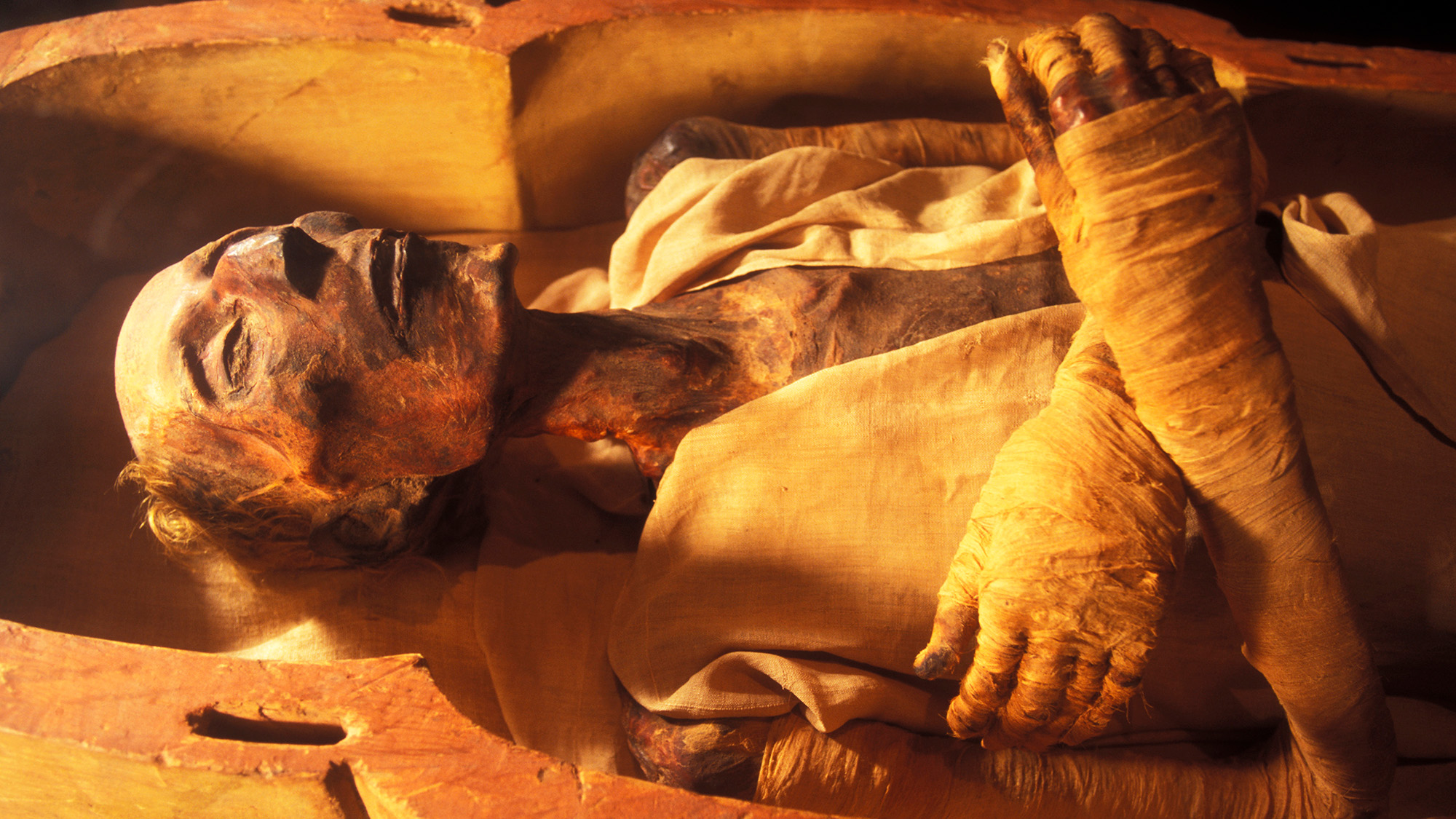
Over the next five weeks, the natron on top turned crusty and brown from absorbing bodily juices, forcing Brier and Wade to crack through it with an iron rod. (Today Brier remembers the odor as acrid but not unpleasant, although news reports at the time say he and Wade donned surgical masks against the smell.) Regardless, the sight of the body beneath thrilled Brier. As it dries, the skin of mummies tightens and shrivels, especially on the face and scalp. The lips retract to reveal the teeth, and skin with less melanin turns brown-yellow. Brier always wondered whether those changes resulted from the immediate mummification process, or from several thousand years of weathering in Egypt’s arid climate. One glance at his mummy and Brier knew the answer: even after five weeks, “he looked just like Ramses the Great,” he recalls, with leathery skin, a beaky nose, and wispy hair sticking up. The embalming process, not time, made the iconic mummies we know today.
Ramses II’s long-preserved mummy. Experts have recreated the mummification process to learn more about how the ancient Egyptians preserved their dead.
(Image credit: Patrick Landmann via Getty Images)
Beyond changing the body’s appearance, the dehydration process left the limbs as stiff as tree branches, and dropped its weight from 188 pounds [85 kg] to just 79 [36 kg]. (Thirty-one pounds [14 kg] of that represented the removal of organs.) The organs drying in the bowls withered as well, which helped explain another mystery of Egyptian mummification: as other archaeologists have noted, embalmers typically placed the organs in so‑called canopic jars, funerary vessels with slim necks — so slim that it seemed impossible to fit the larger organs inside. But the natron shrunk them down enough to slip right in.
After removing him from the natron, Brier and Wade gave Mr. Balm a full body massage with lotus, cedar, and palm oils, another step that, while important ritualistically, also had pragmatic benefits — restoring flexibility to the joints, making the mummy easier to handle. This accomplished, they wrapped the body in linen bandages. (Embalmers in ancient times started with the hands and feet, wrapping each digit separately, then proceeded to the arms, legs, and torso. The penis was individually wrapped as well — or, if embarrassingly shriveled, a cod‑piece of stiff linen was bound in place.) At this point, they let the mummy dry for three more months in the arid office, which dropped its weight to 51 pounds [23 kg]. Afterward, they added several more layers of wrappings. In between the layers, they slipped magic amulets and scraps of papyrus with spells on them, a common practice in ancient times.
For the past three decades, the mummy has been lying in a metal casket in Maryland, stored at room temperature. Brier and Wade have partially unwrapped it twice to check for rot, but found nothing amiss. “He’s dead and well,” says Brier.
Sam Kean is the New York Times-bestselling author of seven books. He spent years collecting mercury from broken thermometers as a kid, and now lives in Washington, D.C. His stories have appeared in National Geographic, The Best American Science and Nature Writing, The New Yorker, The Atlantic, and Slate, among other places, and his work has been featured on NPR’s “Radiolab,” “Science Friday,” and “All Things Considered.”
LITTLE, BROWN
Dinner With King Tut: How Rogue Archaeologists Are Re-Creating the Sights, Sounds, Smells, and Tastes of Lost Civilizations
Finalist for the 2026 PEN/E.O. Wilson Literary Science Writing Award | LOS ANGELES TIMES BESTSELLER | INDIE BESTSELLER | The New Yorker’s Best Books of 2025
Whether it’s the mighty pyramids of Egypt or the majestic temples of Mexico, we have a good idea of what the past looked like. But what about our other senses: The tang of Roman fish sauce and the springy crust of Egyptian sourdough? The boom of medieval cannons and the clash of Viking swords? The frenzied plays of an Aztec ballgame…and the chilling reality that the losers might also lose their lives?
See how much you know about mummies with our mummy quiz!