





Follow us
Add us as a preferred source on Google
Subscribe to our newsletter
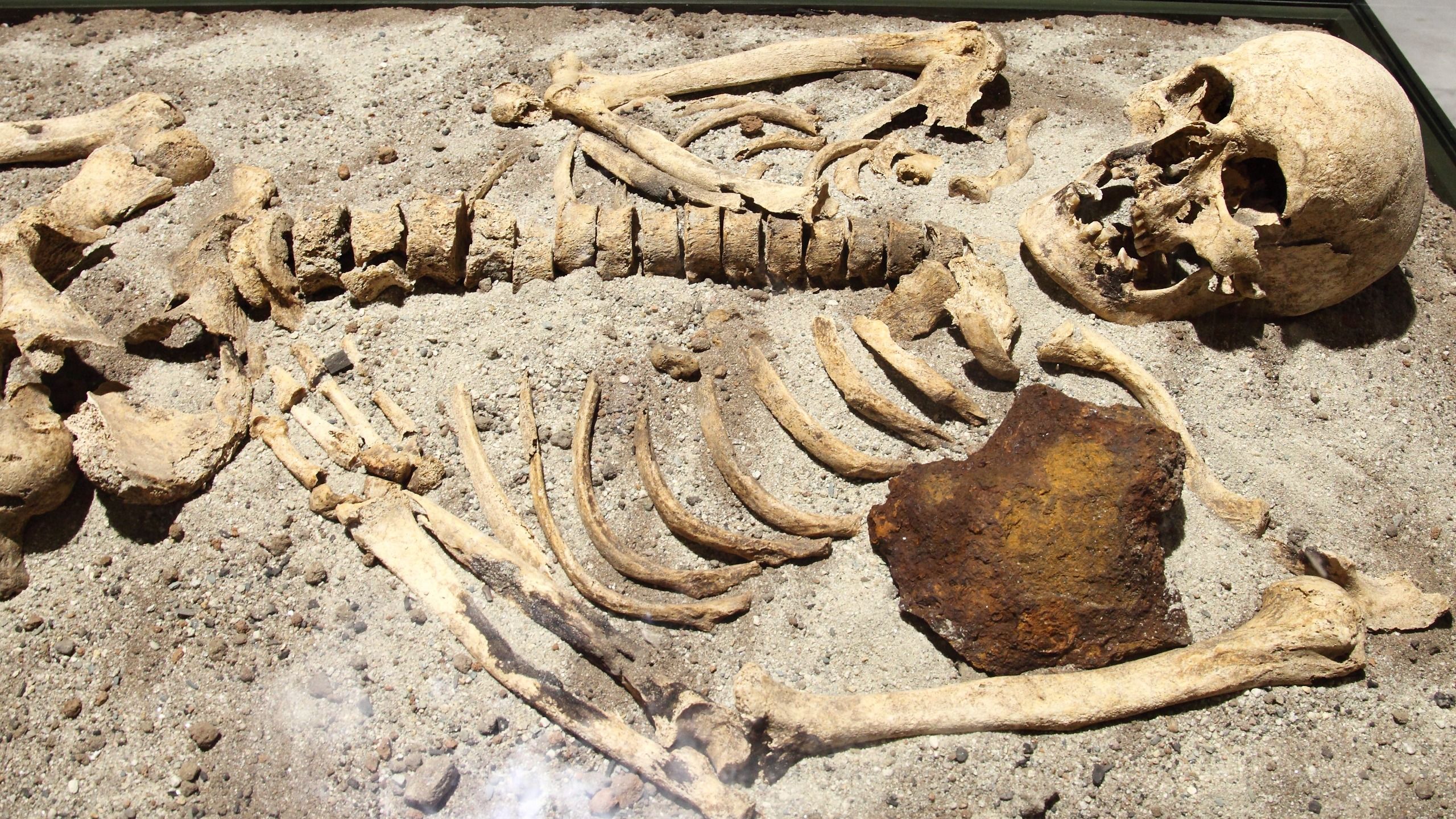
In the 17th and 18th centuries, the fear of vampires reached extraordinarily heights. People believed corpses could reanimate and wander around, terrorizing villages and spreading disease. They went to extreme lengths to prevent a vampire from rising. Some chopped the deceased person’s head off, others placed sickles across their necks. Many were placed face down in their graves. In one grave in Poland, the remains of a boy were found with an iron padlock around his foot.
In this excerpt from “Killing the Dead: Vampire Epidemics from Mesopotamia to the New World” (Princeton University Press, 2025), author and historian John Blair reveals the impact the printed press had on the spread of vampiric lore — and the grizzly purported practice of ingesting the blood and organs of a vampire to prevent other people becoming one.
With the invention of printing, the circulation of European stories about restless corpses moved up several gears. Occasional early references were followed by a clutch of theological and philosophical discussions during c. 1580-1610, and then — from the 1670s — a steadily growing volume of printed academic and historical debate and commentary, reaching a climax in 1732.
Another landmark came in 1746 when the Benedictine scholar Dom Augustin Calmet published his survey of supernatural beings, which was quickly reissued in several editions, including an English one of 1759. This book’s section on vampires was the most influential academic work on the subject ever published. Its straightforwardly evidence-based approach was a breath of fresh air after a long series of increasingly derivative works.
It achieved its remarkable popularity because it entered the market at the right point: saturated with so much fragmented and repetitive discussion of “vampires” (still a relatively new word), the reading public wanted a textbook. Calmet inspired a huge progeny of followers and popularisers, bringing the stories to a much wider readership; a good example of the genre is the Histoire des vampires et des spectres malfaisants [History of Vampires and Malevolent Specters] of 1820, a pocketbook that re-packages Calmet for the mass market.
Calmet’s book remains the ultimate source of much modern vampire literature in Europe and America, both fictional and supposedly historical, and was transformative in bringing the topic to a wider reading public. There and elsewhere, stories were now frozen on the printed page, where later generations could read them. But they were stories still: not necessarily more reliable, and by no means stable in transmission.
The tangled story of consuming blood from vampire corpses starts in a different and very unexpected place.
The complexity of interactions between learned discourse and popular practice is illustrated by one particularly bizarre and repellant (not to say dangerous) strand in the belief-system. This is the practice of ingesting blood or organs from a supposed vampire corpse, or ashes derived from burning them, as a remedy for vampire-induced illness.
Although not wholly dissimilar from the idea that victims will recover as they watch the smoke rise from burning vampire organs — already known in 11th-century England — its shocking physicality sets it apart. Did people in pre-modern Europe really do this?
A complicating factor is the medicinal use of human blood and bodyparts, in accordance with the theories of the physician, philosopher, and alchemist “Paracelsus” (Theophrastus von Hohenheim, c. 1493–1541). A brilliant experimenter, Paracelsus believed that substances healed through occult ‘influences’ or ‘spirits,’ the most powerful being those derived from what they were meant to cure: the human body.
The fact that medicine now rejects these hypotheses should not make us view them patronizingly: in the early modern period, ingesting or anointing with substances from Egyptian mummies or the blood of executed criminals seemed as rational as doing the same with any other substance. These Paracelsian ideas entered popular practice: at a beheading in Vienna in 1668/9, a man ran forward and caught the spouting blood to cure his epilepsy.
An illustration of an execution of a vampire.
The tangled story of consuming blood from vampire corpses starts in a different and very unexpected place. In 1687, a major ethnographical account of parts of West Africa by the Capuchin missionary Giovanni Antonio Cavazzi was published in Bologna. In it, Cavazzi describes magical and medical practices among the Mbundu of Angola, including a method of obtaining vital curative fluid from undecayed corpses:
When they are in a fresh and intact state when unearthed, their heads are cut from their bodies, from which it is said that blood flows out (which may happen through some illusion or deceit). It is collected and made into poultices for the sick, or mixed into their food, which infallibly guarantees health. Thereafter the dead person, having lost his strength, will no longer be able to harass them.
From Angola to Paris: in May 1693, a story appeared in the society magazine Mercure Galant. The author was the courtier and polymath Pierre des Noyers (1607–93), who spent several years in Poland in the entourage of Queen Louise-Marie. Much earlier, in 1639, he had written to a friend about the being known as upior (Ruthenian) or striga (Polish): born with teeth; eating its shroud and then its hands and arms in the coffin; causing successive deaths of family members; and extinguished by decapitation and release of pent-up blood.
This story is rather highly coloured (eating the hands and arms is unusual), but it does probably originate in genuine oral accounts of the shroud-chewer belief.
Very different is des Noyers’s account from 1693. Now the striges and upierz have become corpse-hijacking demons: ‘It is said that the demon takes this blood from the body of a living person, or from certain animals, and carries it into a dead body; for it is alleged that the demon goes out from this corpse during a certain period, between noon and midnight, after which it returns and stores there the blood that it has gathered.’
They denied cutting out the heart, mixing the blood into flour, and baking cakes with it, but the judges were sceptical and made them swear an oath.
The blood comes out of the mouth, nose, and ears of the corpse, the corpse swims in blood, and it starts to eat its shroud. The demon especially troubles former associates and relatives of the dead ‘host,’ appearing to them in the guise of parents or friends, and does not leave until all the family members have died in succession. The remedy is to exhume the corpse, which is found soft, flexible, bloated, and red:
When they are found in that state, having the likeness of those who had appeared in dreams, their heads are cut off and their hearts are opened, and a quantity of blood flows out. It is collected and kneaded into flour, which is made into bread, which is a certain remedy to guarantee against such a terrible affliction. After the heads [of the dead people] have been cut off, those whom the Spirit torments at night are no longer troubled by it, and are well thereafter.
This narrative has problems. The idea of the demon using the corpse as a safe-deposit for its hoard of blood seems to be unique; so, probably, is the time-slot between noon and midnight. These read like clerical rationalizations, perhaps fed to des Noyers by some Polish priest and overlaid on his earlier, more authentic observations. But more fundamentally, it seems obvious that des Noyers’s account of Poland shamelessly re-works Cavazzi’s account of Angola, published eight years previously.
It might not be quite so simple. An earlier common source, still unidentified, remains possible. The descriptions of mixing blood into food and poultices look remarkably close to Paracelsian ideas, extended from ordinary corpses to undead ones: was even Cavazzi’s account distorted by his own medical learning? But in any case des Noyers’s account is a piece of unprincipled plagiarism, worthless as evidence for Polish folk-belief.
Even so, it has bounced down through the echo-chambers of vampire literature ever since. The following year, a lawyer called Marigner built on the narrative — which he took at face value — with long philosophical musings on the nature of vampires. Inevitably, in 1746, it was republished in Calmet’s book, which made it permanently available to vampire-aware readers.
While otherwise faithful to des Noyers, Calmet’s version irons out the motif of demonic corpse-possession by calling this predator a vampire ‘or a demon in its form.’ This process of moulding to a more familiar template culminates in a recent version that presents the story as straightforward ethnographic reporting, omitting the demonic motif completely.
Exclusive to Live Science Pro
So far, this has just been a morality tale of plagiarism and uncritical copying. But in 1713, at Dąbrówka (now western Ukraine), some villagers were tried in the Uniate episcopal court for exhuming a woman’s corpse and mutilating it in inventive ways. They admitted to the exhumation (because the dead woman had been walking around and attacking people), and to drinking the corpse’s blood mixed with vodka. They denied cutting out the heart, mixing the blood into flour, and baking cakes with it, but the judges were sceptical and made them swear an oath.
This will sound very familiar to readers of early modern witch trials, where suspects were regularly bullied into admitting bizarre fantasies formulated by the persecutors. In this case, it seems clear that at least the idea of the blood-cakes was suggested by the judges; the same could be true of the blood-drinking, even though the accused were induced to confess that. It is distinctly possible, not to say likely, that an ordinary corpse-killing was embellished with luridly fictitious detail by judges who knew des Noyers’s report from twenty years earlier.
Killing The Dead: Vampire Epidemics from Mesopotamia to the New World. Copyright © 2025 by John Blair, published by Princeton University Press and reprinted here by permission.
Help us improve Live Science Pro: We’re always trying to make our content better. Leave us feedback about Pro here.

Princeton University Press
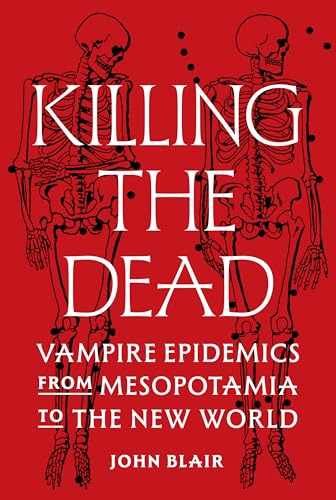
Killing the Dead: Vampire Epidemics From Mesopotamia to the New World
Killing the Dead provides the first in-depth, global account of one of the world’s most widespread yet misunderstood forms of mass hysteria—the vampire epidemic. In a spellbinding narrative, John Blair takes readers from ancient Mesopotamia to present-day Haiti to explore a macabre frontier of life and death where corpses are believed to wander or do harm from the grave, and where the vampire is a physical expression of society’s inexplicable terrors and anxieties.