





Follow us
Add us as a preferred source on Google
Subscribe to our newsletter
Last year’s massive earthquake in Myanmar could help researchers better predict where the worst shaking will be if the “Big One” hits the San Andreas Fault in California.
The magnitude 7.7 quake hit on March 28, 2025, near the city of Mandalay and shook buildings as far away as Bangkok, 830 miles (1,330 kilometers) away. The death toll was at least 3,700 people. New research that used detailed satellite data and a one-of-a-kind video of the ground rupturing reveals that the fault had a twisty, almost helical shape, which affected the shaking.
The Sagaing Fault in Myanmar that triggered the quake is analogous to many strike-slip faults worldwide that threaten population centers, said Alice-Agnes Gabriel, a geophysicist at the Scripps Institution of Oceanography at the University of California, San Diego and co-author of the new research, which was published Oct. 14 in the journal Nature Communications. This includes California’s San Andreas Fault, which is similarly tilted and likely capable of generating a 7.8 magnitude earthquake. Studying what happened as the ground ruptured near Mandalay can reveal what might occur in future earthquakes on similar faults, Gabriel told Live Science.
Latest Videos FromLive Science
“The idea is, we cannot predict when and where an earthquake might happen” along a particular fault, she said, “but we may be able to predict certain aspects of it.”
Gabriel uses powerful supercomputers to model earthquake scenarios, but these scenarios are only as good as the data that goes into them. In the case of the Myanmar quake, the researchers had a unique piece of data to ground-truth their model on: a security video of the ground cracking as the fault ruptured. This phenomenon had not been captured on video before.
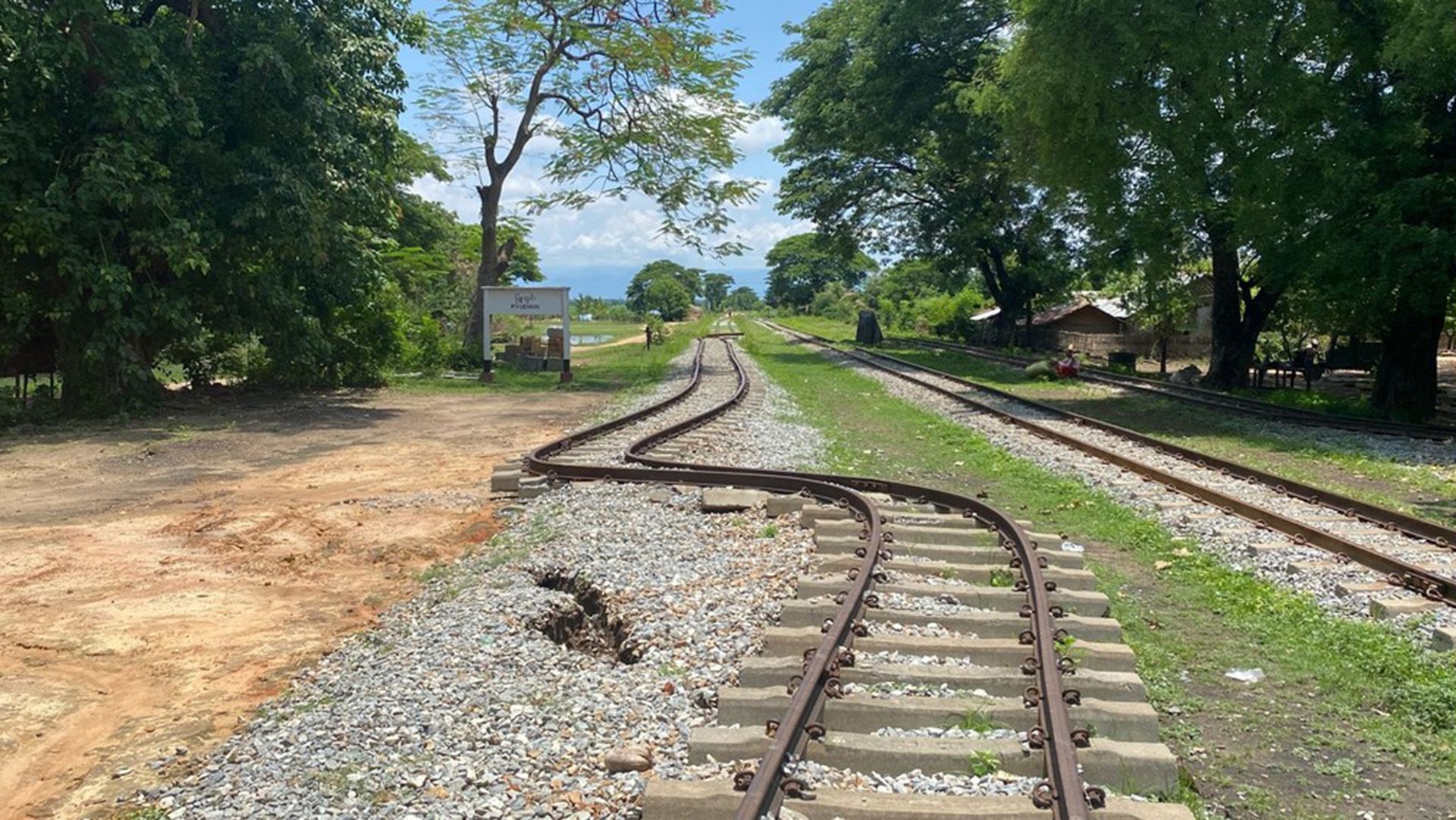
Damage from the magnitude 7.7 earthquake that hit on March 28, 2025, near the city of Mandalay.
(Image credit: Photo(s) taken by Dr. Tha Zin Htet Tin of East Yangon University)
The researchers’ models revealed that the fault is not a vertical plane under the ground. Instead, the surface dips west on the northern end of the fault, becomes vertical in the middle, and then dips eastward at the southern end, they found.
In general, more shaking occurs in the direction in which a fault line dips, Gabriel said. In the case of the San Andreas Fault, the dip is inland, toward California’s high desert — an area that’s less populated than coastal regions on the other side of the fault. This means that, if the Big One acts similarly to the Myanmar quake, the high desert side of the fault will experience more intense shaking than the coastal side. The San Andreas Fault has also built up strain for over a century, so the researchers believe it could act in a similar way to the Sagaing Fault.
Get the world’s most fascinating discoveries delivered straight to your inbox.
However, everyone near a dangerous fault should still prepare for major shaking, Gabriel warned, because small local variations, like how much sediment has accumulated over the bedrock in an area, can make a difference in how bad the ground movement gets. Los Angeles, for example, sits on a sediment-filled basin that would jiggle like jelly in a large quake.
The researchers also investigated whether they could have predicted aspects of the Mandalay quake from monitoring data they had available from before the quake. They knew that the Sagaing Fault had been “locked” in certain segments, meaning that while the two tectonic plates on each side of the fault were moving, the rocks at the fault line were jammed against each other. These locked segments had been accumulating strain for 186 years.
The researchers found that they could predict the path, shape and speed of the rupture on the Sagaing Fault in Myanmar with details available prior to the quake, such as the detailed shape of the fault deep underground and how long sections had been locked. Similar predictions could be made for the San Andreas and other important faults. Previous studies have also shed light on other aspects of the fault, such as its simplicity and maturity, that could inform what might happen at other faults around the world.
Researchers are currently working to update their model of what the Big One would look like on the San Andreas. The results of the update will be shared to help the public prepare, inform building codes and educate emergency managers.
“This really shows how we can use this long-term fault-monitoring data,” Gabriel said.
Ulrich, T., Zou, X., Marchandon, M., Schliwa, N., Tan, F., Gabriel, A.-A., Fan, W., Shearer, P., Thant, M., Tin, T. Z. H., Lindsey, E. O., & Fialko, Y. (2026). On predictability of slip, rupture geometry, and speed of the 2025 m7.8 Mandalay, Myanmar, earthquake. Nature Communications, 17(1). https://doi.org/10.1038/s41467-026-77203-x