NASA has confirmed that its Voyager 1 spacecraft has reached a record-breaking 1 light-day from Earth — but new milestones come with old problems.
On Nov. 14, the Voyager mission team discovered that the nearly 50-year-old space probe had stopped sending science data back to Earth, according to NASA — a problem that the team had to deal with as recently as 2024. As of Thursday (Nov. 19), the team had not resolved the problem.
But they did detect a “carrier” signal that is used to ferry science and engineering information from Voyager 1 to Earth, confirming that the probe is still powered up and pointed in the right direction.
Latest Videos FromLive Science
“We have an anomaly that is not unseen before,” Suzanne Dodd, Voyager project manager, said at a NASA news conference Thursday, adding that she is “confident” that the science data will continue flowing again soon.
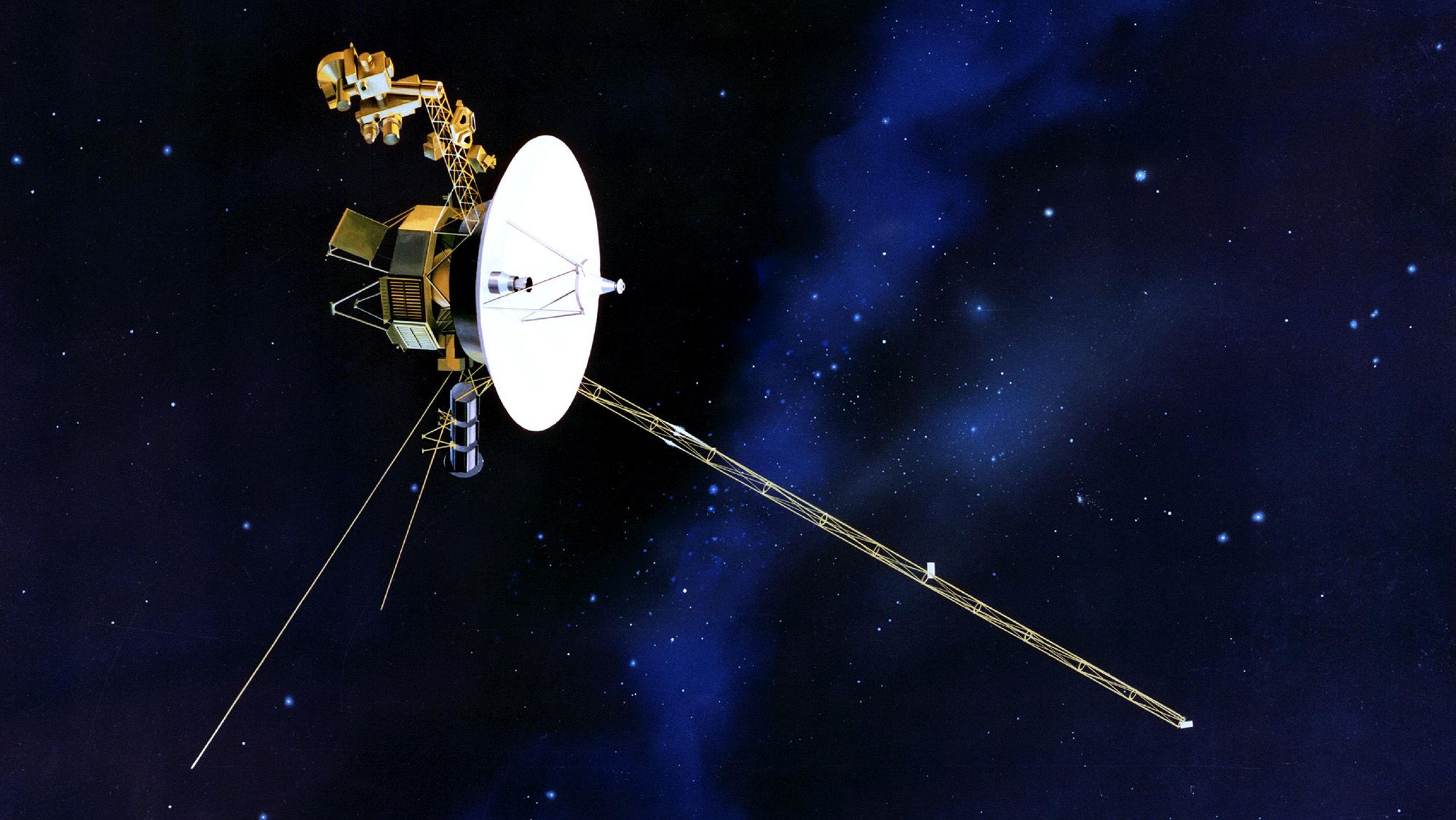
Using the carrier signal, the team confirmed that the probe had reached its latest distance milestone of 1 light-day from Earth, or roughly 16.1 billion miles (25.9 billion kilometers) away, Wednesday (Nov. 18). At this distance, which no human-made object had ever reached before, it takes a full 24 hours for radio signals traveling at the speed of light to get from Earth to Voyager 1 and vice versa. (The spacecraft’s twin probe, Voyager 2, is expected to reach its own light-day in 2035.)
This incredible distance, coupled with the spacecraft’s five-decade-old hardware, makes troubleshooting problems on the probe extremely arduous, Dodd explained.
An illustration depicting Voyager 1 at one light-day from Earth.
(Image credit: NASA/JPL-Caltech)
“It takes two days to diagnose anything with the spacecraft — so we can’t do anything fast, and the data rates are very low,” she said. “We are in a realm where we’re going to see more anomalies with Voyager, just due to the distance and the age.”
Get the world’s most fascinating discoveries delivered straight to your inbox.
More space, more problems
According to NASA, the current glitch likely stems from Voyager’s onboard computer, which is responsible for collecting data from its science instruments and transmitting it back to Earth in a readable format. The team encountered a similar problem in November 2023 that prevented Voyager 1 from sharing science data until engineers solved the issue in June 2024. The mission team is approaching this new glitch the same way they solved the previous one, NASA wrote in a blog post.
If the fix succeeds, Voyager 1 will continue transmitting data from its two remaining science instruments — a magnetometer, which measures magnetic fields in interstellar space, and a plasma wave detector, which measures charged particles in the interstellar medium. To conserve power on the aging spacecraft, the mission team shut off some of Voyager’s instruments earlier this year while powering other, more efficient ones in a “Big Bang” maneuver that should keep the probe alive through at least 2027.
We are in a realm where we’re going to see more anomalies with Voyager, just due to the distance and the age
Suzanne Dodd, Voyager project manager
However, it’s only a matter of time before Voyager 1 runs out of juice and closes its mechanical eyes to the cosmos. After that, it will continue drifting through interstellar space indefinitely, carrying a Golden Record of images, music and information about life on Earth. In the meantime, Voyager will continue learning everything it can about the strange environment of the interstellar medium — the space between stars, where only Voyagers 1 and 2 have ever been before.
Voyager 1 officially reached interstellar space in 2012, after transforming our views of Jupiter, Saturn and other solar system bodies. For more about the probe’s incredible discoveries, check out our collection of Voyager 1’s iconic photos.
See how well you know our planetary neighborhood with our solar system quiz!