


NEWYou can now listen to articles!
A Trump-appointed federal judge dealt a blow to Colorado’s effort to ramp up oversight of an ICE detention center by temporarily blocking key provisions in a state law after finding the state likely overstepped its authority.
Chief U.S. District Judge Daniel Domenico issued the preliminary injunction Thursday, ruling that Colorado likely crossed a constitutional line in a state law by imposing new requirements specifically targeting the GEO Group’s Aurora ICE Processing Center, which operates under a federal contract and is the state’s lone ICE detention center.
“Here, GEO has shown that it is singled out for a special bill that applies to no other facility,” Domenico wrote. “That other facilities might have some similar regulatory burdens does not change the fact that none of them are required to comply with HB 1276. As GEO notes, the extent of the additional burden is irrelevant for purposes of this test.”
BLUE STATE’S ANTI-ICE PLEDGE COLLAPSES AS GOP WARNS OF NEW SANCTUARY ‘CONFEDERACY’
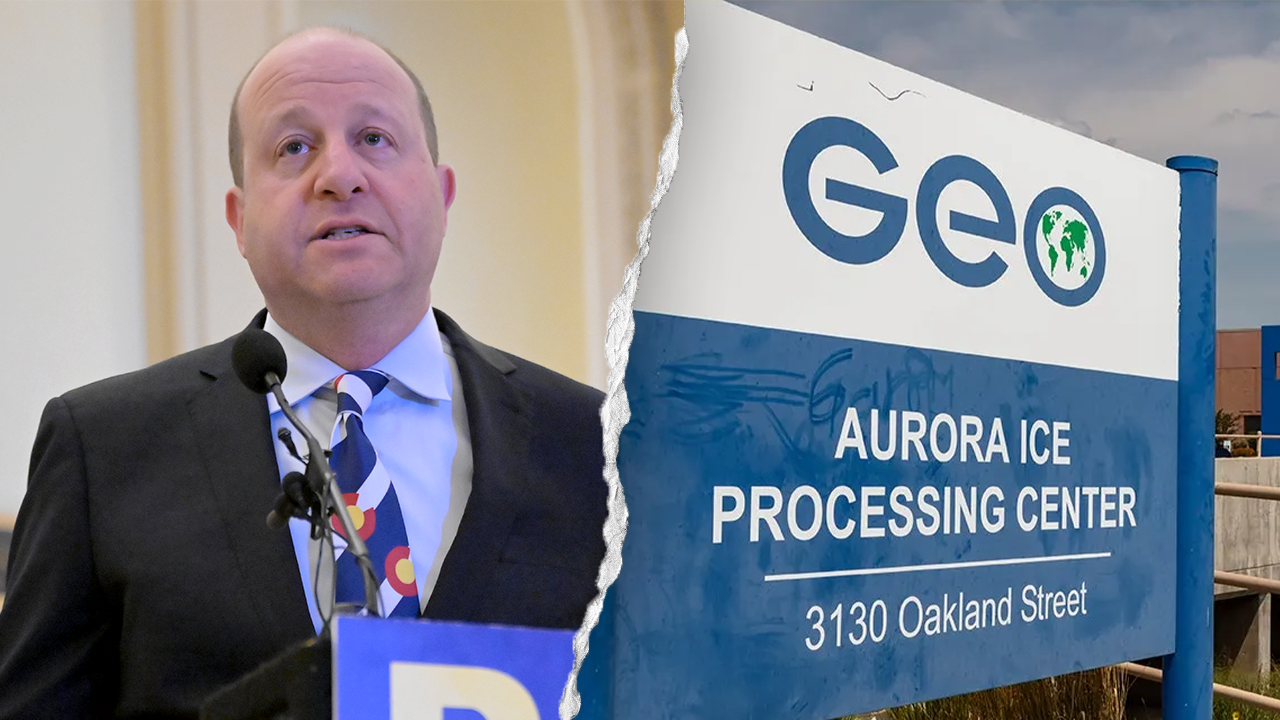
A Trump-appointed judge temporarily blocked key provisions in a Colorado state law putting immigration detention centers under greater state scrutiny. (Hyoung Chang/The Denver Post via Getty Images)
Democratic Colorado Gov. Jared Polis signed House Bill 26-1276 into law on June 4, expanding state and local oversight of immigration detention facilities.
In his order, Domenico noted that GEO’s Aurora detention center was the only facility in Colorado subject to the law’s additional regulations as of May.
“And though Colorado argues that the law only brings GEO into compliance with existing state regulations applied to other detention facilities, that law singles out this one category of facility for a separately defined set of restrictions and rulemaking,” Domenico wrote. “And that is sufficient to establish that HB 1276 discriminates against GEO based on its status as a federal contractor.”
FEDERAL JUDGE BLOCKS NEW YORK LAW BANNING ICE AGENTS FROM WEARING MASKS

The immigrant detention facility operated by the privately owned GEO Group for U.S. Immigration and Customs Enforcement (ICE) is pictured in Aurora, Colo. (Jim West/UCG/Universal Images Group via Getty Images)
The blocked provisions required unannounced inspections of the facility at least once every three months, with GEO required to pay for the inspections. The law also authorized civil penalties of up to $50,000 for each refusal to permit an inspection.
“At least some of the burdens of this bill are unique,” Domenico wrote. “The requirement of a certain number of unannounced visits, for example, does not appear elsewhere. And the state acknowledges that the penalty scheme is not imposed on other facilities.”
Colorado argued that the law simply put GEO on the same footing as other private detention facilities.
But Domenico said that if the state had required immigration facilities to follow the same regulations governing facilities carrying out state policies, that argument “might be persuasive.”
CITIZENS BANK CUTS TIES WITH ICE PRISON CONTRACTORS AFTER MONTHS OF ACTIVIST PRESSURE
The ruling relied heavily on the Constitution’s Supremacy Clause. Domenico cited Supreme Court precedent stating that federal government activities generally must remain free from state regulation and that protections can extend to private contractors carrying out federal operations.
Colorado’s new law also sought to give the state authority to impose additional reporting and staffing requirements. Those provisions include potential annual reports concerning people with chronic health conditions and disabilities, dietary restrictions, access to attorneys and access to spaces for worship. The law also addresses the housing of minors and requires onsite medical and mental health professionals.

An Immigration and Customs Enforcement (ICE) agent stands before a large American flag. (Charly Triballeau/AFP via Getty Images)
Domenico did not block those provisions because Colorado told the court they were not currently being enforced and would require a future rulemaking process, which the state said it had no immediate plans to begin.
The preliminary injunction will end on Oct. 15, when GEO’s existing federal contract to operate the Aurora facility expires.
JUSTICE DEPARTMENT SUES COLORADO OVER IN-STATE TUITION AND FINANCIAL AID FOR ILLEGAL IMMIGRANTS
Democratic Colorado Attorney General Phil Weiser said the ruling was only a minor victory for GEO.
“Today’s ruling granted the GEO Group a narrow, temporary injunction against one provision of a new 2026 law—not the broad relief it sought—and leaves Colorado’s existing public health and safety authority intact,” Weiser said in a statement Thursday. “Separately, our lawsuit filed yesterday seeks to enforce that existing authority and require GEO to cooperate with the state’s investigation into tuberculosis at the Aurora facility, and we will continue using every available tool to protect the health and safety of Coloradans.”
Colorado sued GEO on Wednesday, seeking to force the company to comply with a public health order stemming from a tuberculosis investigation at the Aurora facility. Health officials confirmed an active TB case there on June 22, but the state alleges GEO has failed to provide the records and cooperation needed to determine the extent of potential exposure.
CLICK HERE TO DOWNLOAD THE APP
The state argues its authority to investigate communicable diseases predates HB 26-1276 and remains intact, despite Domenico’s decision temporarily blocking the law’s new inspection requirements.
Digital reached out to GEO and Polis’ office for comment.