

Close Menu
  • Home
  • United States
  • World
  • Politics
  • Business
  • Lifestyle
  • Entertainment
  • Health
  • Science
  • Tech
  • Sports
  • More
    • Web Stories
    • Editor’s Picks
    • Press Release

Subscribe to Updates

Get the latest USA news and updates directly to your inbox.

What's On
Amazon launches 1-hour, 3-hour delivery options: Here’s what it will cost you

Amazon launches 1-hour, 3-hour delivery options: Here’s what it will cost you

March 17, 2026
US general aiding Ukraine left secret map on train — and got concussion after drunken night out, watchdog finds

US general aiding Ukraine left secret map on train — and got concussion after drunken night out, watchdog finds

March 17, 2026
Pipe bomb suspect claims Trump pardons should dismiss Jan. 6 case

Pipe bomb suspect claims Trump pardons should dismiss Jan. 6 case

March 17, 2026
Facebook X (Twitter) Instagram
Trending
  • Amazon launches 1-hour, 3-hour delivery options: Here’s what it will cost you
  • US general aiding Ukraine left secret map on train — and got concussion after drunken night out, watchdog finds
  • Pipe bomb suspect claims Trump pardons should dismiss Jan. 6 case
  • 8 Must-Watch Fantasy Movies on Netflix (March 2026): ‘The Green Knight’ and More
  • HS basketball star critically injured in car crash after committing to Louisville
  • Brazil’s underprotected Cerrado savanna stores a staggering amount of carbon, study finds
  • Super agile humanoid robot seen playing tennis with humans in uncanny video
  • US diesel tops $5 per gallon, oil spikes 4% as Strait of Hormuz crisis continues
  • Privacy
  • Terms
  • Advertise
  • Contact Us
Join Us
USA TimesUSA Times
Newsletter Login
  • Home
  • United States
  • World
  • Politics
  • Business
  • Lifestyle
  • Entertainment
  • Health
  • Science
  • Tech
  • Sports
  • More
    • Web Stories
    • Editor’s Picks
    • Press Release
USA TimesUSA Times
Home » City-size, cold-volcano comet transforms into a glowing ‘snail shell’ after major explosive outburst
City-size, cold-volcano comet transforms into a glowing ‘snail shell’ after major explosive outburst
Science

City-size, cold-volcano comet transforms into a glowing ‘snail shell’ after major explosive outburst

News RoomBy News RoomFebruary 18, 20260 ViewsNo Comments

A mysterious volcanic comet has transformed into a giant, “fossil-like” spiral of light after one of its most violent outbursts in years, new photos reveal. The stunning spectacle is a reminder of how puzzling this particular planetary remnant really is.

The unusual comet, known as 29P/Schwassmann-Wachmann (29P), is a hefty ice ball spanning around 37 miles (60 kilometers) — roughly three times the length of Manhattan. It is part of a rare group of around 500 objects dubbed “cetaurs,” which spend their entire lives circling the inner solar system. The comet also belongs to an even more exclusive club known as cryovolcanic comets, which occasionally spew gas and ice across our cosmic neighborhood.

A cryovolcanic comet blows its top when its icy shell, or nucleus, soaks up too much solar radiation. This extra radiation superheats the mix of frozen gas and dust — called cryomagma — in the comet’s interior and causes the icy mix to sublimate. The resulting gas causes a pressure buildup in the comet’s center, which eventually forces open a crack in the nucleus, allowing it to spray its icy guts into space. When this happens, the fuzzy cloud of material surrounding the comet, known as its coma, expands significantly, allowing it to reflect more sunlight and making it shine much more brightly in the night sky.


You may like

On Feb. 10, Comet 29P experienced a sudden brightening event, roughly equivalent to a 100-fold increase in its luminosity, signaling that it had undergone a major eruptive event, according to Spaceweather.com.

This outburst is one of the comet’s “top five” eruptions of the past two and a half decades, experts told Spaceweather.com, and it’s the most powerful event since a quadruple eruption in October 2024, which caused Comet 29P to shine 300 times brighter than normal.

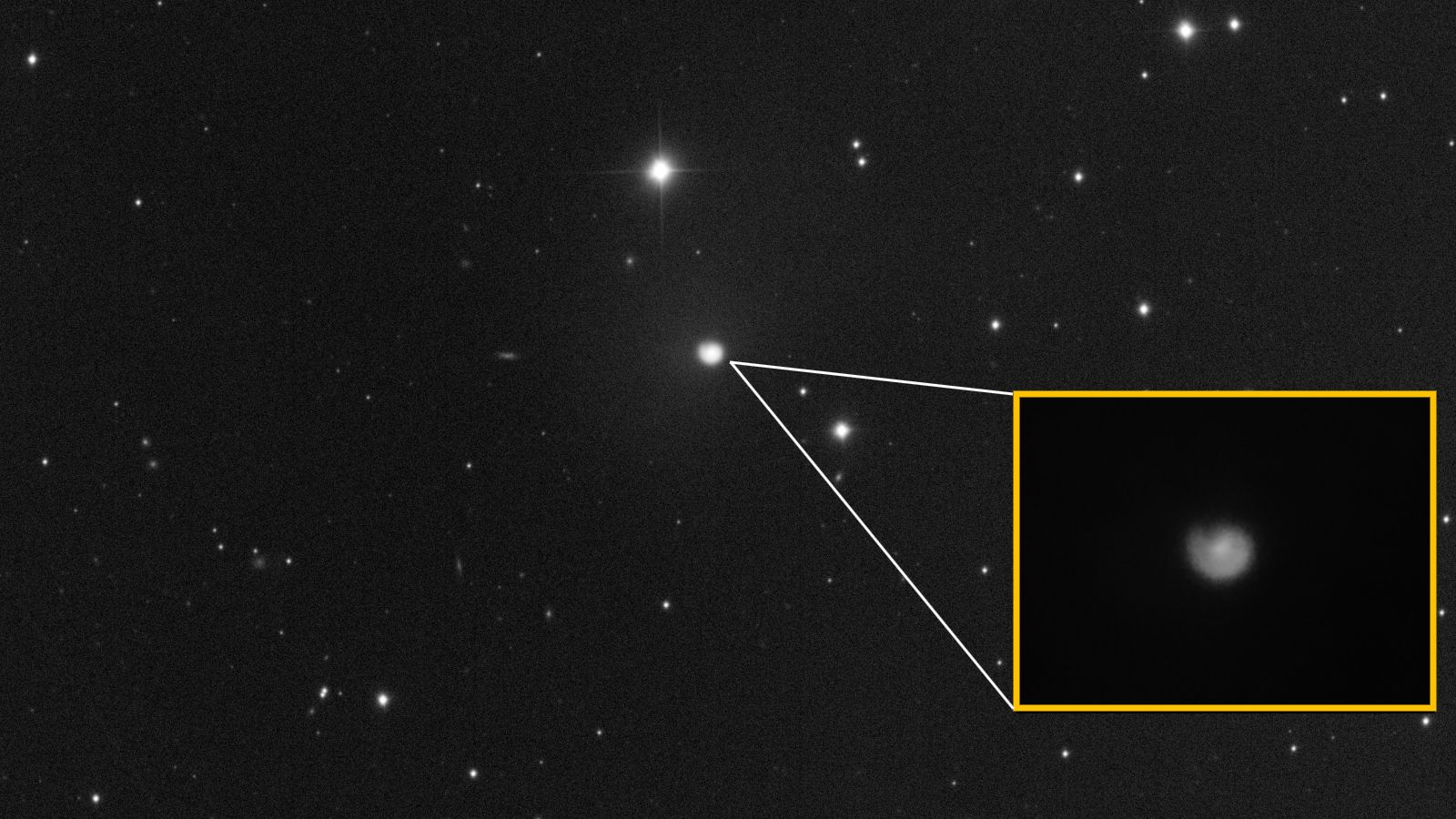
In the days following the Feb. 10 outburst, Comet 29P’s coma has expanded into a distinct spiral-like shape. (Image credit: Eliot Herman)

However, in the days following the explosive outburst, researchers began to notice something unusual about 29P’s expanding coma: The reflective cloud was not evenly distributed around the comet as it typically would be. Instead, the cloud appeared to have stretched out into a rare spiral shape.

Amateur astronomer and astrophotographer Eliot Herman snapped the lopsided coma from the Rio Hurtado valley in Chile (see above) and said it resembled a fossil of an extinct shelled cephalopod known as an ammonoid. Fellow photographer Anthony Kroes, who also captured a stunning shot of the spiral from Wisconsin, remarked on its “snail-shell appearance.”

Get the world’s most fascinating discoveries delivered straight to your inbox.

The unusual shape likely results from an internal rotation of the comet’s interior relative to its nucleus, which causes cryomagma to unevenly spew out of a newly formed vent on its icy surface, according to Spaceweather.com.

This is very similar to the “devil comet,” 12P/Pons-Brooks, which appeared to grow demonic horns during the initial eruptions of its solar flyby in late 2023, likely due to a notch on its surface that partially blocked the outflow of cryomagma, experts said at the time.

The interstellar comet 3I/ATLAS, which made headlines as it zoomed through the inner solar system last year, also displayed evidence of cryovolcanism and likely leaked cryomagma through multiple jets.


You may like

Unexplained outbursts

Most cryovolcanic comets, like 12P/Pons-Brooks and the recently discovered Comet SWAN, are long-period comets that dwell in the outer solar system and drift toward the sun every few hundred or thousand years. They erupt only as they near our home star — and soak up additional radiation — before ceasing activity and quietly returning to the edge of our cosmic neighborhood.

However, Comet 29P orbits the sun in a roughly circular trajectory, meaning it’s pretty much always the same distance from the sun. It is located between Jupiter and Saturn — around six times farther from our home star than Earth is — so it does not receive much sunlight.

An orbital diagram showing hoe comet 29P circles the sun

Comet 29P has a roughly circular orbit around the sun and is further from our home star than Jupiter, making its cryovolcanism somewhat surprising. (Image credit: NASA/JPL/Small-Body Database Lookup)

Still, Comet 29P experiences an average of 20 eruptions per year. Most of these are small, but occasionally, a much bigger outburst — like the one we have just seen — comes along, releasing up to 1 million tons of cryomagma into space.

This has been frustrating for researchers because they have no clear idea of what triggers these larger outbursts, when the comet’s conditions appear to remain fairly stable.

In April 2023, researchers predicted one of these major eruptions in advance, thanks to a mini dimming event just before the comet blew its top. However, they were still unsure why it happened.

How to see 29P/Schwassmann-Wachmann

Comet 29P has passed its peak brightness. However, it has remained unusually luminous thanks to a second, smaller outburst Sunday (Feb. 15), which pumped a fresh batch of cryomagma into the comet’s coma, according to Spaceweather.com. (It is currently unclear if the reinvigorated coma will also expand into a spiral.)

You should still be able to see the comet with a decent telescope or pair of stargazing binoculars. It is currently located in the constellation Leo, according to TheSkyLive.com.

Major eruptions like this are often followed by multiple smaller eruptions, or “aftershocks,” meaning we could see more outbursts in the coming days or weeks, Richard Miles, an astronomer with the British Astronomical Association who has studied Comet 29P, told Spaceweather.com.

If you decide to head out under the stars, you may also want to keep an eye out for Comet C/2024 E1 (Wierzchoś), which is shining brightly after passing its closest point to Earth on Tuesday (Feb. 17). Researchers predict that this ice ball may soon be kicked out of the solar system forever, similar to 3I/ATLAS, so this may be your only chance to see it.

In April, we will be treated to two more exciting comets: the newly discovered “sungrazer” comet C/2026 A1 (MAPS), which could shine bright enough to be seen with the naked eye during the daytime, and the long-period comet C/2025 R3 (PanSTARRS), which could also become visible without a telescope at night.

Share. Facebook Twitter LinkedIn Telegram WhatsApp Email

Keep Reading

Brazil’s underprotected Cerrado savanna stores a staggering amount of carbon, study finds

Brazil’s underprotected Cerrado savanna stores a staggering amount of carbon, study finds

Understanding telescope magnification: A beginner’s guide to eyepieces, aperture and getting the best views

Understanding telescope magnification: A beginner’s guide to eyepieces, aperture and getting the best views

Iran war could create a ‘fertilizer shock’ that impacts agriculture and raises food prices

Iran war could create a ‘fertilizer shock’ that impacts agriculture and raises food prices

‘We got evidence of boars, deer, bears, aurochs’: Ancient DNA reveals sunken realm Doggerland had habitable forests during the last ice age

‘We got evidence of boars, deer, bears, aurochs’: Ancient DNA reveals sunken realm Doggerland had habitable forests during the last ice age

Rainbow-colored phantom lakes emerge around Namibia’s ‘Great White Place’ — Earth from space

Rainbow-colored phantom lakes emerge around Namibia’s ‘Great White Place’ — Earth from space

‘Super El Niño’ could push global temperatures to unprecedented highs, forecasters say

‘Super El Niño’ could push global temperatures to unprecedented highs, forecasters say

How plants moved from sea to land and changed Earth forever

How plants moved from sea to land and changed Earth forever

A single injection of mRNA-like treatment could help heart muscle heal after a heart attack in mice and pigs. Could it work in humans too?

A single injection of mRNA-like treatment could help heart muscle heal after a heart attack in mice and pigs. Could it work in humans too?

Live Science Today: ‘Hexagonal’ diamonds and fish scale down

Live Science Today: ‘Hexagonal’ diamonds and fish scale down

Add A Comment
Leave A Reply Cancel Reply

Editors Picks

US general aiding Ukraine left secret map on train — and got concussion after drunken night out, watchdog finds

US general aiding Ukraine left secret map on train — and got concussion after drunken night out, watchdog finds

March 17, 2026
Pipe bomb suspect claims Trump pardons should dismiss Jan. 6 case

Pipe bomb suspect claims Trump pardons should dismiss Jan. 6 case

March 17, 2026
8 Must-Watch Fantasy Movies on Netflix (March 2026): ‘The Green Knight’ and More

8 Must-Watch Fantasy Movies on Netflix (March 2026): ‘The Green Knight’ and More

March 17, 2026
HS basketball star critically injured in car crash after committing to Louisville

HS basketball star critically injured in car crash after committing to Louisville

March 17, 2026

Subscribe to News

Get the latest USA news and updates directly to your inbox.

Latest News
Brazil’s underprotected Cerrado savanna stores a staggering amount of carbon, study finds

Brazil’s underprotected Cerrado savanna stores a staggering amount of carbon, study finds

March 17, 2026
Super agile humanoid robot seen playing tennis with humans in uncanny video

Super agile humanoid robot seen playing tennis with humans in uncanny video

March 17, 2026
US diesel tops  per gallon, oil spikes 4% as Strait of Hormuz crisis continues

US diesel tops $5 per gallon, oil spikes 4% as Strait of Hormuz crisis continues

March 17, 2026
Facebook X (Twitter) Pinterest WhatsApp TikTok Instagram
© 2026 USA Times. All Rights Reserved.
  • Privacy Policy
  • Terms
  • Advertise
  • Contact

Type above and press Enter to search. Press Esc to cancel.