



NEWYou can now listen to articles!
Chicago’s public schools stand as a monument to bureaucratic inertia and misplaced priorities, where vast sums of taxpayer money vanish into underutilized buildings while student outcomes plummet. Frederick Douglass Academy High School exemplifies the dysfunction. Built to accommodate 1,008 students, the school now enrolls just 27, yet it remains open with 28 full-time employees – more staff than children. A one-to-one staff-to-student ratio is a luxury that even private schools can’t offer, but here it yields zero academic progress.
In 2024, operational spending at Douglass exceeded $93,000 per student, and that figure excludes capital outlay and debt service, pushing total expenditures even higher. Despite this lavish funding, the latest state data from 2024 reveal not a single 11th grade student proficient in math or reading.
Poor attendance compounds the failure: 65.6% of enrolled students are chronically absent, missing more than 10% of school days. Fewer than a dozen children show up with any regularity, turning the building into little more than an expensive daycare for a handful of kids – and even that description overstates its educational value.
Douglass is no outlier in Chicago Public Schools (CPS). At least 255 school buildings are underutilized, representing more than half of the district’s standalone public schools. Among those, 145 are more than half empty, and 24 operate at over 75% vacancy. These ghost schools drain resources that could transform education elsewhere.
CHARTER SCHOOL CEO SAYS ‘SYSTEM FAILING’ AS NEARLY HALF OF NEW YORK 3-8 GRADERS NOT PROFICIENT IN ENGLISH
Members of the Chicago Teachers Union gathered at a rally ahead of a potential educators strike on September 24, 2019, in Chicago. (Photo by Scott Heins/Getty Images)
Since 2019, CPS has lost 10% of its student enrollment, yet staffing has ballooned by 20%, inflating costs without improving results. In 2024 alone, 80 public schools in Chicago reported zero students proficient in math, and 24 had zero proficiency in reading. The pattern is clear: pouring more money into failing structures does nothing to elevate student achievement.
The Chicago Teachers Union (CTU) bears much of the blame for perpetuating this inefficiency. The union fights tooth and nail against closing any public school, no matter how empty or ineffective. Union leaders argue that closures disrupt communities, but the real disruption comes from propping up zombie institutions that trap families in mediocrity.
In 2023, the CTU successfully lobbied to kill Illinois’s Invest in Kids scholarship program, which had provided school choice options to over 9,000 children from low-income families. That program allowed parents to escape failing districts, but the union prioritized monopoly control over student opportunity.
SCHOOLS THAT LET STUDENTS LEAVE CLASS TO PROTEST ICE HAVE FAILING ACADEMIC RECORDS
The union also successfully capped the number of charter schools in the city, stifling competition and innovation – a policy that must be reversed to allow more high-performing options to flourish.
This stance has pushed the CTU to a record-low favorability in a new poll, showing a net favorability of negative 26.1%, with most Chicago voters reporting a negative opinion.
Hypocrisy runs deep in the CTU’s leadership. President Stacy Davis Gates once labeled school choice “racist,” yet she enrolls her own son in a private school, affording him the options she denies to others. Such double standards expose the union’s true agenda: protecting jobs and dues revenue, not serving children. By blocking closures and choice, the CTU ensures that dollars flow to empty hallways rather than effective classrooms.
TEXAS PARENTS FLOOD SCHOOL CHOICE PROGRAM, FAR EXCEEDING THE INITIAL 90,000 STUDENT CAPACITY
Advocates for the status quo claim that more funding solves all ills, but Chicago’s empty schools shatter that myth. If money alone were the answer, Douglass High School – with its exorbitant per-pupil spending and personalized staffing – would produce scholars, not dropouts.
Instead, the district’s failures stem from a lack of accountability and competition. Public schools operate as monopolies, insulated from the pressures that drive improvement in other sectors. Families cannot easily vote with their feet, and unions wield veto power over reforms.
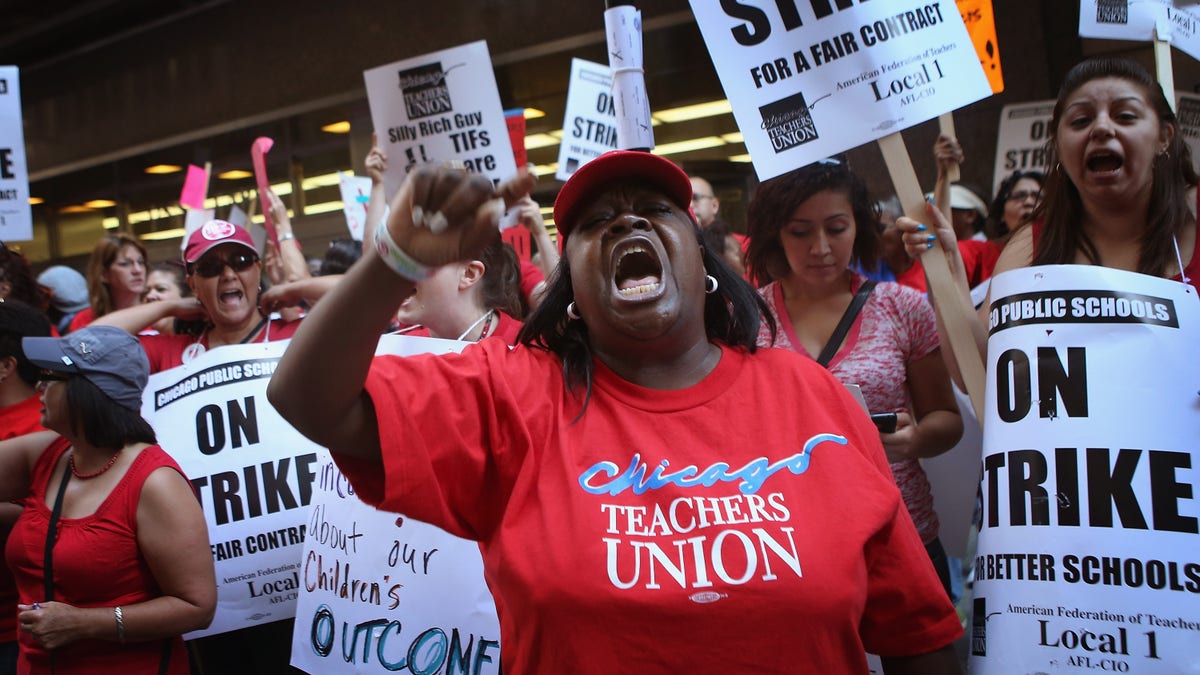
Despite union membership declining since 2000, a rising number of Americans approve of unions, according to a 2022 Gallup poll. (Photo by Scott Olson/Getty Images)
Closing these underutilized schools would not harm educators or students. It would benefit them. Redirecting funds from vacant buildings could boost salaries for teachers in thriving schools, attracting top talent and rewarding performance. The savings on fixed costs – utilities, maintenance and overhead – could also compensate staff displaced from closures, allowing them to earn more at consolidated locations with fuller classrooms.
WASHINGTON POST RIPS CHICAGO TEACHERS UNION FOR PURSUING SOCIAL JUSTICE INITIATIVES AS STUDENTS STRUGGLE
Before any closures, charter schools or private schools should get the right of first refusal on these vacant buildings, enabling them to repurpose the space for better educational models.
For the few students in these failing environments, even a fraction of that $93,000 per child could fund tuition at a private or charter school tailored to their needs.
CLICK HERE FOR MORE OPINION
The district’s enrollment has declined steadily as families flee to suburbs or seek alternatives, yet bureaucrats cling to outdated infrastructure. Shuttering the 24 most vacant schools alone could save tens of millions annually, freeing resources for class-size reductions, technology upgrades, or merit pay in high-performing buildings. Teachers unions decry such moves as attacks on public education, but the real attack is maintaining a system that wastes billions while graduating illiterate students.
Nationwide, similar patterns emerge in urban districts from Detroit to Los Angeles, where enrollment drops but spending rises unchecked. The solution lies in empowering parents through universal school choice programs which tie funding to students rather than buildings. When money follows the child, schools must compete to attract enrollment, fostering innovation and efficiency. States like Arizona and Florida have embraced this model, seeing enrollment surges in choice options and improved outcomes across the board.
CLICK HERE TO DOWNLOAD THE APP
Critics warn that choice drains public schools, but evidence shows the opposite: competition spurs reform. In Milwaukee, studies reveal that voucher programs elevated performance in both private and public sectors. Chicago could follow suit, but the CTU’s grip stifles progress. Until unions prioritize students over self-preservation, the cycle of waste and failure will continue.
Chicago’s empty schools serve as a cautionary tale for policymakers everywhere. More money funneled into broken systems yields only more brokenness. True reform demands accountability, choice, and a willingness to let failing institutions close. Families deserve better than ghost schools and empty promises. By embracing competition and efficiency, Chicago can redirect its resources to where they matter most: the education of its children.
CLICK HERE TO READ MORE BY COREY DEANGELIS