


Thousands of sun “twins” spotted by a space telescope could shed new light on how our star came to host at least one life-friendly world — and a big stellar migration was involved.
Researchers used data from the now-retired Gaia space telescope, a European Space Agency observatory that charted the movements of millions of stars in high definition from 2014 to 2025. The telescope yielded 6,594 stellar “twins” — stars with similar ages, temperatures, compositions and surface gravities as the sun — about 30 times more than previous surveys had found.
Moreover, most of these sibling stars were spotted in our sun’s nearby neighborhood. Collectively, the samples tell of a mass movement of stars out of the galaxy’s crowded center over billions of years.
Article continues below
“By studying a large population of these solar twins, we found evidence suggesting that many solar twins of the same age migrated through the Milky Way around the same time as the sun, giving us new clues about when and how the sun moved from its birthplace to its current location,” Daisuke Taniguchi, an assistant professor at Tokyo Metropolitan University who co-led the team with Takuji Tsujimoto from the National Astronomical Observatory of Japan, told Live Science in an email.
Migration of the stars
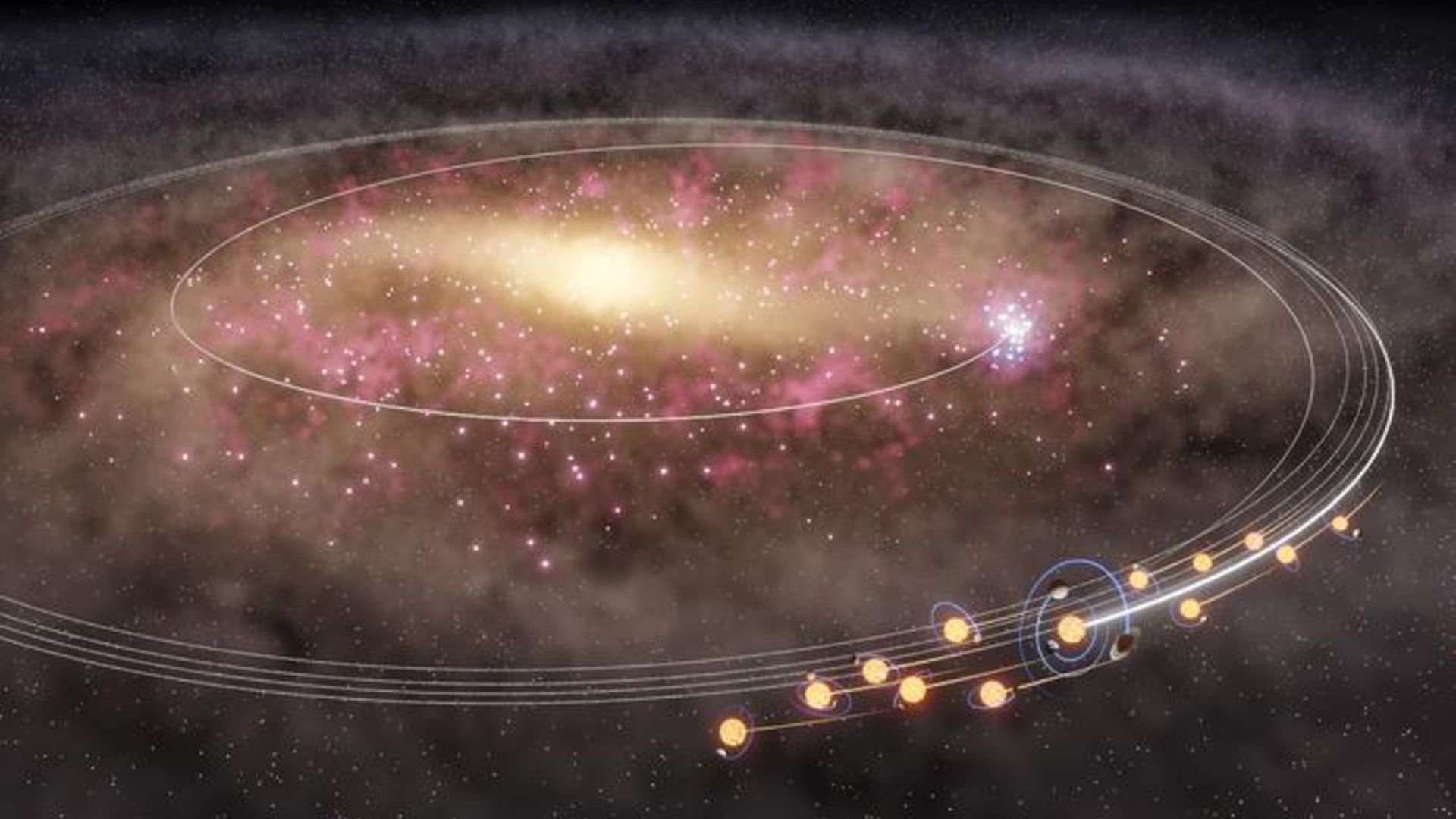
Taniguchi led one of the studies published Thursday (March 12) in the journal Astronomy & Astrophysics and co-authored the other. Together, the studies propose that when the central “bar” of stars and gas in the Milky Way formed, this process both enhanced star formation and sent a number of stars into other regions of the galaxy. This formation and “migration,” as the researchers called it, also included the sun.
“We propose that the formation of the Milky Way’s central bar enhanced star formation and also triggered large-scale migration, leading to the formation and outward migration of the sun—and many solar twins,” Taniguchi said.
Previous studies had noted that, based on its composition, the sun must have moved by at least a few thousand light-years out of the galaxy’s center. But the issue is that the bar in the Milky Way serves as a “barrier” to stars moving so far away, some models show. The solution to this issue is to propose that the barrier formed only after all of the stars left the region, the scientists suggested.
“This scenario, if correct, could also provide new constraints on the epoch of the galactic bar formation,” Taniguchi said. The researchers suggested that our galaxy’s central bar took shape about 4 billion to 6 billion years ago. (The sun itself is roughly 4.5 billion years old, which puts it squarely within that time frame.)
Taniguchi pointed out that in the center of the Milky Way, supernovas and other kinds of “energetic events” tend to occur more frequently than in other regions — in part due to the extreme population density of stars there. This would make the inner parts of the galaxy potentially hostile to life. And that has implications for how life arose on Earth, as well as potentially other planets in the galaxy.
“If the sun migrated outward relatively soon after its birth, as our study suggests, the solar system may have spent most of its history in the quieter outer disk,” Taniguchi said. “In other words, the sun may not have arrived in a life-friendly environment purely by chance, but rather as a consequence of the formation of the galactic bar.”