


Follow us
Add us as a preferred source on Google
Subscribe to our newsletter
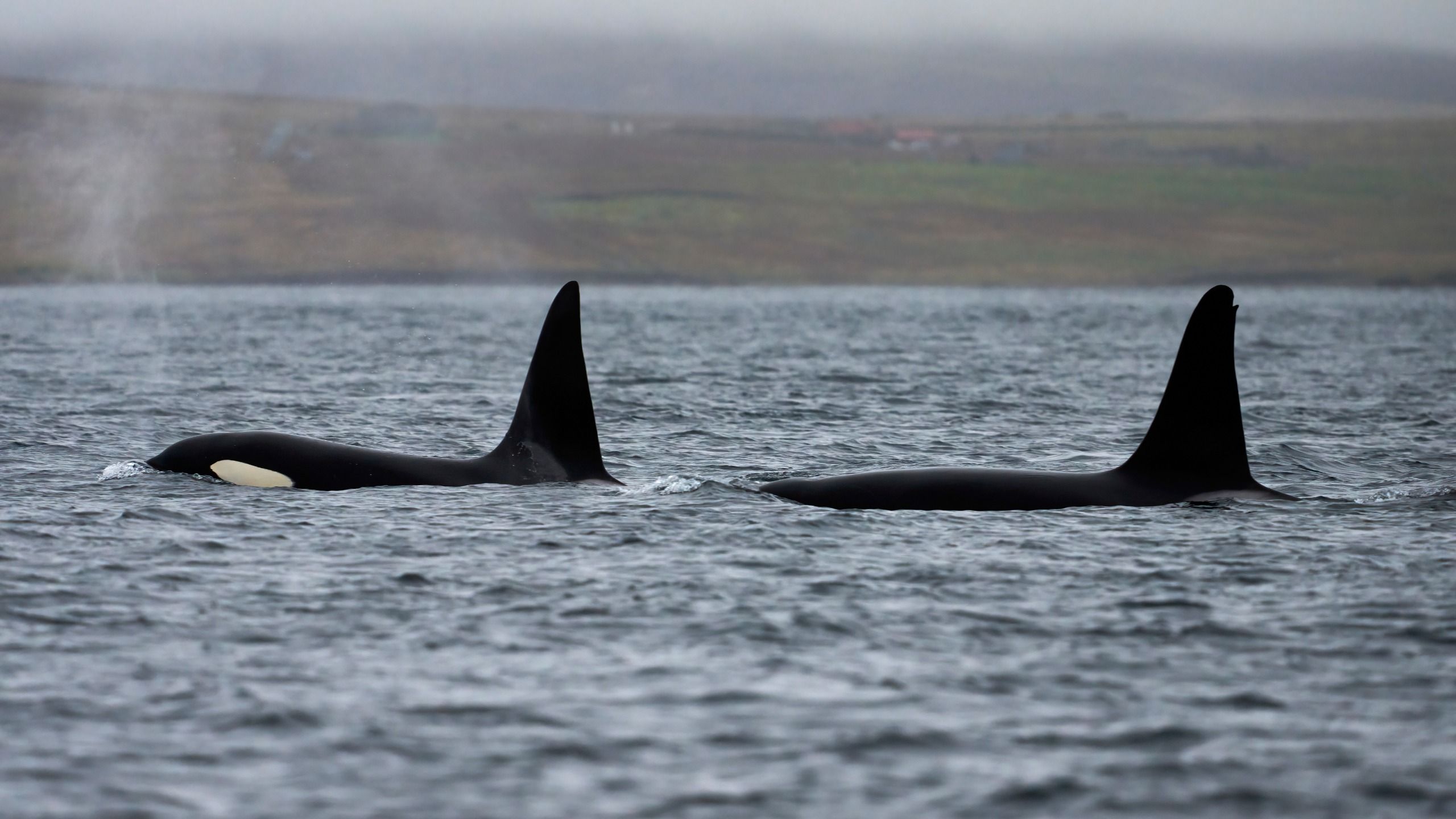
Nuclear fallout has potentially revealed the oldest male orca ever recorded, scientists have found.
The radioactive residue, a result of bomb testing in previous decades, was preserved in the teeth of orcas (Orcinus orca) and sperm whales (Physeter macrocephalus) that washed up over the years in Scotland, according to a recent study.
“It gives us what we call a kind of bomb pulse,” study first author Kieran Tierney, a research scientist at the Scottish Universities Environmental Research Centre, told Live Science.
Latest Videos FromLive Science
Male orcas are thought to have a maximum lifespan of around 50 to 60 years. However, in the recent study, published Oct. 1 in the journal Frontiers in Marine Science, the radiocarbon signature identified in one stranded male suggested he had lived to more than 65 years old.
The research team noted that the radiocarbon data doesn’t provide a precise age. However, that doesn’t mean the estimate is implausible.
Maximum ages are notoriously difficult to measure in nature — researchers can’t track every animal to see which individual lives longest in all species — and there isn’t an extensive worldwide record of orca longevity.
“The age estimates we have from life history studies are only a few decades old and researchers have only looked at limited numbers of individuals from a few orca populations,” said Erich Hoyt, co-chair of the IUCN Important Marine Mammal Area Specialist Group and author of “Orca: The Whale Called Killer” (Firefly Books, 2019). “It would not surprise me if male killer whales were sometimes living to age 65 and beyond,” Hoyt, who was not involved in the study, told Live Science in an email.
Sign up for the Live Science daily newsletter now
Get the world’s most fascinating discoveries delivered straight to your inbox.
Orcas and sperm whales have banded growth layers in their teeth, which researchers believe form every year, like the rings in a tree trunk. To test this idea and learn more about the animals washing up in Scotland, the authors of the new study examined teeth from three orcas stranded between 1995 and 2016, and from two sperm whales stranded in the 1990s.
Researchers studied the tooth of an iconic male sperm whale named Moby, which stranded in 1997.
(Image credit: Kieran M. Tierney)
Atomic weapons testing, particularly during the middle of the 20th century, unleashed vast quantities of radioactive material, including radiocarbon, which subsequently entered the marine environment and is preserved in the teeth of cetaceans like sperm whales and orcas. Radiocarbon exists naturally in the atmosphere, but the detonation of these bombs significantly spiked environmental levels of this radioactive isotope, so by measuring levels of this compound, researchers could identify whether animals lived through the testing era.
Banded layers in the sperm whale teeth matched the atomic data, with the two whales estimated to have died in their 20s and 40s, respectively, suggesting that the layers formed annually at least in early- to mid-life. However, while the tooth layers and atomic age matched for one of the orcas — estimating the animal was in its early 20s — the other male’s data didn’t match at all, according to the study.
The oddball orca, named KW2, stranded in Uist, an island in western Scotland in 2015. The tooth analysis suggested that KW2 lived into his 50s, but the radiocarbon analysis suggested he was at least 65 when he died. Tierney speculated that either a cluster of layers appeared in the tooth as a single year, or new layers stopped forming in later years.
“We think that the tooth effectively ran out of space to put down any more layers,” Tierney said.
The last of their kind
The banded layers and atomic data also didn’t match for the study’s only female orca, named Lulu. In Lulu’s case, she didn’t have a clear bomb pulse signal, making comparisons difficult. The tooth layers suggested she was in her 30s when she died, while her radiocarbon signal was indicative of historic nuclear plant discharges in the Irish Sea in the latter half of the 20th century, which were carried to the Scottish west coast.
By looking at stable isotopes of carbon and nitrogen in the tooth samples, the researchers identified traces of what the animals might have eaten. Lulu appears to have had a higher proportion of marine mammals in her diet than the males, which seemed to eat more fish, according to the study.
Orcas’ diets vary across different populations, and Lulu’s is likely tied to her community. She was part of Scotland’s West Coast Community — a genetically distinct orca population on the brink of extinction — before she stranded in 2016. The West Coast Community is known to prey on other marine mammals.
Lulu was famous for being the last known female in the West Coast Community. The population hasn’t produced any calves in the decades researchers have studied it. Now down to just two surviving males, the remaining bulls are expected to be the last of their kind.
While the West Coast Community’s living bulls weren’t part of the new study, they are thought to be more than 50 years old. This longevity, combined with the estimated age of KW2, raises tantalizing questions for future orca research.
Tierney noted that until now, orca studies have mostly focused on populations off the Pacific coast of North America. There, males have a mama’s boy reputation; they’re typically observed spending their entire lives with their mothers, with life expectancy dropping significantly after their mothers die. But if male orcas are living longer lives off Scotland, and the West Coast Community’s bulls are getting by without their mothers’ support, then it’s possible they could be more independent than their North American Pacific counterparts.
“It looks like the killer whales around our shores maybe do something a little bit different,” Tierney said.
Tierney, K. M., McGill, R. A. R., Brownlow, A., Sayle, K. L., Tripney, B. G., Dunbar, E., Newton, J., Terrapon, M., Doeschate, M. T. I. T., Davison, N. J., Timmons, Z., & Kitchener, A. C. (2026). Integrating radiocarbon and stable isotopes in odontocete teeth to reveal life histories. Frontiers in Marine Science, 13. https://doi.org/10.3389/fmars.2026.1934180