



Follow us
Add us as a preferred source on Google
Winter is an incredible time for stargazing. With the long hours of darkness and an impressive variety of celestial objects on display, it’s easy to fall in love with the night sky during the winter. Whether you have binoculars, a telescope, a smart telescope or are just observing with your eyes, there’s something for everyone to enjoy over the coming months.
We’ve listed all the best sights to see this winter, including the supermoons, star clusters, galaxies and deep-sky nebulae that are best placed in the sky in December, January and February. We see the return of Orion and the Pleiades, with Jupiter and Saturn also making their way back into the night sky, while December also has one of the best and brightest meteor showers of the entire year — the Geminids.
This is by no means an exhaustive list of everything you can see — we’d be here until July — but just a collection of some of our favorite winter sights. Some, like the supermoons and planets, are specific to 2026/2027 timings, but the constellations and deep sky objects we see over the winter are something stargazers look forward to all year. Something to get us through the cold, dreary weather, and a reassuring sign that we made it through another year.
Lunar & planetary
Three winter supermoons
A composite photo of a full supermoon rising into the sky.
(Image credit: Hal Bergman via Getty images)
This winter is host to three consecutive supermoons (in addition to the supermoon we had in November, making four in a row). The first, and the most festive, is the Christmas Eve supermoon, peaking on December 24, 2026, at 01:28 UTC (which works out as late evening on the 23rd in North America). This last moon of the year is traditionally called the Cold Moon, and this supermoon will look up to 14% larger and 30% brighter than a normal full moon.
The first full moon of 2027, known as the Wolf Moon, peaks on January 22, 2027 at 12:17 UTC. Finally, the super Snow Moon peaks on February 20, 2027 at 23:24 UTC, coinciding with a penumbral lunar eclipse. This is when the sun, moon and Earth line up loosely during a full moon, causing the moon to pass through the Earth’s faint outer shadow — the penumbra. During this type of eclipse, the moon only dims slightly, so it won’t be nearly as dramatic as a blood moon eclipse.
Annular solar eclipse

A photo of an annular, or “ring of fire”, solar eclipse.
(Image credit: Rebecca Harding Via Getty Images)
Observers in South America and Africa will witness an annular solar eclipse on February 6, 2027, peaking at around 16:00 UTC. It will appear as a “ring of fire” in the sky, as an annular solar eclipse happens when the moon passes between Earth and the sun when the moon is near or at its farthest from Earth, known as apogee. Unlike a total solar eclipse, the sun isn’t totally blocked, and the sky doesn’t turn dark.
Saturn in the evening sky

A photo of a bright planet glowing in the evening sky.
(Image credit: Alan Dyer/Stocktrek Images via Getty Images)
Since Saturn made its return to the evening sky in the fall, it rises earlier and earlier over the winter months, making this a great time to observe Saturn at a reasonable hour. There are still a few years before we will see the rings at full tilt again, but in 2026/2027 we can start to see more details in the rings after the planet appeared edge-on last year.
To get a good glimpse of Saturn this winter, you’ll need a telescope with at least 4 or 5 inches of aperture and a good eyepiece that gives you at least 100x magnification. Smart telescopes and binoculars don’t have the reach, so this is a job for an observational telescope. But that’s all right; the hill we’ll die on is that there’s nothing that’ll take your breath away quite like seeing Saturn’s rings with your own eyes.
Jupiter at opposition

Jupiter glows in the night sky.
(Image credit: Kerrin / 500px via Getty Images)
Jupiter will reach opposition on the night of February 10-11, 2027, when it will be at its brightest and closest to Earth, making it appear its largest in the sky. This is the perfect time to observe it with your telescope to see the bands and the Great Red Spot, as well as its four Galilean moons. You’ll be able to see the moons with a pair of big astronomy binoculars (we can see them with our 15×70’s), but you’ll need a telescope to make out any of the finer details on the planet itself.
Mars at opposition

An image of Mars, the Red Planet
(Image credit: DrPixel Via Getty Images)
After almost a year of absence, Mars made its return to the evening sky in November (albeit quite late in the evening) and will reach opposition on February 19, 2027. Despite being one of our closest neighboring planets, Mars is notoriously difficult to get any meaningful observations with via a telescope, so its opposition is the best chance you’ll have.
You’d be forgiven for thinking that because Mars is technically closer to Earth than Jupiter, Saturn and deep-sky objects like the Andromeda Galaxy or the Orion Nebula, viewing it through a telescope would be a breeze, but that’s not the case. Mars is very small, with low-contrast features, and only comes observably close to Earth for a few months at a time around every 26-27 months, so it demands quite a lot from a telescope. Even with larger telescopes, it’ll only show up as a fuzzy orange dot most of the time.
If you want to try viewing Mars with a telescope this opposition, you’ll need 4-6 inches of aperture minimum, depending on what kind of telescope you have. However, for Mars, it’s arguably more important to have good seeing (unfortunate with the nearly full moon on this day), excellent quality optics, a stable (preferably motorized) mount, a good focuser and an eyepiece with good eye relief that gives 100x magnification or more to observe any of the planet’s finer details.
Alternatively, if you’re more of a beginner and are just starting your stargazing hobby, you can head outside with just your eyes and go “Hey look, there’s Mars. Cool!” and be done with it.
Meteor showers
Geminids

A photo of the Geminid meteor shower.
(Image credit: Haitong Yu via Getty Images)
The Geminids meteor shower is active from December 4-20, peaking on the night of December 13-14, 2026. The waxing crescent moon sets early, leaving dark skies after around 9 pm for prime meteor viewing, and this is one of the few meteor showers that very kindly peaks before midnight.
The Geminids are one of the strongest meteor showers of the year, and this year’s show is expected to have around 120 to 150 meteors per hour under clear, dark skies — making it an exciting opportunity for astrophotography.
Unlike most meteor showers, which come from icy comets, the Geminids originate from a rocky asteroid called 3200 Phaethon. The debris from this asteroid is much denser than the dust from comets, making it able to survive deeper into the atmosphere before burning up. This results in brighter, stronger and more colorful fireballs than the other meteor showers.
Ursids
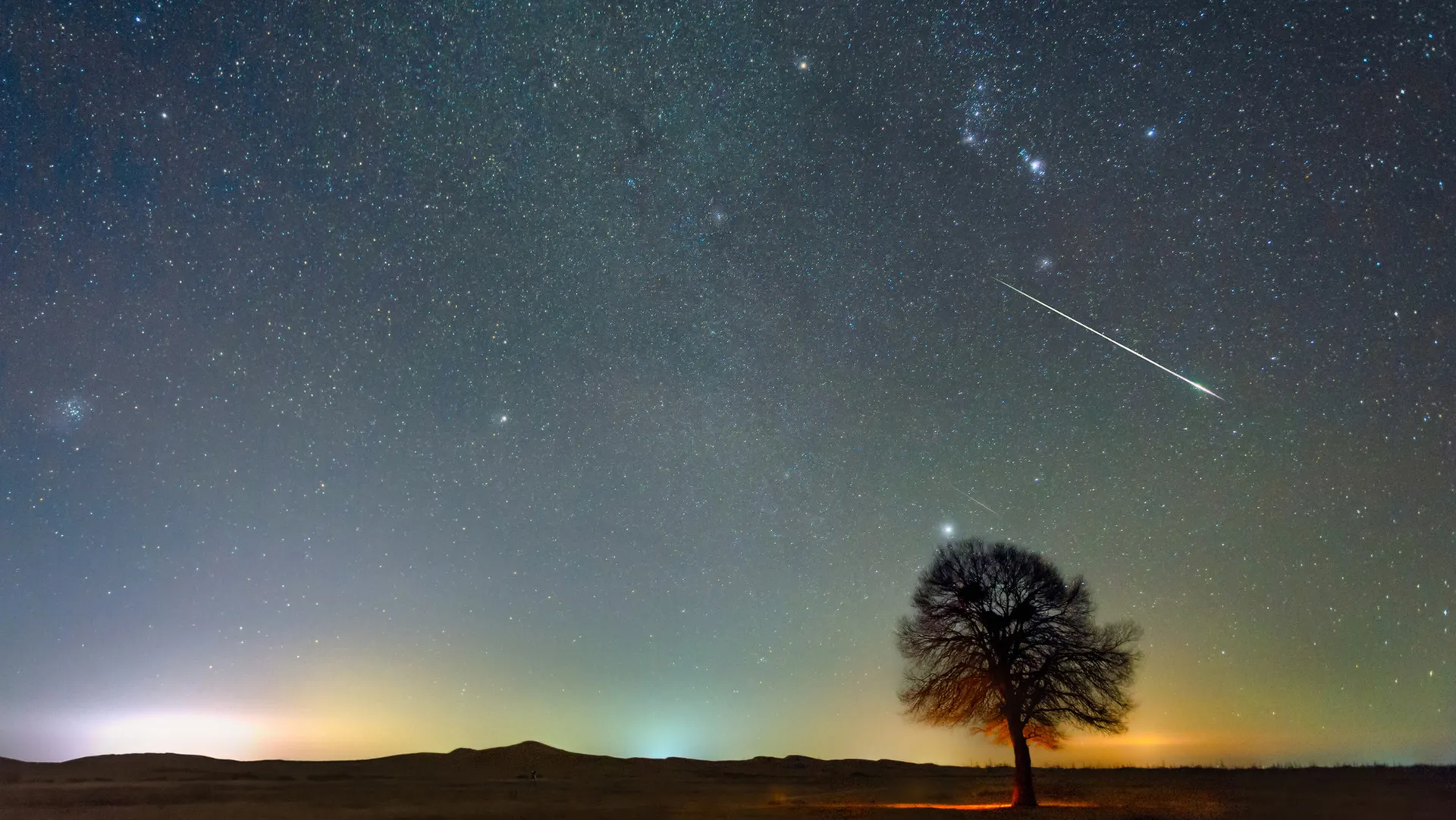
A photo of the Ursid meteor shower.
(Image credit: wenbin via Getty Images)
If the Geminids left you hooked on meteor showers, you’ll only have a few weeks to wait until the Ursids peak on December 22-23, 2026.
However, there are a couple of hurdles here. First, the activity rate is usually quite low — between 5 and 10 meteors per hour. Second, the nearly full moon will hinder visibility and limit sightings to only the brightest meteors. However, as they originate from Ursa Minor, which is circumpolar, the peak viewing time of 21:00-22:00 UTC is much friendlier than the showers that peak in the middle of the night, so it won’t require an unreasonable amount of commitment if you do want to catch them.
Quadrantids

A photo of the quadrantid meteor shower.
(Image credit: Stocktrek Images via Getty Images)
The first meteor shower of 2027, the Quadrantids, is active between December 28, 2026 and January 28, 2027, peaking on the night of January 3-4, 2027. The thin waning crescent moon won’t interfere with viewing conditions, and we could see up to 100-120 meteors per hour. The best time to view will be from midnight through to the pre-dawn hours, when the radiant point, Bootes, is highest in the sky.
Constellations, asterisms and star clusters
Sirius and Canis Major

Constellations glow in the night sky.
(Image credit: wenbin via Getty Images)
Canis Major (the “Greater Dog”) is visible over the winter months through until spring, and is easily recognisable by Sirius, the brightest star in the night sky. It’s one of the closest stars to our solar system, sitting 8.6 light-years away, and due to its distance and apparent magnitude, its twinkling and flashes of color are particularly noticeable. This is known as scintillation, where turbulence in Earth’s atmosphere bends starlight as it passes through different layers of air. It’s especially noticeable when Sirius is low in the sky, as the light has more atmosphere to pass through.
You don’t need any specialist gear to spot Sirius — it’s easily visible with the naked eye. However, if you do have a pair of binoculars, you can even try to spot it in the daytime at certain times of the year.
Canis Minor

The Canis Minor constellation.
(Image credit: Nazarii Neshcherenskyi Via Getty Images)
Look above Canis Major, and you’ll find Canis Minor — the “Little Dog”. It primarily consists of two bright stars: Procyon and Gomeisa, the former making up a key part of the Winter Triangle and Winter Hexagon. Canis Minor is a fairly faint constellation, but a pair of binoculars will give you a better view.
Canis Minor and Canis Major are most famously known as the loyal hunting dogs of Orion, who spent seven years pursuing the Pleiades sisters to no avail. He should have just led with the fact that he had two dogs.
Orion’s belt

A photo of the Orion constellation.
(Image credit: Inigo Cia via Getty Images)
Speaking of Orion, one of the most recognizable sights in the night sky is Orion’s belt, consisting of three bright stars in a straight line: Alnitak, Alnilam and Mintaka. Because of its prominence in the winter sky, Orion’s belt has served as a universal celestial marker for navigation, timekeeping and mythologies across human history. The entire Orion constellation is a favorite among stargazers because there’s so much to see, both with the naked eye and through binoculars or a telescope.
Another prominent feature of the Orion constellation is Betelgeuse. This red supergiant is easily visible to the naked eye, and astronomers expect it to explode as a supernova within the next 100,000 years. When that eventually happens, it will become visible in broad daylight and shine as brightly as the full moon for a few months. Betelgeuse, Sirius (Canis Major) and Procyon (Canis Minor) make up the Winter Triangle.
There’s also Rigel, the brightest star in the constellation, which marks the hunter’s foot, and Orion’s Sword, a hanging line of stars just below the belt, which contains the Orion Nebula (more on that later).
Taurus, the Bull (and the Pleiades)

An image of the Taurus constellation.
(Image credit: sololos Via Getty Images)
Although Taurus returned to the evening sky in the fall, winter offers the best viewing time because it sits higher earlier in the evening. The brightest star in the constellation, Aldebaran, is easily recognizable as an orange-red star that marks the bull’s eye.
With a pair of binoculars, you’ll be able to see two beautiful star clusters — the Pleiades (M45) and the Hyades. The former is a bright open star cluster consisting of seven stars (also known as the Seven Sisters) that you can just about see with the naked eye under very dark skies, and the latter is a V-shaped open cluster that forms the face and head of the bull.
The Pleiades is an ideal first target if you’re thinking of buying an entry-level smart telescope, and it’s also easy to pick out in wide-field iPhone photos of the night sky.
Auriga

A photo of the Auriga constellation.
(Image credit: Christophe Lehenaff via Getty Images)
Auriga is a pentagon-shaped constellation high in the sky between Taurus and Gemini, and is home to a few star clusters to observe this winter.
M36, the Pinwheel Cluster, contains around 60 to 100 stars and is located north of the star El Nath in Auriga. M38, known as the Starfish Cluster, contains over 100 stars, with its brightest forming an X shape, giving it a starfish-like appearance. Finally, M37, known as the Salt and Pepper Cluster, is the brightest and richest cluster in the constellation and contains over 500 stars.
Gemini, the Twins

A photo of the Gemini constellation.
(Image credit: Christophe Lehenaff Via Getty Images)
Not only is Gemini the radiant point of the Geminids meteor shower, but its two most prominent stars, Pollux and Castor, are a very recognizable winter target in the night sky. Pollux is an orange giant star and the constellation’s brightest point, while Castor appears blue. Although Castor looks like one star to the naked eye, it’s actually a complex multiple star system, consisting of three distinct binary pairs: Castor A, Castor B and Castor C. With a small telescope, you can split Castor into its two main pairs, Castor Aa and Castor Ba.
Gemini also contains M35, a large open cluster also known as the Shoe Buckle Cluster, which you can easily view with binoculars.
Winter Hexagon

An image of the Winter Hexagon.
(Image credit: Stellarium)
It’s not an official constellation, but the Winter Hexagon (also known as the Winter Circle) is a recognizable pattern of prominent stars in the winter sky. It consists of Rigel (Orion), Aldebaran (Taurus), Capella (Auriga), Pollux (Gemini), Procyon (Canis Minor) and Sirius (Canis Major).
Once you spot all of the stars that make up the Winter Hexagon, it provides an easy way to navigate your way around the night sky with your binoculars or telescope.
Deep sky nebulas and galaxies
Orion Nebula (M42)

A photo of the Orion Nebula.
(Image credit: Jose A Bernat Bacete Via Getty Images)
Probably everyone’s favorite nebula, largely because it’s very easy to spot. It’s located in Orion’s sword, just below Orion’s belt, and when conditions are dark enough, you can even see it with the naked eye and identify it in smartphone photos. Binoculars reveal it as a faint smudge, while telescopes give you a better view of the bright, glowing gas. It’s also a wonderful target for smart telescopes with a wide field of view.
While you’re there, you can find the Running Man Nebula, a bright reflection nebula complex located just north of the Orion Nebula — and it can be captured in the same frame if you’re photographing it. If nebulas are your thing, Orion is absolutely packed with them, including the Casper the Friendly Ghost Nebula (M78), the Monkey Head Nebula (NGC 2174) and the Witch Head Nebula (IC 2118), although many of Orion’s nebulas are quite faint and tricky to capture, requiring long integration times.
Another great target in Orion is….
Horsehead (IC 434) and Flame Nebula (NGC 2024)

A photo of the Horsehead and Flame Nebulas
(Image credit: Sharon Bell Via Getty Images)
The Horsehead and Flame Nebula in Orion is another popular target for smart telescopes, as it takes up a big portion of the frame and doesn’t need a super-long integration time to get a decent, web-ready image (although we’d always recommend shooting for as long as you can).
The Flame and Horsehead are technically two separate entities, but are often paired together due to their close apparent proximity, often fitting inside the same frame. The Flame Nebula is a bright, vibrant emission nebula that gets its name from its fiery network of dark, dense dust lanes. The Horsehead Nebula, on the other hand, is a dark nebula. It’s composed of a dense cloud of molecular dust and gas that blocks the light from the emission nebula and stars around it. As the name suggests, this dark nebula takes on the form of a horse’s head and neck.
Rosette Nebula (NGC 2237)

A photo of the Rosette Nebula.
(Image credit: Avatarmin Via Getty Images)
The Rosette Nebula is a vast, star-forming region in the constellation of Monoceros and is a fantastic astrophotography target. Its large, flower-like appearance comes from stellar winds and radiation from the central cluster of young stars. The best time to view and photograph the Rosette Nebula is from January, when Monoceros climbs higher and higher in the evening sky.
California Nebula (NGC 1499)

A photo of the California Nebula.
(Image credit: Javier Zayaz Via Getty Images)
The California Nebula lives in the constellation Perseus and gets its name from its resemblance to the U.S. state. This famous emission nebula is made up of ionized gas from the nearby Xi Persei, giving it its vibrant red and pink appearance. It has an apparent size of approximately 2.5 degrees, making it a great target for astrophotography and smart telescopes, as it appears quite large in the frame. Peak visibility of the California Nebula is from now until February.
Tadpole Nebula (IC 410)

A photo of the Tadpole Nebula.
(Image credit: Westend61 Via Getty Images)
12,000 light-years away, in the constellation Auriga, you’ll find the Tadpole Nebula — a beautiful emission nebula and active stellar nursery. It spans 100 light-years across and makes for a stunning smart telescope target. It gets its name from the distinct, prominent gas and dust pillars that resemble cosmic tadpoles swimming through space — only these tadpoles are around 10 light-years long.
If you’re using a smart telescope or astrophotography camera, you’ll typically need an integration time of 2-3 hours to bring out more structure in the nebulosity, although longer sessions will yield better results.
Flaming Star Nebula (IC 405)

A photo of the Flaming Star Nebula.
(Image credit: imageBROKER/Christian Zappel via Getty Images)
Also in Auriga is the Flaming Star Nebula, although this nebula is much closer to Earth — around 1,500 light-years away — and spans about 5 light-years across. Despite being “smaller” than other targets, it appears quite big in the frame of a smart telescope due to its distance from Earth. It’s best seen throughout late autumn and winter when Auriga is climbing high in the sky.
The Flaming Star Nebula is an emission and reflection nebula, with each type of nebulosity responding to different filters. In this instance, capturing two sets of data to stack in astrophotography software can help reveal more detail and colors. Broadband filter exposures capture the full range of visible light, including the blue light reflected by dust, as well as natural star colors. Narrowband or dual-band filters isolate specific emission wavelengths, such as hydrogen-alpha (Ha) and oxygen-III (OIII). By using these filters for separate sessions, your final image will show the red glow from the emission nebula and the blue tones from the reflective dust.