



In a new study, scientists reared lab mice that were missing sections of their brains and then replaced the missing tissue with human cells.
The experiment represents a step forward in the study of human brain organoids — tiny models of the human brain grown from stem cells. In the long run, scientists aim to use organoids to better understand how the brain develops and how its structure and function change in the context of disease.
“It is definitely an advance in the field,” said Dr. H. Isaac Chen, an associate professor of neurosurgery at the University of Pennsylvania Perelman School of Medicine. Chen was not involved in the current study but has conducted experiments transplanting human brain organoids into rodents’ heads.
Organoids offer a window into early brain development that’s impossible to observe closely in humans, namely because it unfolds inside developing fetuses. Although organoids are not perfect re-creations of full-size human brains, scientists think organoids are useful models for studying the developing brain in both health and disease.
The model in the new study “certainly creates some pretty interesting options in terms of modeling human neurodevelopment and various types of neurodevelopmental disorders,” Chen said. “If you’re looking for a model that really allows you to look at larger areas of human neural tissue from a cellular, molecular perspective, I think there’s a lot that this model has to offer.”
Image 1 of 3
(Image credit: S. Pasca lab, Stanford University)
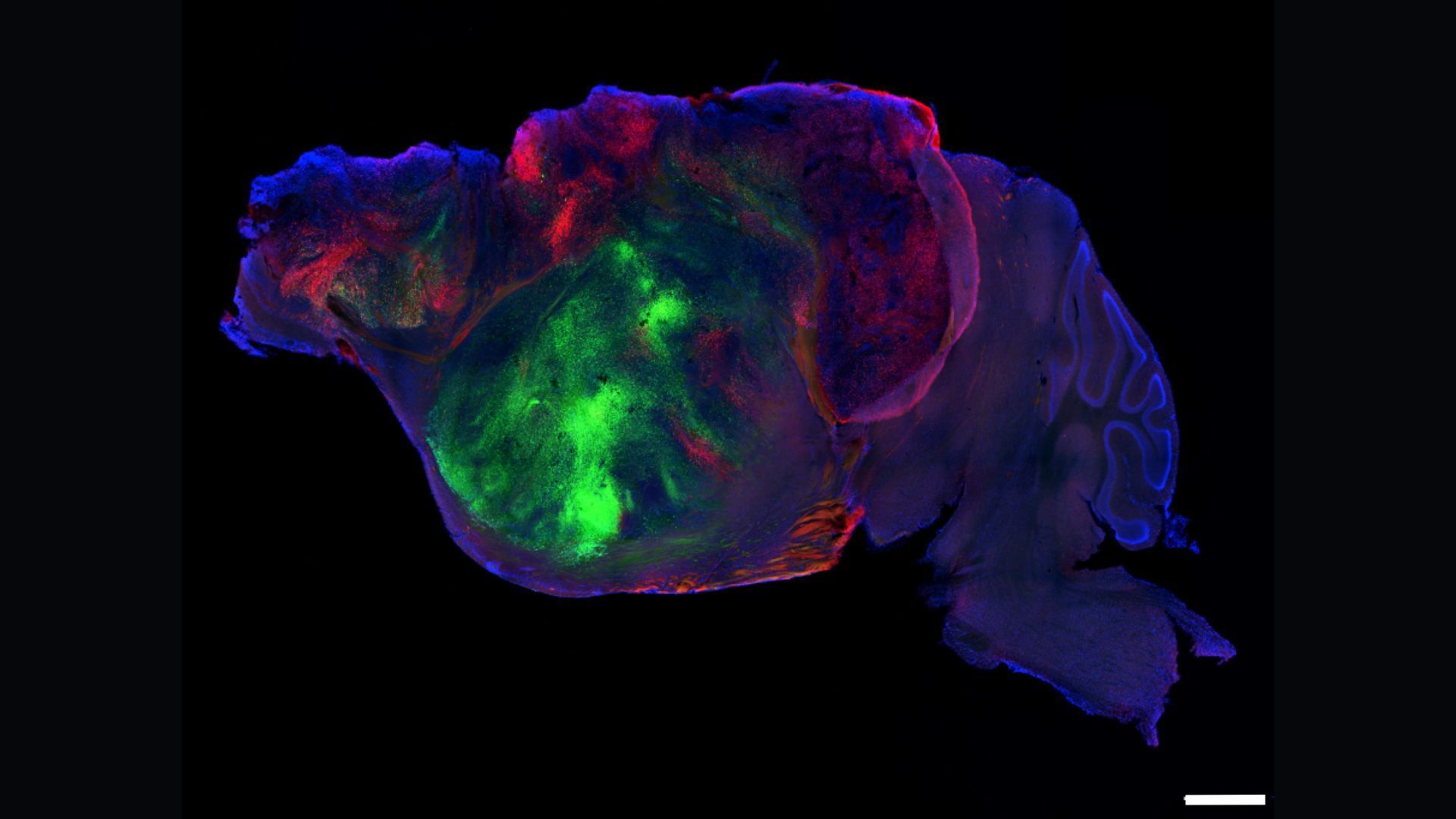
A top-down view of a mouse brain grafted with human brain organoids (labeled in green and red). The scale bar is 0.08 inches (2 mm).

(Image credit: S. Pasca lab, Stanford University)
The white lines outline human brain organoids within the mouse’s brain tissue. The colors indicate the main direction each nerve fiber is going within the organ: green (top to bottom); red (front to back); and blue (side to side).

(Image credit: S. Pasca lab, Stanford University)
An MRI showing human brain organoids (outlined in dashed white lines) and the nerve fibers extending from them. The colors indicate the main direction each fiber is going: green (top to bottom); red (front to back); and blue (side to side).
Making space for human cells
Often, brain organoids are grown outside living organisms, either in lab dishes or devices that keep these “minibrains” suspended in a solution. Multiple organoids representing different parts of the brain, or even different people’s brains, can also be brought together to form more-complex structures.
Why, then, are some scientists growing human organoids inside mice? One reason is that there’s a secret sauce inside living organisms that helps organoids mature better in animals than they do in lab dishes. In the body (in vivo), there are mysterious signals that help direct neurons’ development and organization, and these signals are missing in lab dishes (in vitro).
Get the world’s most fascinating discoveries delivered straight to your inbox.
“There are some cues that are present in vivo that are really important, and we simply don’t know what to add in, in vitro,” said study co-author Dr. Sergiu Pașca, a professor of psychiatry and behavioral sciences at Stanford University. The team demonstrated this phenomenon by transplanting organoids into lab rats in a study published in 2022; the transplanted organoids grew larger, formed better connections and were more active than organoids grown in dishes.
But transplanting human brain cells into rodents comes with different challenges. One is that human brains mature at a slower rate than rodent brains do. “Even when they’re put in an animal, in a mouse or in a rat, they will still develop about 20 times slower than the mouse or the rat,” Pașca told Live Science.
The host’s brain cells quickly grow and form new connections, while the human cells lag behind and get outcompeted, Pașca explained. This limits the amount of space that the human cells can take up. As neurons mature, they become myelinated, meaning they gain fatty insulation that helps them communicate more efficiently. The rodent neurons become myelinated more quickly than the human cells do, and that fat creates a physical barrier that the human cells struggle to penetrate, Pașca said.
In their study, described Wednesday (Sept. 16) in the journal Nature, Pașca and colleagues aimed to give the human neurons a leg up. They couldn’t solve the issue of human cells maturing slowly, but they could lend the cells extra space to grow in.
Through years of work, they developed a genetically modified mouse that develops only 2% of its cerebral cortex. The majority of its hippocampus — a major memory center in the brain — is also missing. Within a few days of the mouse’s birth, the team transplants human neural tissue into that vacant space, and about 90% of the time, that human tissue integrates successfully and starts to grow, Pașca said.

The brains of normal lab mice look like the brain on the left, whereas the center brain is missing 98% of its cortex and hippocampus. The brain on the right has human cortical tissue added to it. (Here, “XCX” is short for “xenocortical,” and “xeno” references the transfer of tissues from one species to another.)
(Image credit: Pasca Lab/Stanford University)
“We just took cortical organoids, about four of them, and transferred them with a syringe into that vacant space,” he said. “That’s it. They go in there, they graft, and within a few weeks, they start to grow. And then within a few months, they’ve taken most of that volume.”
In the weeks following the transplantation procedure, the human brain cells in the mice’s heads grew, formed connections and extended projections into the underlying mouse tissue. The human tissue didn’t organize itself into distinct layers as it normally would inside a human’s head, but it included many cell types that are typically seen in the human cerebral cortex.
Future of the field
The researchers compared the mice imbued with brain organoids with mice that were missing the same amount of brain tissue but didn’t get organoids. They also compared both groups to unmodified lab mice.
Perhaps surprisingly, the mice missing large chunks of their brains still functioned fairly well. “You look at them, and you can’t really honestly tell,” Pașca said. Upon closer inspection, though, the mice had subtle deficits in their fine-motor skills, working memory and socialization, he noted.
“From our perspective as humans, so much of what we do day to day depends on the cortex,” Chen noted. But in a mouse, the cortex makes up a minority of the overall brain, and various studies have suggested that the animals can get by without it, he said. “I don’t think the transplantation process itself is significantly hurting the animal,” he added.
It would be much more problematic if this was to happen in a species that has a larger brain and is closer to humans evolutionarily.
Dr. Sergiu Pașca, a professor of psychiatry and behavioral sciences at Stanford University
In the future, the ability to compare these three sets of mice — with organoids, without organoids, and unmodified — could help scientists tease apart how the human tissue is contributing to a given experimental result. Pașca envisions that the approach will be useful for studying the effects of insults to the brain, such as hypoxia (low oxygen) and exposure to toxins or drugs in the womb. Additionally, the genetics of the human organoids could be tweaked to see how those changes affect the brain’s development, structure and function. That could be useful for studying cerebral palsy or autism, he suggested.
Chen expects that this new approach will be useful for studying aspects of early brain development at the molecular and cellular levels. The new model incorporates a larger volume of human tissue than models have done in the past, and that’s an additional advantage. The human tissue doesn’t organize itself into layers or lobes as you’d see in a real human brain, he noted, but he thinks there’s still a lot that can be learned from it.
From an ethical standpoint, Pașca consulted with experts at Stanford and an external ethics committee regarding the welfare of the animals used in the study. Studies that involve putting human brain tissue into animals also raise questions about whether that added tissue could grant the animals new cognitive abilities — make them more human-like, in essence. The ethics committee fielded these concerns as well.
“We have not seen emergence of any new properties,” Pașca noted. “It’s not surprising because we’re still at a very early stage of development.” They grew the organoids for only six months, so the human organoids were roughly as developed as a 6-month-old fetus’s brain tissue.
If the organoids matured to be more human-like — developing layers and lobes — that might present more of a concern. But both Pașca and Chen said that type of development might be hard to recreate in a mouse anyway.
Chen argued that the sheer size of the human brain contributes to its complexity, and it also contains specialized regions that work together to execute different tasks. A mouse’s head cannot support the scale of a human brain, and at this point, organoids don’t develop the same organization and specialization that we see in people, he said.
“It would be much more problematic if this was to happen in a species that has a larger brain and is closer to humans evolutionarily,” Pașca argued. Pigs and nonhuman primates, such as monkeys, would be examples. Especially in regard to transplanting human organoids into monkeys, “that would be an experiment that I don’t see is justified at this point,” Pașca said.
See how much you know about the most complex organ in the human body with our brain quiz!