




For decades, engineers have been working to create smaller and smaller transistors to fit ever-larger numbers of them onto computer chips, all in the name of greater processing power. Now, in the age of artificial intelligence (AI), that effort has turned into an all-out race.
So how small can a transistor actually get? And is smaller even still the goal?
To understand the answer, first you need to know what a transistor is.
Latest Videos FromLive Science
“If you take a computer or your mobile phone and you were to pry it open, you will see that there is a printed circuit board,” Suman Datta, a professor of electrical and computer engineering at Georgia Tech, told Live Science.
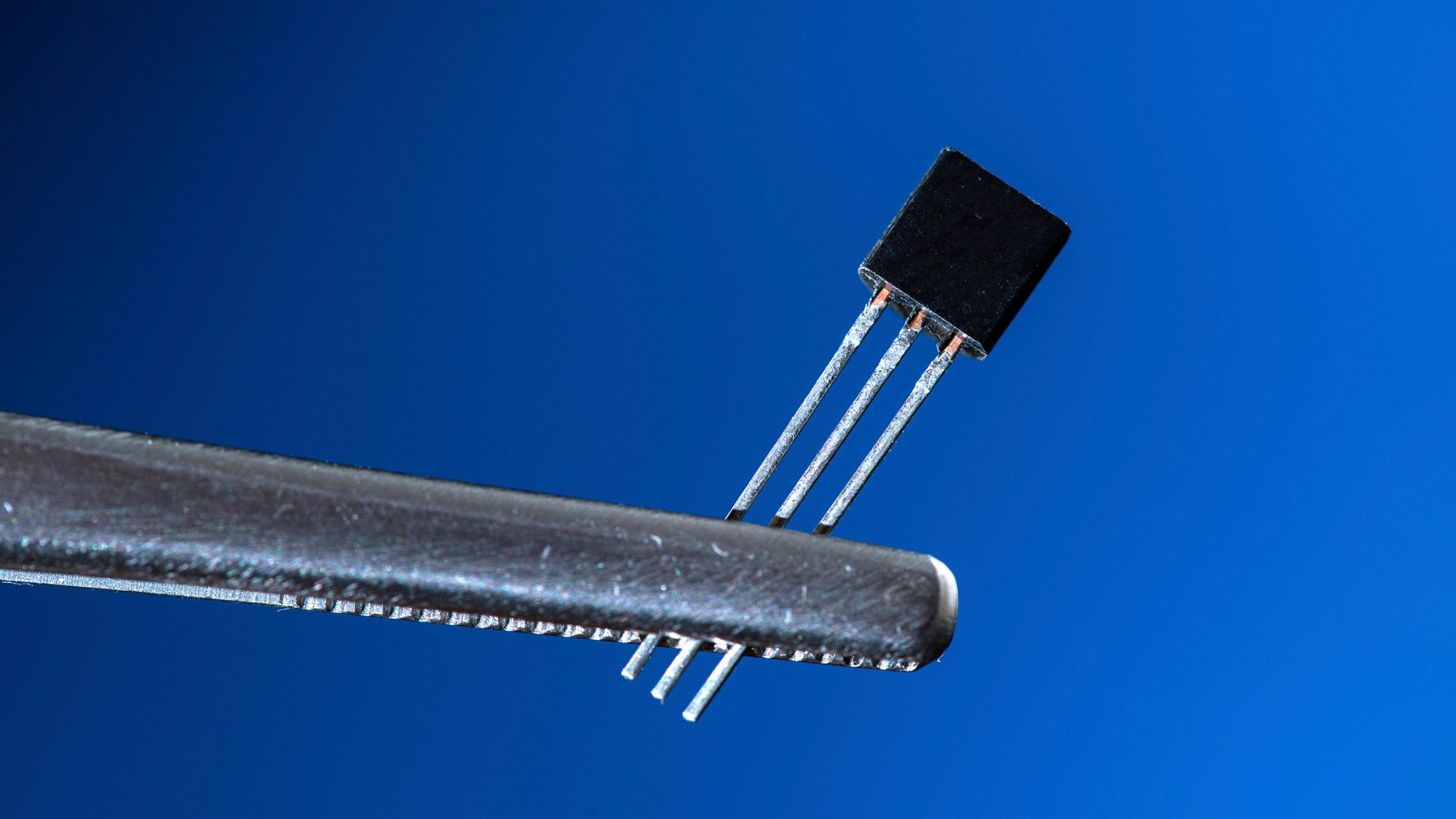
On that circuit board are small, rectangular objects called chips, and inside each chip is a tiny piece of silicon. “And in that silicon, if you zoom in like a million times … maybe, if you’re lucky, you will start seeing these tiny switches or transistors sitting etched into that piece of silicon,” Datta said.
Sign up for our newsletter
(Image credit: Marilyn Perkins / Future)
Sign up for our weekly Life’s Little Mysteries newsletter to get the latest mysteries before they appear online.
Each transistor is effectively a switch that turns on and off in response to jolts of electricity pulsing 4 billion times per second. Modern devices contain billions of transistors, and each one turning on and off in a precise orchestration to move and store 1s and 0s powers everything from Google searches and AI data centers to the device you’re using to read these words.
The smaller the transistors are, the more can fit on each chip and the greater the chip’s speed and functionality. So how small have they gotten so far?

Transistors were once visible to to the naked eye, but have now been made orders of magnitude smaller than the width of a human hair.
(Image credit: Bettmann via Getty Images)
“Researchers have built proof-of-concept devices in which a single atom controls the flow of electrons, although the rest of the device is still much larger,” Anton Persson, an assistant professor at Chalmers University of Technology in Sweden, and Tara Peña, an incoming assistant professor at UCLA, told Live Science via a jointly written email. That means the switching part of a transistor has been made at the smallest scale physically possible, even though a complete device that small doesn’t exist yet. New materials and approaches could make these devices even smaller. In a study published in June in the journal Nature Nanotechnology, Persson, Peña and colleagues used two-dimensional semiconductors made of tungsten disulfide, among other materials, to shrink nanoribbon transistors down to a channel width of 25 nanometers — about 0.00025 the width of a human hair.

An illustration showing the small transistor made by Persson, Peña and their colleagues.
(Image credit: Peña et al (2026).)
Two-dimensional semiconductors are electrically active materials that are only one or a few atoms thick, and because electrical current can be controlled more precisely in such a thin layer, they allow for smaller transistors than traditional silicon does.
Over the next decade, they still expect silicon transistors to shrink, but more slowly than they did in the past, they said. “To go considerably smaller, we may eventually need to move beyond silicon to atomically thin materials, such as the two-dimensional semiconductors we study.”
A host of considerations
Size isn’t the only consideration; cost is important, too. It’s enormously expensive up front to design and build a new chip. “We are as R&D-intensive as drug companies that spend billions of dollars developing one drug,” Datta said. “It’s a very similar business model.”
There are also manufacturing factors to consider. “The often much harder step is producing billions of those transistors reliably, at scale and at a price that makes sense commercially,” Persson and Peña said. “Something that works once in a laboratory does not necessarily work in a factory.”
Another consideration is energy efficiency. “If I’m adding more and more transistors onto that little piece of silicon, and at the individual transistor level, they don’t become more energy efficient … then when I go from, let’s say, 10 transistors to 20 transistors, my power budget has to be doubled, all things being equal,” Datta said.
For example, the latest Nvidia data center GPUs consume 1.4 kilowatts of electricity, and Nvidia’s upcoming release is estimated to consume nearly a kilowatt more than that. Half of that is given up as waste heat, Datta said.
“So it’s not just smaller, faster, cheaper, but also more energy efficient,” Datta said. “You have to work on all the four vectors.”
Is smaller still the goal in the age of AI?
Still, there is a limit to the physical space available for additional transistors, which is why engineers are turning to 3D designs — think taller instead of smaller.
“Instead of only making each transistor smaller, the idea is increasingly to stack transistors on top of one another so that more of them fit within the same chip area,” Persson and Peña said. “That way, we can still make our electronics considerably more powerful, even if each transistor shrinks only modestly.”
The quest for faster, more efficient chips is only getting more urgent with the explosive growth of AI. But smaller transistors and more powerful chips aren’t just important for AI data centers; they also mean smaller, potentially cheaper consumer electronics.
“People certainly notice the consequences of smaller transistors,” Persson and Peña said. “They can use less power and allow more computing power to fit on the same chip. That can mean faster electronics, longer battery life and lower costs. Historically, that combination has enabled today’s smartphones to outperform room-sized supercomputers from decades ago.”
So how small can transistors get? “We will do everything to make it as small as possible as long as we can control the physics,” Datta said. “And as long as we can, we will find a way to make the economics work.”
TOPICS