


Close Menu
  • Home
  • United States
  • World
  • Politics
  • Business
  • Lifestyle
  • Entertainment
  • Health
  • Science
  • Tech
  • Sports
  • More
    • Web Stories
    • Editor’s Picks
    • Press Release

Subscribe to Updates

Get the latest USA news and updates directly to your inbox.

What's On
Patrick Stewart Mourned ‘Practically Nonexistent’ Relationship With His 2 Kids Before Death at 86

Patrick Stewart Mourned ‘Practically Nonexistent’ Relationship With His 2 Kids Before Death at 86

October 30, 2026
Brewers’ bizarre cigarette ritual revealed after World Series win

Brewers’ bizarre cigarette ritual revealed after World Series win

October 30, 2026
Nearly 30% of US adults admit to lying about or exaggerating their symptoms to get antibiotics from doctors, survey finds

Nearly 30% of US adults admit to lying about or exaggerating their symptoms to get antibiotics from doctors, survey finds

October 30, 2026
Facebook X (Twitter) Instagram
Trending
  • Patrick Stewart Mourned ‘Practically Nonexistent’ Relationship With His 2 Kids Before Death at 86
  • Brewers’ bizarre cigarette ritual revealed after World Series win
  • Nearly 30% of US adults admit to lying about or exaggerating their symptoms to get antibiotics from doctors, survey finds
  • I injected a peptide to lose weight — my liver started failing just days later
  • 5 everyday spending habits that put you deeper into debt
  • Why efforts to end the sick college sports money grab are in danger as midterms loom
  • True crime influencer charged with wiretapping Patrick Clancy’s dad
  • Kyle Cooke Addresses ‘Emotional and Frustrating’ Amanda Batula Scandal After Blasting West Wilson
  • Privacy
  • Terms
  • Advertise
  • Contact Us
Join Us
USA TimesUSA Times
Newsletter Login
  • Home
  • United States
  • World
  • Politics
  • Business
  • Lifestyle
  • Entertainment
  • Health
  • Science
  • Tech
  • Sports
  • More
    • Web Stories
    • Editor’s Picks
    • Press Release
USA TimesUSA Times
Home » An ancient ‘supervolcano’ has been found hiding beneath eastern England. But experts say there’s not enough evidence to call it that.
An ancient ‘supervolcano’ has been found hiding beneath eastern England. But experts say there’s not enough evidence to call it that.
Science

An ancient ‘supervolcano’ has been found hiding beneath eastern England. But experts say there’s not enough evidence to call it that.

News RoomBy News RoomSeptember 3, 20266 ViewsNo Comments

Scientists have identified an ancient volcano on England’s east coast that is so eroded, it took researchers three decades to piece together its enormous size and explosive past. What remains of the caldera system is located beneath the English counties of Norfolk and Lincolnshire.

However, while the volcano undoubtedly produced at least one huge-scale eruption, some experts don’t think there is enough evidence for the structure to be called a supervolcano.

“It obviously must have been a very large eruption, but it would be very difficult to calculate the volume of the eruption given the poor preservation of the deposits,” said Michael Poland, a research geophysicist with the Cascades Volcano Observatory and the scientist-in-charge of the Yellowstone Volcano Observatory. “This is part of the reason I really hate the term ‘supervolcano,'” Poland, who was not involved in the discovery, told Live Science in an email.

Latest Videos FromLive Science

In a recent analysis, published April 29 in the Geological Society of America Bulletin, scientists examined zircon crystals that were taken 80 years ago from boreholes 40 miles (65 kilometers) apart in Norfolk and Lincolnshire. Zircon crystals are smaller than the diameter of a human hair and form within molten magma underground before a volcano erupts. They contain uranium that decays into lead isotopes at a known rate, enabling researchers to precisely date eruptions.

The results showed an age match between the zircon crystals from Norfolk and Lincolnshire and counterparts taken from the Kinnekulle tephra, a thick layer of volcanic ash covering Scandinavia and the Baltic region. This suggests the ash plume from the volcano in what is now eastern England blew across the Tornquist Sea, a body of water that existed during the Ordovician period (488.3 million to 443.7 million years ago), and settled on what is now Scandinavia.


You may like

The Kinnekulle tephra is visible next to train track north of Oslo in Norway. Dipping strata of the Arnestad Formation (Late Ordovician) contain thin beds of gray-green altered volcanic ash.

(Image credit: © Tim Pharaoh)

Researchers already knew that the Kinnekulle tephra was formed during a massive volcanic eruption. But the recent analysis shows for the first time how far the ash traveled and, therefore, how big the eruption really was.

The eruption would have also produced huge pyroclastic flows, or avalanches of rocky debris, ash and hot gas that race down the sides of some erupting volcanoes, Peter Rowley, a volcanologist and senior lecturer at the University of Bristol in the U.K. who was not involved in the analysis. “The last eruption of this kind of scale was the Oranui event at Taupō in New Zealand, over 26,000 years ago,” he told Live Science in an email.

Get the world’s most fascinating discoveries delivered straight to your inbox.

However, while the explosion would have been impressive and equivalent to the force of thousands of atomic bombs, experts said the definition of a supervolcano is vague and there are better ways to describe what happened.

“The scientific definition of a supervolcano varies a little; it’s a term we tend not to use as volcanologists much,” Rowley said. “In this case we would describe it as an ultraplinian eruption.”

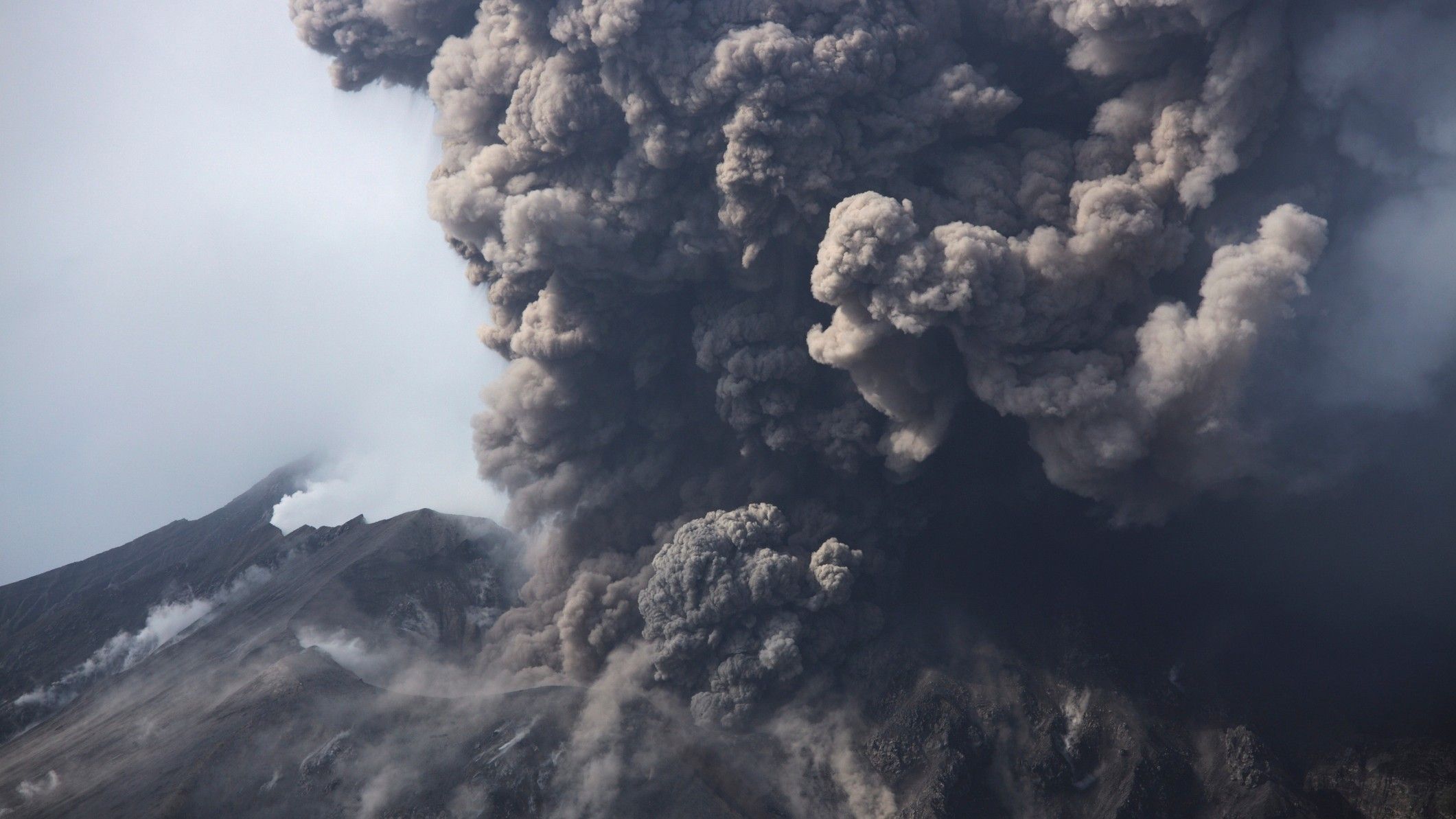
Ultraplinian eruptions are the most violent type of volcanic explosions, ejecting more than 240 cubic miles (1,000 cubic kilometers) of material. It’s difficult to say exactly what the eruption that formed the Kinnekulle tephra would have looked like, but it likely lasted days to weeks and formed ash clouds taller than 25 miles (40 km) that reached into the stratosphere.


What to read next

Geologists tend to reject the term supervolcano because it is imprecise, instead preferring to describe eruptions by the volume of material they eject.

Stephen Self, a physical volcanologist at the University of California, Berkeley, agreed that the term supervolcano can be too vague. “Supervolcano has become a kind-of buzz-word,” he told Live Science in an email. “It’s the deposits of the eruptions that are recognized, not the volcano.”

Very little of the material ejected in England’s ultraplinian eruption remains today, because most of it was eroded or buried. “The geological record is far from complete so it can be very difficult to say much about these eruption volumes with very old volcanoes,” Rowley said.

A field in England where scientists drilled boreholes into an ancient volcano.

The location of one of the borehole samples studied, at North Creake in Norfolk.

(Image credit: © Tim Pharaoh)

Similarly, the Kinnekulle tephra has been degraded over time, Poland said.

The researchers also found evidence for an earlier eruption of the volcano that occurred 453.7 million years ago. However, there is no trace of these eruptions at the surface today; the boreholes are located in some of England’s flattest landscapes, study first author Tim Pharaoh, a geophysicist with the British Geological Survey, said in a statement in August.

It’s not surprising to find traces of big, ancient volcanoes in England. The recently identified volcano is part of a wider volcanic system that was active 450 million years ago and includes Eryri National Park in Wales and the Lake District in northwestern England, Rowley said.

“It’s best not to imagine whole preserved volcanoes, but rather that we have deposits from their eruptions, or rocks which formed in the magma reservoirs beneath the original volcano,” Rowley said. “These are often deformed and altered by tectonic events meaning that it takes some careful geological investigation to interpret the true picture.”

Pharaoh, T. C., Rushton, J., Condon, D., Chenery, S., Horstwood, M., Sahy, D., Thomas, C., Hamilton, E., Gowing, C. J., Busby, J., Haslam, R., & Torsvik, T. H. (2026). The Wash Igneous Complex of eastern England: A candidate Avalonian source for Sandbian tephra in Baltoscandia and implications for closure of the Tornquist Sea. Geological Society of America Bulletin. https://doi.org/10.1130/b38831.1

Share. Facebook Twitter LinkedIn Telegram WhatsApp Email

Keep Reading

Nearly 30% of US adults admit to lying about or exaggerating their symptoms to get antibiotics from doctors, survey finds

Nearly 30% of US adults admit to lying about or exaggerating their symptoms to get antibiotics from doctors, survey finds

Could AI ever build itself? Scientists map the road to the ‘last AI built by humans.’

Could AI ever build itself? Scientists map the road to the ‘last AI built by humans.’

Vera C. Rubin Observatory discovers possible new solar system dwarf planet beyond Neptune

Vera C. Rubin Observatory discovers possible new solar system dwarf planet beyond Neptune

‘This is so crazy!’ Virginia college student looking for shark teeth finds rare Native American spearpoint

‘This is so crazy!’ Virginia college student looking for shark teeth finds rare Native American spearpoint

Decapitated man buried near fort in Roman-era Scotland gets a new virtual face

Decapitated man buried near fort in Roman-era Scotland gets a new virtual face

Neanderthal DNA still survives in our human family tree. What were our ancient relatives’ relationships like?

Neanderthal DNA still survives in our human family tree. What were our ancient relatives’ relationships like?

New simulation of the universe shows the first 2 billion years after the Big Bang play out in stunning detail

New simulation of the universe shows the first 2 billion years after the Big Bang play out in stunning detail

Colorectal cancer is especially aggressive in young people — a new study may reveal why

Colorectal cancer is especially aggressive in young people — a new study may reveal why

Bronze Age sword discovered in an Italian lake is still sharp after 3,300 years

Bronze Age sword discovered in an Italian lake is still sharp after 3,300 years

Add A Comment
Leave A Reply Cancel Reply

Editors Picks

Brewers’ bizarre cigarette ritual revealed after World Series win

Brewers’ bizarre cigarette ritual revealed after World Series win

October 30, 2026
Nearly 30% of US adults admit to lying about or exaggerating their symptoms to get antibiotics from doctors, survey finds

Nearly 30% of US adults admit to lying about or exaggerating their symptoms to get antibiotics from doctors, survey finds

October 30, 2026
I injected a peptide to lose weight — my liver started failing just days later

I injected a peptide to lose weight — my liver started failing just days later

October 30, 2026
5 everyday spending habits that put you deeper into debt

5 everyday spending habits that put you deeper into debt

October 30, 2026

Subscribe to News

Get the latest USA news and updates directly to your inbox.

Latest News
Why efforts to end the sick college sports money grab are in danger as midterms loom

Why efforts to end the sick college sports money grab are in danger as midterms loom

October 30, 2026
True crime influencer charged with wiretapping Patrick Clancy’s dad

True crime influencer charged with wiretapping Patrick Clancy’s dad

October 30, 2026
Kyle Cooke Addresses ‘Emotional and Frustrating’ Amanda Batula Scandal After Blasting West Wilson

Kyle Cooke Addresses ‘Emotional and Frustrating’ Amanda Batula Scandal After Blasting West Wilson

October 30, 2026
Facebook X (Twitter) Pinterest WhatsApp TikTok Instagram
© 2026 USA Times. All Rights Reserved.
  • Privacy Policy
  • Terms
  • Advertise
  • Contact

Type above and press Enter to search. Press Esc to cancel.