




Taming Nature: Inside China’s efforts to control the region’s water
China is facing water scarcity that affects millions of people, so the country is embarking on water projects on a scale the planet has never seen. This three-part series investigates three elements of this effort: the world’s biggest dam, a doomed effort to create a “river in the sky,” and a colossal water transfer project.
Towering 14,800 feet (4,500 meters) above sea level, the Tibetan Plateau, with its frigid temperatures and glacier-covered mountains, is the source of most of Asia’s major rivers — the Yellow, Yangtze, Yarlung Tsangpo (Brahmaputra) and Lancang (Mekong) — which supply almost 2 billion people downstream, including the two most populous countries on Earth: China and India.
For that reason, the Tibetan Plateau is often called the roof of the world, the third pole and Asia’s water tower.
But in recent years, the region has also earned a new moniker: Asia’s power tower, thanks to its huge, untapped potential for generating hydropower.
Faced with water scarcity in densely populated, industrialized and irrigated regions of China; an insatiable need for energy; and a drive to eliminate fossil fuel use, Chinese authorities are pursuing a number of hydropower projects in the region. Together, they will not only tap the region’s vast power potential but also attain unprecedented levels of control over vital water sources its neighbors rely on.
The government’s flagship project is the Motuo (also called Medog) megadam project on the Yarlung Tsangpo River. The project officially started construction in July 2025, and its costs are staggering — estimated at up to $168 billion.
The megadam is slated to be completed in less than a decade and will dwarf all other hydroelectric projects in the world with its estimated 300 terawatts of annual power output— three times the output of the Three Gorges Dam on the Yangtze, the world’s current largest dam, and more than the entire U.S. produced in net hydropower in 2024.
The dam is just part of a bigger Chinese initiative to transform its environment.
Get the world’s most fascinating discoveries delivered straight to your inbox.
Science spotlight
(Image credit: Marilyn Perkins / Future)
Science Spotlight takes a deeper look at emerging science and gives you, our readers, the perspective you need on these advances. Our stories highlight trends in different fields, how new research is changing old ideas, and how the picture of the world we live in is being transformed thanks to science.
“You have a modern, powerful China who is in a way very, very confident of taming nature,” said Tenzin Norgay, a researcher at the International Campaign for Tibet (ICT), a nongovernmental organization that works to promote human rights and democratic freedoms for the people of Tibet. The ICT is closely monitoring dam building in the region. “That’s literally what they are trying to do, right?” Norgay told Live Science. “They are trying to tame nature.”
But the massive project comes with huge risks for both people in Tibet and the hundreds of millions of people in countries downstream, including those in India and Bangladesh, experts told Live Science.
“Controlling [the] nature of the water or the river itself is a danger for the entire Himalayan belt particularly for countries like India, Bangladesh and to some extent also Nepal,” said Jagannath Panda, head of the Stockholm Center for South Asian and Indo-Pacific Affairs at the Institute for Security and Development Policy, told Live Science.
Project of the century
China is the world leader in dam building. The government has constructed around 98,000 dams and reservoirs across China, including 40% of the world’s largest dams, and numerous dams outside the country as part of its Belt and Road Initiative. But this new project is different.
“There’s nothing on this scale, and nothing close to it,” Brian Eyler, director of the Southeast Asia and energy, water and sustainability programs at the Stimson Center think tank in Washington, D.C., told Live Science.
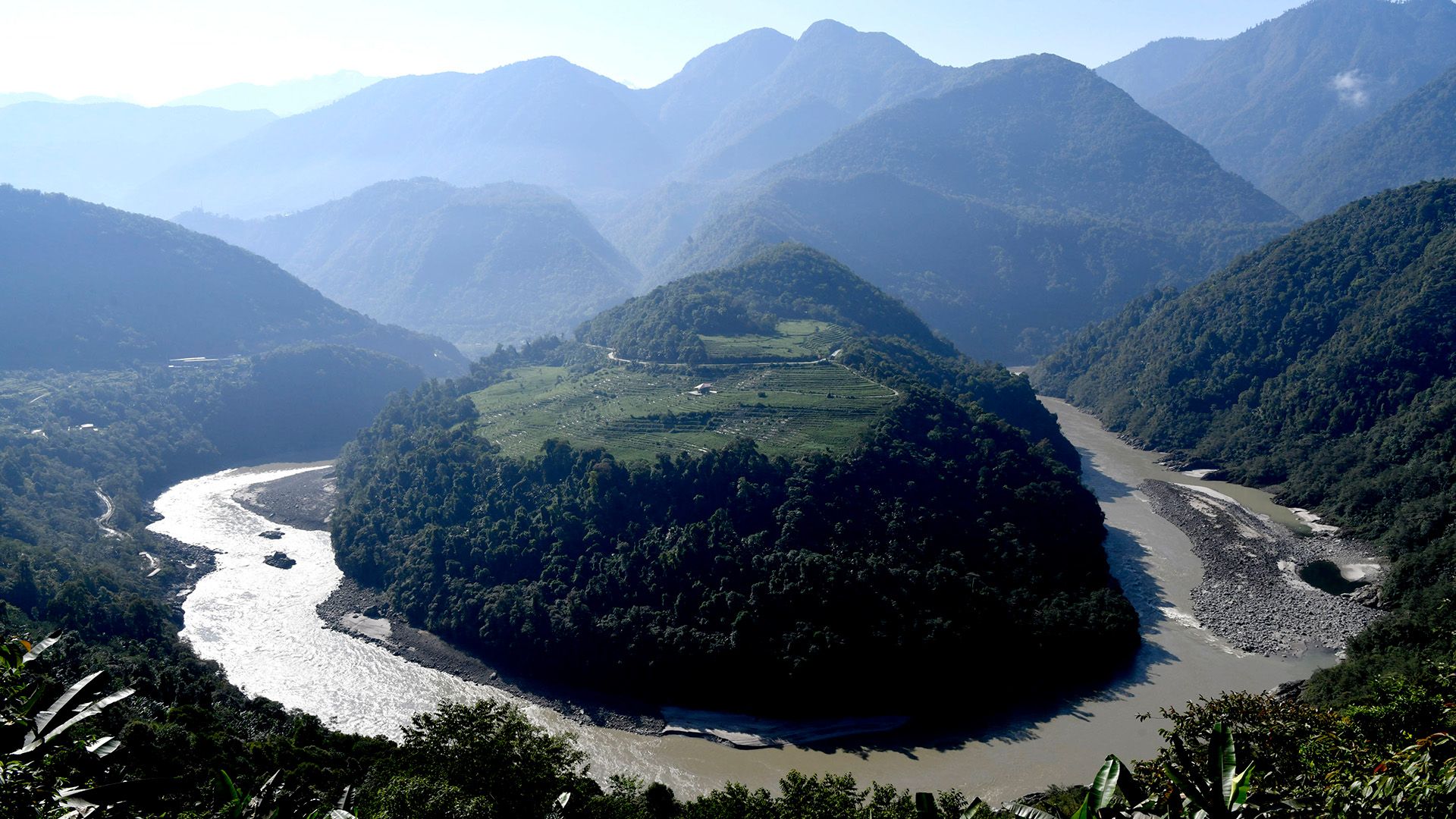
The project will utilize Tibet’s unique geography to full effect. In the project area, the Yarlung Tsangpo River (known as the Brahmaputra in India and Jamuna in Bangladesh) flows through the world’s deepest canyon, called the Yarlung Tsangpo Grand Canyon, and rapidly drops around the horseshoe-shaped “Great Bend,” before continuing to flow down and into India and, eventually, Bangladesh.

The route will cut through the mountainside, dropping 6,600 feet and passing through several hydropower stations within the tunnels, before rejoining the river farther downstream, Eyler explained.
(Image credit: © 2026 Google, Map Data provided by Landsat / Copernicus)
The project will dam the upper section of the river and divert the water through a series of tunnels that will be cut through the 25,500-foot-tall (7,800 m) Mount Namcha Barwa, before returning the water to a lower section of the river, circumventing the Great Bend. The project will likely have five dams in total, with hydropower stations inside the tunnels. The water will drop 6,500 feet (2,000 m) within 30 miles (50 kilometers) of tunnels, thereby generating a huge amount of hydroelectric power.
“It’s really incredible that this type of project can be built,” Eyler added.
The cascading dam system will require huge amounts of water to run effectively, meaning there will likely be a reservoir at the beginning, and so during the dry season the Great Bend will effectively run dry, Eyler said.
Mega project, mega challenges
Building such a large project in this region is fraught with risk, experts noted.
The Tibetan Plateau is one of the most seismically active regions in the world, driven by the ongoing collision between the Indian and Eurasian plates. The region has recently been rocked by several major earthquakes, including the 7.1 magnitude Dingri quake in January 2025, which damaged five dams in the region, and the 7.8 magnitude Nepal earthquake in 2015 that damaged a fifth of the country’s hydropower capacity.
Parts of the Himalayas are unsuitable for dam construction due to the high risk of seismicity and its effects, researchers have warned, noting that dams are particularly vulnerable to earthquake-induced landslides.
In addition to naturally caused earthquakes, large-scale projects involving land excavation, tunneling and water redirection have the potential to trigger seismic activity, while the creation of reservoirs has been strongly linked with earthquakes in China.
Other natural disasters could endanger people beyond Tibet.
Glacial lakes — bodies of water created by melting glaciers and permafrost — can pose a problem to people downstream if they suddenly release their water and overwhelm dams. This scenario happened in northeastern India in 2023, causing a large, newly built dam to catastrophically fail, killing at least 46 people and impacting 88,000 more.
Climate change is accelerating glacial melt, meaning the threat will only increase as the region’s glaciers are further destabilized, experts have warned.
Climate change could also render the dam obsolete sooner than anticipated. Dams typically function for around 70 to 100 years, experts told Live Science. Water levels in the Yarlung Tsangpo are expected to peak in 2060, so when water levels start to fall after that, the whole dam could become useless during dry periods because the water level will be too low to produce hydropower — a status known as minimum pool elevation. Water levels could even drop so low that they can’t pass through a dam. This situation, known as “dead pool,” is already an issue for some dams on the Colorado River.

The Three Gorges dam in Hubei province, central China, is currently the world’s biggest hydroelectric dam. But the new Motuo dam will generate three times as much power when it comes online around 2033.
(Image credit: NurPhoto via Getty Images)
The project will also affect Tibetans. “From our viewpoint, displacement of people around that and submergence of cultural sites” are the biggest issues, Norgay told Live Science.
However, the area is sparsely populated, and the reservoirs needed will almost certainly not be as big or as deep as reservoirs of other megadams. So although there will be an impact, it won’t be on the scale of the 1.3 million people displaced by the Three Gorges Dam, Eyler noted.
Downstream impacts
Even without a climate-driven reduction in water, the river’s flow will be transformed. To ensure a continuous, controlled flow of water through the dam, authorities typically fill reservoirs during the wet season and release water during the dry season. While this ensures that the hydroelectric dam can function, it inevitably impacts the river’s natural flow and has knock-on effects for communities downstream. The filling-and-releasing process also raises the possibility of the upstream country — namely, China — “turning off the taps” to benefit the dam at the expense of other downstream water users.
“If a dam operator has an opportunity to take water during a time of drought, they’re going to take at the expense of downstream users,” Eyler said. “We’ve seen this happen in the Mekong, where the downstream was suffering drought, but China still filled its reservoirs,” worsening drought in 2019 in Thailand, Cambodia and Vietnam.
In the case of the Motuo megadam, any change in water flow will affect India and Bangladesh. The Brahmaputra flows for about 1,800 miles (2,900 km), eventually joining with the massive Ganges River, and is a vital source of water and natural fertilizer for more than 130 million people. It provides India with 30% of its freshwater reserves, while Bangladesh is heavily dependent on the river to support its irrigated agriculture.

The Great Bend is a vital source of sediment for farmers in Bangladesh.
(Image credit: Shibu bhattacharjee via Getty Images)
“The greatest ecological and environmental impact will be related to sediment flow. The Great Bend itself is a rich provider of sediment to the downstream [countries],” Eyler said. “Sediment is important for agricultural production. It’s a very inexpensive natural fertilizer.”
Sediment from the Brahmaputra is integral to building up the Ganges-Brahmaputra delta, helping the low-lying region stay above rapidly rising sea levels. The delta is home to nearly 200 million people — including in the megacity of Kolkata — and is considered one of the places most at risk from sea level rise. The Yarlung Tsangpo in Chinese-controlled territory provides up to 50% of the river’s downstream sediment flow.
“River deltas are built by sediment flows pushing land out into the ocean year after year,” Eyler said. “And either the dams themselves or the lack of flow within the Great Bend will cause a great reduction in the amount of sediment coming down.”
The potential reduction in sediment could threaten food security in the downstream countries.
“Millions of people’s lives are dependent on this river,” Norgay noted.
India also plans to build major dams on the waterway, Norgay added, which could itself have negative impacts downstream.
Not true “green power”
The Motuo megaproject is just one of several new dams planned or under construction in Tibet; the ICT counts at least 193 dams in the region that have been planned or built since 2000, when China embarked on a policy of expanding infrastructure projects in the region.

The region’s rugged terrain, seismicity and remoteness could make building such large-scale infrastructure projects a challenge.
(Image credit: Feng Wei Photography via Getty Images)
The surge in hydropower projects is intended to help China move away from fossil fuels, experts told Live Science.
“It is part of a more widespread strategic vision where China is trying to become more sustainable,” said Tom Harper, a lecturer in international relations at the University of East London who specializes in China.
One key to China’s strategic vision is phasing out coal.
“This dam has been described as the coal killer. There are numerous coal plants that can be taken offline as a result of this and retired permanently,” Eyler said. “When you bring in China’s carbon emissions reduction goals, through 2050, the dam makes a lot of sense.”
However, hydropower is not as sustainable as it’s often portrayed, and it has environmental impacts. Large dams can cause severe environmental damage to river ecosystems. The creation of reservoirs can also release greenhouse gases as trees and plants are covered with water and subsequently rot, though this is less of an issue in cold places like the Tibetan Plateau, Darrin Magee, a hydropower expert at Western Washington University, told Live Science.
Typically, the larger the project, the greater the impacts, and this is the largest dam system ever created.
Brian Eyler
Though the authorities claim there will be no significant environmental impact from the dam, that’s hard to believe, Eyler said. “Typically, the larger the project, the greater the impacts, and this is the largest dam system ever created.”
Scientists also question the necessity of using hydropower to meet sustainability goals, when the Tibetan Plateau has huge, untapped wind and solar power potential.
Experts had different theories of what China would do with such a vast amount of energy generated in such a remote and sparsely populated area.
“There’s certainly no need for it, right now or in the foreseeable future in the area where Motuo Dam is sited,” Magee said. “But China solves that problem by building ultra-high voltage DC transmission lines at, at a rate that no one in the world is matching.” These high-voltage lines transport energy from the west to east, bypassing local grid networks, he added.
Norgay and Panda both think Tibetans are unlikely to benefit.
The power will likely be moved east to power Chinese industry, they said, and it could also align with the political goal of further integrating Tibet into China, Panda added.
Eyler, meanwhile, thinks it will be used to power data centers in Tibet, “which can be built around the super dam, in a naturally cool and cold environment.”

Better cooperation needed
There is little official information about the megadam for Chinese authorities, Eyler noted, and the lack of transparency is fueling fears. For example, Indian politicians have expressed concern that the megadam will give China full control of the river, and that China could potentially weaponize the river by deliberately reducing the flow of water or by releasing large amounts of water in one go, thereby devastating downstream communities. Some researchers have called this possibility a “water bomb.”
Eyler, however, said that this risk is low, and that the dam system’s design means it cannot hold back enough water to cut off supplies downstream.
“I don’t think that there’s some type of nefarious plot out there from Beijing to bring these countries to heel by controlling the upstream of the rivers,” he said. “China’s top priority is to develop its economy, bring stability to the country, and building large dams on rivers is one way to do that.”
The expansion of hydropower is a key aim for China in the next few years, as the country embarks on the 15th five-year plan from 2026. With shared water resources in short supply, better cooperation among neighboring countries is vital, experts said. Yet China and India share only limited data, Panda noted.
Some of the concerns from neighbors could be mitigated by better communication between stakeholders, Magee said. “Be more transparent with the data, bring more voices into the conversation, have some realistic assessment of both need for the project and the impacts.”
But even with better communication, the megadam and other upcoming dams means China will still largely control the region’s water resources due to its upstream position.
“This is a dam project which actually gives China the upper hand,” Panda said.