




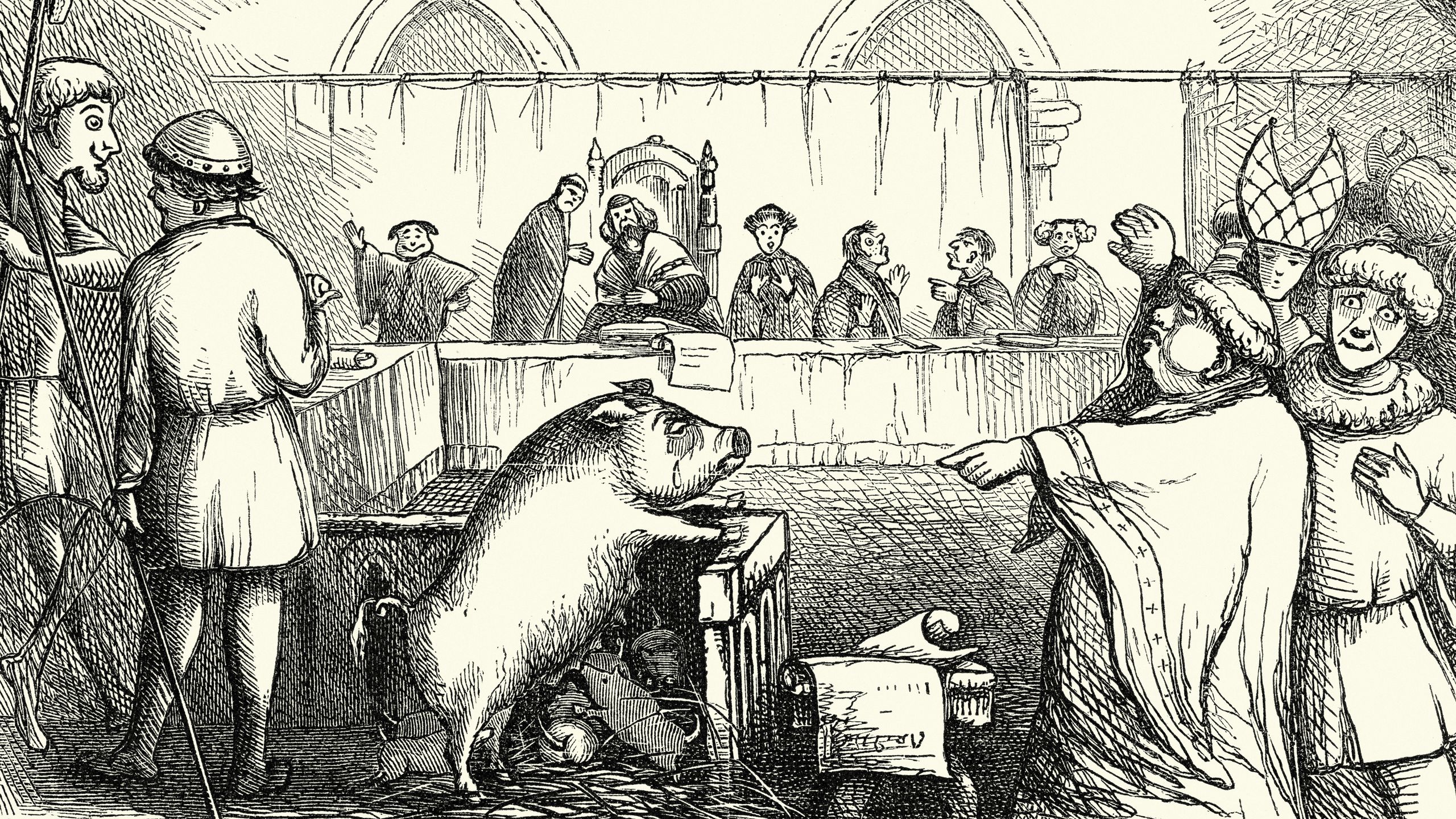

In this excerpt from “Cats: A History” (Johns Hopkins University Press, 2026), author Rod Phillips, professor of history at Carleton University, Ottawa, Canada, examines a bizarre practice that began in the Middle Ages — putting animals on trials for “crimes” they had committed. Animals, including birds, insects and livestock, were taken to court and punished as humans would be. But there was a surprising outlier: law-abiding cats.
It might seem odd, even irrational, to blame cats for being cats. We might accept that it is simply the nature of cats and that while some individual cats tend to be more or less friendly toward humans, others remain consistently aloof.
But in the early modern period animals (and birds and insects) were attributed responsibility for their behavior as if they had the same agency and intentionality, and bore the same moral accountability, as humans. To this extent they could be punished for behavior that was deemed criminal or immoral.
A striking example is the trials of animals that were held throughout much of Europe from the Late Middle Ages to the end of the 18th century. (There were scattered cases in Europe after that time, and others in places as diverse as Russia, Brazil, the United States, and Canada.) In the early modern period animal trials seem to have been most common in France, but they also took place in Switzerland, Germany, the Netherlands, and occasionally in Britain, Spain, and Italy.
Rod Phillips
Rod Phillips is a professor of history at Carleton University, Ottawa, Canada. He is the author of “Alcohol: A History” and “A New History of Divorce.”
These trials were no different from regular trials except that the defendant was not a human but an animal or, in some cases, several animals or a herd, flock, pack, or swarm of creatures. The indictments in animal trials were based on the law codes in force at the time and involved a range of crimes. Large mammals, such as cows and horses, sometimes killed humans and were charged with murder. Animals, notably sheep, that were subject to bestiality were said to have consented and were executed along with the human perpetrator.
The most common defendants in animal trials were pigs, which were widely kept in and around households in Europe at the time, and which sometimes killed and ate babies and small children. Animal trials were presided over by regular judges and the cases were argued by lawyers. The punishments, if the animals were found guilty, were the same as those imposed on humans: animals were imprisoned in jails where humans were incarcerated or executed by the same professional executioners who dispatched convicted humans. When they were fined, their owners were required to pay.
A different sort of case involved suits in church courts against insects, rodents, and other vermin that had damaged crops. The defendants in these cases included locusts, leeches, rats, and mice, and when they were found guilty, they were generally excommunicated and sometimes ordered to go to places where they could do no harm.
Get the world’s most fascinating discoveries delivered straight to your inbox.
There is a big difference between the place of animals in these cases and modern cases that involve animals that have caused harm. Dogs are sometimes ordered killed (“destroyed” is the usual term) by courts when they inflict serious injuries on people, but they are not found guilty of the offense in a formal sense, even though they perpetrated it. They are usually killed not to punish them but to prevent a recurrence and to protect other people. In many of these cases, the owner of the dog is punished in some way in addition to being deprived of their dog.
In the animal trials, in contrast, the animals themselves were found criminally responsible, and the owners were not punished, even if some were deprived of valuable animals or had to pay fines on their behalf. In an apparent exception in Chartres, France, in 1499, the parents of a child killed by their pig were ordered to pay a fine, but they were ordered to do so not because of their pig’s actions but because they had failed to watch over their child more carefully.
There is some debate whether Europeans believed that non-human creatures had a sense of intentionality that made them as responsible as humans for their actions. Animal trials might instead show, suggests Emre Koyuncu, that the principles of being subject to the law “were not strictly grounded on rationality and intelligence.” There is no explicit evidence that anyone participating in these cases believed that animals were rational in the same sense as humans, and some legal authorities clearly stated that they were not.
Yet the way these proceedings unfolded strongly implied culpability on the part of creatures found guilty. The unresolved issue is the extent to which a finding of guilt implied rationality and intentionality.

Despite their prevalence among humans, there are very few records of cats being accused of crimes.
(Image credit: Christine_Kohler/Getty Images)
There is another phenomenon suggesting that non-human animals were believed capable of rational calculation of a human kind. It was a common practice, for many centuries, to hang dead or mutilated specimens of unwelcome animals so as to convince their fellow creatures to stay away. Sometimes referred to as a “gamekeeper’s gibbet,” the custom sometimes took the form of hanging rabbits or weasels from tree branches as a warning to others. It is analogous to the practices, also common in early modern Europe, of executing people in public and sticking the decapitated heads of executed criminals on spikes as a warning to passersby.
Whether they worked as deterrents we cannot know, but at least it had a chance with beings (people) who could draw a lesson from the sight of a severed head. If people thought that animals could draw the same lessons, it tells us about their understanding of the intellect and moral codes of animals.
Although a wide range of animals, birds, and insects were involved in animal trials, there are hardly any records of cats being charged with any crime. Even dogs, considered the most faithful of creatures, quite often found themselves on trial, usually for biting people — although there is one medieval account of a faithful dog that brought its master’s murderer to court, where he was convicted and executed.
Cats did not commit crimes that were serious enough. Unlike pigs they did not eat children, unlike dogs they did not bite people.
One compilation of animal trials from the ninth to 19th centuries lists almost 200 but not one cat is included among the defendants — which include dogs, wolves, grasshoppers, snails, goats, pigs, and horses. Even so, a satirical print (about 1690) by the Dutch artist Egbert van Heemskerck shows a female cat being tried by a monkey magistrate in the presence of various animal witnesses.
Cats participated in some animal trials, but not as defendants. In the early 16th century the rats of the diocese of Autun, in Burgundy, were summoned to appear before a court for having eaten the barley crop, but they failed to appear at the specified time. Their lawyer won the rats an extension by arguing that cats were watching for them, making their journey to the court perilous, and that no one should be expected to appear at the court unless they could do so safely. There is no record whether the rats later turned up to face the charge.
The reason no cats seem to have been arraigned in animal trials might simply have been that cats did not commit crimes that were serious enough. Unlike pigs they did not eat children, unlike dogs they did not bite people (at least, not seriously), unlike cattle they did not gore people to death, unlike locusts they did not ravage crops, and unlike a range of other creatures they were not involved in bestiality.
For all that might have been said against cats, they were remarkably law-abiding animals, even if because they did not have the physical ability, size, or dietary preferences to commit the offenses that landed other creatures in court. That did not prevent people from torturing and killing cats, but those were extrajudicial actions that were far removed from animal trials. When cats were identified as witches’ familiars, however, it was another matter entirely.

Johns Hopkins University Press
Cats: A History
The many roles that cats have played throughout history illuminate a variety of contradictions in humans’ perceptions of them: as affectionate yet aloof, adorable and evil, ordinary and exceptional. This book is the definitive story of the feline presence in human history―an elegant study of how we live with animals whom we see as living by their own rules.