
Astronomers have developed a new way to test one of the central assumptions of modern cosmology — that the universe behaves uniformly on the largest scales. When applying the method to real observational data, the researchers found tentative signs that this assumption may not fully hold, potentially pointing to new physics beyond the standard cosmological model.
The work combines observations of distant exploding stars and large-scale galaxy surveys to probe whether the universe truly follows a nearly 100-year-old mathematical framework known as Friedmann-Lemaître-Robertson-Walker (FLRW) cosmology. The analyses revealed mild-but-intriguing deviations from the predictions of the standard model.
“We saw a surprising violation of an FLRW curvature consistency test, hinting at new physics beyond the standard model,” study co-author Asta Heinesen, a physicist at the Niels Bohr Institute in Copenhagen and Queen Mary University in London, told Live Science via email, referring to the assumption that the space’s curvature is the same everywhere. “This could potentially be due to various effects, but more research is needed to address the cause of the FLRW violation that we see empirically.”
The findings were presented in a series of three papers that introduce new diagnostic tests for cosmology and apply them to existing observational datasets. The papers, available on the preprint server arXiv, have not been peer-reviewed yet.
Testing the foundations of cosmology
Modern cosmology is built on the assumption that, when viewed on sufficiently large scales, the universe is homogeneous and isotropic — meaning matter is distributed evenly and the cosmos looks roughly the same in every direction. This idea underlies FLRW cosmology, which forms the basis of the standard model of cosmology, known as lambda cold dark matter.
But the real universe contains a tangled cosmic web of galaxies, galaxy clusters and enormous empty regions known as voids. According to Heinesen, this complexity means the FLRW description may not always apply perfectly.
“FLRW cosmology assumes a space-time that has spaces that are maximally-symmetric,” Heinesen said. “It is necessary to go beyond FLRW space-times when cosmological structures are present such as galaxy clusters and voids of empty space.”
The researchers focused on two possible effects that could distort the apparent geometry of the universe. One is the Dyer-Roeder effect, which occurs because light from distant objects often travels mainly through empty regions of space rather than through matter-rich environments. This could cause physicists to miss much of the matter density of the universe, “which would make the universe appear emptier to us than it actually is,” Heinesen explained.
The second possibility involves an effect called cosmological backreaction. In this scenario, the growth of large-scale cosmic structures alters the average expansion of space itself.
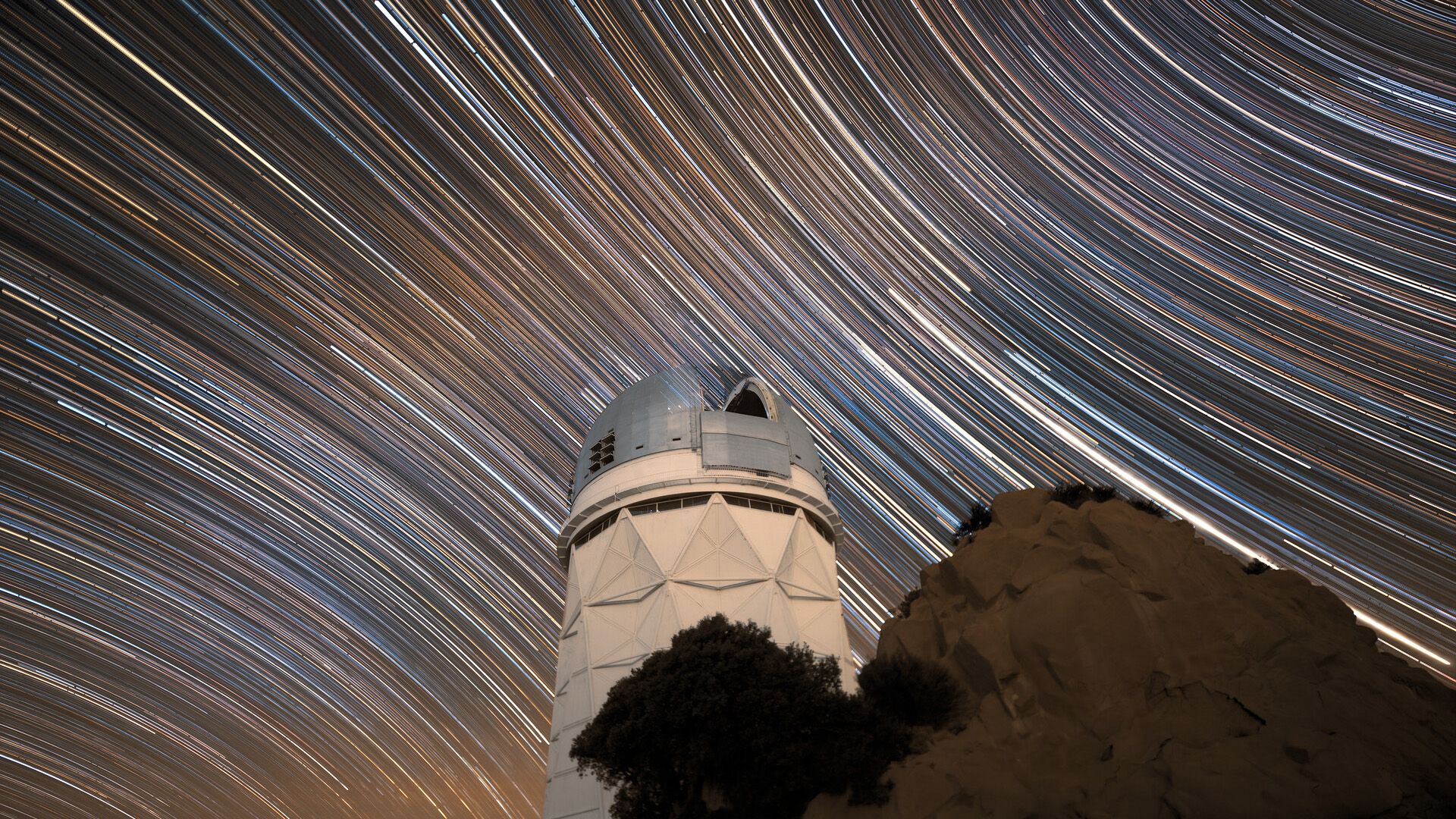
DESI’s 3-year map of the universe shows the distribution of matter across space-time. New studies based on DESI and other survey data hint that our standard model of cosmology may need an update.
(Image credit: DESI Collaboration/DOE/KPNO/NOIRLab/NSF/AURA/R. Proctor)
A new way to probe cosmic geometry
To investigate these possibilities, the researchers performed mathematical consistency tests designed to check whether observational data obeys the rules expected in an FLRW universe. In particular, they used variants of the Clarkson-Bassett-Lu test, a method that compares measurements of cosmic distances and expansion rates.
The team developed a more general framework that works even when the universe does not perfectly follow FLRW assumptions.
They also introduced machine learning techniques known as symbolic regression to reconstruct cosmic expansion histories directly from observational data. Instead of assuming a predefined cosmological model, the method searches for mathematical expressions that best fit the data.
Using observations from the Pantheon+ catalog of supernovas, together with measurements from the Dark Energy Spectroscopic Instrument (DESI) — a major international project that maps millions of galaxies across the universe — the researchers reconstructed how fast the cosmos has expanded over time. They also used data from baryon acoustic oscillation surveys, which track ancient patterns in the distribution of galaxies left by sound waves that traveled through the hot plasma of the early universe.
The analyses revealed small but potentially important departures from the predictions of standard FLRW cosmology. Depending on the dataset and analysis method, the discrepancy reached a statistical significance of about 2 to 4 sigma. In physics, sigma measures how likely a result is to arise purely by chance; a 5-sigma result is typically required before scientists claim a discovery, so the new findings remain tentative. Still, the results suggest that something unexpected may be affecting the geometry or expansion of the universe.
“The main finding is that you can directly measure Dyer-Roeder and backreaction effects from available cosmological data, and clearly distinguish these effects from other alterations of the standard cosmological model, such as evolving dark energy and modified gravity theories,” Heinesen said. “This was previously not possible in such a direct way, and this is what I think is the breakthrough in our work.”
Challenges and future directions
The researchers cautioned that the evidence remains preliminary. Current cosmological data is still relatively sparse, especially for measurements of the universe’s expansion rate at different epochs. The symbolic regression methods also introduce uncertainties that require further study.
In the papers, the authors stressed that improved observations from future surveys will be essential to determine whether the apparent FLRW violations are genuine.
“If these indicated deviations from an FLRW geometry are real, it would signify that most of the cosmological solutions considered for solving the cosmological tensions — evolving or interacting dark energy, new types of matter or energy, modified gravity and related ideas within the FLRW framework — are ruled out,” the researchers wrote.
The next step will involve applying the new theoretical framework to larger and more precise datasets. “It is to apply our theoretical results to data to test the standard model and to produce constraints on the Dyer-Roeder and backreaction effects,” Heinesen said.
Because the method can already be used with existing astronomical observations, researchers may soon obtain sharper answers about whether the universe truly follows the simple large-scale picture assumed by standard cosmology or whether hidden complexities are reshaping our understanding of cosmic evolution.