

Close Menu
  • Home
  • United States
  • World
  • Politics
  • Business
  • Lifestyle
  • Entertainment
  • Health
  • Science
  • Tech
  • Sports
  • More
    • Web Stories
    • Editor’s Picks
    • Press Release

Subscribe to Updates

Get the latest USA news and updates directly to your inbox.

What's On
Trump endorses ‘El Tigre’ in Colombia presidential runoff election

Trump endorses ‘El Tigre’ in Colombia presidential runoff election

June 21, 2026
Bethenny Frankel Adores This Tummy-Control Swimsuit That Shoppers Say Offers ‘Full Coverage’

Bethenny Frankel Adores This Tummy-Control Swimsuit That Shoppers Say Offers ‘Full Coverage’

June 21, 2026
US Open 2026 enters final round—Here’s how to watch live for free

US Open 2026 enters final round—Here’s how to watch live for free

June 21, 2026
Facebook X (Twitter) Instagram
Trending
  • Trump endorses ‘El Tigre’ in Colombia presidential runoff election
  • Bethenny Frankel Adores This Tummy-Control Swimsuit That Shoppers Say Offers ‘Full Coverage’
  • US Open 2026 enters final round—Here’s how to watch live for free
  • James Webb telescope finds a cosmic cloud of creation buried in the Sword of Orion — Space photo of the week
  • Pope Leo invokes patron saint of immigrants as friction with Trump intensifies
  • Taylor Swift’s Signature Red Lip Lasts for Hours, Thanks to This Cheap Lip Liner
  • Rory McIlroy falls out of US Open contention after back nine implosion
  • What will the Amazon rainforest look like in 100 years?
  • Privacy
  • Terms
  • Advertise
  • Contact Us
Join Us
USA TimesUSA Times
Newsletter Login
  • Home
  • United States
  • World
  • Politics
  • Business
  • Lifestyle
  • Entertainment
  • Health
  • Science
  • Tech
  • Sports
  • More
    • Web Stories
    • Editor’s Picks
    • Press Release
USA TimesUSA Times
Home » Neanderthals’ brains weren’t to blame for their demise, new study suggests
Neanderthals’ brains weren’t to blame for their demise, new study suggests
Science

Neanderthals’ brains weren’t to blame for their demise, new study suggests

News RoomBy News RoomApril 27, 20260 ViewsNo Comments

One idea given for the mysterious disappearance of Neanderthals around 40,000 years ago is a difference in brain power compared with early modern humans (Homo sapiens), who invaded their territory in Eurasia and outcompeted them. But a new study of brain variation reveals that Neanderthals and humans were much more alike than previously assumed.

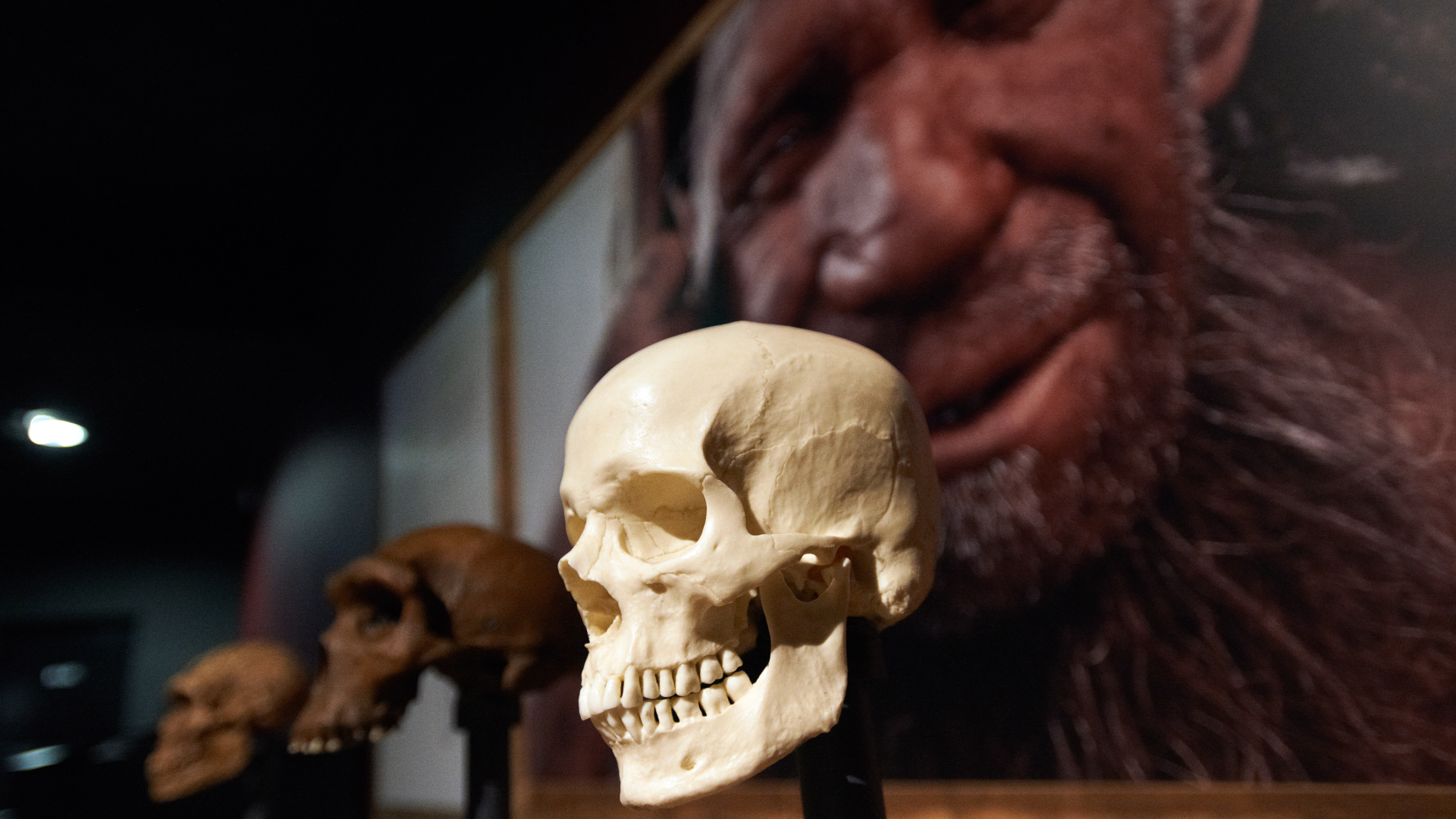
Neanderthal skulls are quite obviously different in shape from those of early modern humans. While Neanderthals had longer, lower skulls with heavier brow ridges and larger nasal openings, modern humans have more globular skulls with smaller facial features. The inside of the skull, called the endocranium, also looks different in Neanderthals versus modern humans.

“These shape differences have long been used to suggest Neanderthals differed cognitively from modern humans,” first author Tom Schoenemann, an anthropologist at Indiana University Bloomington, and colleagues wrote in a study published Monday (April 27) in the journal PNAS.


You may like

Because of the anatomical differences in the skulls, many experts have assumed that Neanderthals couldn’t talk as well as humans, had poor planning skills, and had limited short-term memory. But, problematically, these differences “were not put into the context of modern human populational variation in brain anatomy, which is known to be substantial,” the researchers wrote.

To better understand variation in brain anatomy, the researchers compared two large MRI datasets of the brains of living people: 100 ethnic Han Chinese and 100 Americans with European ancestry. In nearly 70% of the brain regions the researchers assessed, they found that the volume differences between the group of Chinese brains and American brains were larger than those previously found between Neanderthals and early modern humans. These results suggest a very large degree of overlap in brain anatomy and, therefore, cognitive abilities between Neanderthals and humans, the researchers wrote.

“If modern human population differences are not evolutionarily significant (which is what is generally assumed), then any similarly sized Neanderthal/early anatomically modern Homo sapiens brain differences also should not be considered evolutionarily significant,” they wrote.

The researchers noted that even small differences in behavior and brain size can potentially have significant evolutionary consequences. One of the largest differences between Neanderthal and H. sapiens brains was found to be correlated with attention and inhibition, suggesting Neanderthals may have had a slightly lower executive functioning ability. But given how quickly Neanderthals disappeared after modern humans arrived, “it is not clear that such small differences could actually have meaningfully contributed to their replacement,” the researchers wrote.

Get the world’s most fascinating discoveries delivered straight to your inbox.

Given that human brains differ between living populations today to a greater degree than Neanderthal and early modern human brains differed some 40,000 years ago, the researchers don’t think Neanderthals died out because they lacked the intelligence to adapt.

The new study “strongly points to demography and genetic swamping — possibly as a result of some kinds of cultural differences — and not to innate differences in cognitive ability as the most likely cause of Neanderthal replacement,” the researchers wrote. This idea — in which the genes of a minority species are overwhelmed by those of the majority species — echoes recent research that has modeled the integration of H. sapiens into Neanderthal populations, which could have led to the latter’s disappearance within as little as 10,000 years.

More research along these lines may be warranted, the researchers concluded, since they only compared the brains of Chinese and American people.

“It is entirely possible that even larger differences exist among modern human populations, further calling into question the evolutionary significance of the estimated Neanderthal differences in brain anatomy with contemporary anatomically modern H. sapiens,” they wrote.


How much do you know about our closest relatives? Find out with our Neanderthal quiz!

Share. Facebook Twitter LinkedIn Telegram WhatsApp Email

Keep Reading

James Webb telescope finds a cosmic cloud of creation buried in the Sword of Orion — Space photo of the week

James Webb telescope finds a cosmic cloud of creation buried in the Sword of Orion — Space photo of the week

What will the Amazon rainforest look like in 100 years?

What will the Amazon rainforest look like in 100 years?

‘You kill the bacteria and heal the wound at the same time’: Emerging nanotech could be the future of wound healing

‘You kill the bacteria and heal the wound at the same time’: Emerging nanotech could be the future of wound healing

Outdoor cats can be exposed to dangerous germs — here’s how to protect you and your pets, according to more than 400 studies

Outdoor cats can be exposed to dangerous germs — here’s how to protect you and your pets, according to more than 400 studies

Science news this week: Goblin shark filmed for first time, California close to a major quake, physicists split photon, and inside China’s plans to ‘tame nature’

Science news this week: Goblin shark filmed for first time, California close to a major quake, physicists split photon, and inside China’s plans to ‘tame nature’

Diagnostic dilemma: A fish stabs a man through the throat and the base of the skull

Diagnostic dilemma: A fish stabs a man through the throat and the base of the skull

Why does it take our eyes so long to adjust to the dark?

Why does it take our eyes so long to adjust to the dark?

Watch bison herd defend a newborn calf from wolf attack in a primeval Polish forest

Watch bison herd defend a newborn calf from wolf attack in a primeval Polish forest

‘A completely different story’: 300 million-year-old fossils reveal the first vertebrate land dwellers weren’t what we thought, researchers claim

‘A completely different story’: 300 million-year-old fossils reveal the first vertebrate land dwellers weren’t what we thought, researchers claim

Add A Comment
Leave A Reply Cancel Reply

Editors Picks

Bethenny Frankel Adores This Tummy-Control Swimsuit That Shoppers Say Offers ‘Full Coverage’

Bethenny Frankel Adores This Tummy-Control Swimsuit That Shoppers Say Offers ‘Full Coverage’

June 21, 2026
US Open 2026 enters final round—Here’s how to watch live for free

US Open 2026 enters final round—Here’s how to watch live for free

June 21, 2026
James Webb telescope finds a cosmic cloud of creation buried in the Sword of Orion — Space photo of the week

James Webb telescope finds a cosmic cloud of creation buried in the Sword of Orion — Space photo of the week

June 21, 2026
Pope Leo invokes patron saint of immigrants as friction with Trump intensifies

Pope Leo invokes patron saint of immigrants as friction with Trump intensifies

June 21, 2026

Subscribe to News

Get the latest USA news and updates directly to your inbox.

Latest News
Taylor Swift’s Signature Red Lip Lasts for Hours, Thanks to This Cheap Lip Liner

Taylor Swift’s Signature Red Lip Lasts for Hours, Thanks to This Cheap Lip Liner

June 21, 2026
Rory McIlroy falls out of US Open contention after back nine implosion

Rory McIlroy falls out of US Open contention after back nine implosion

June 21, 2026
What will the Amazon rainforest look like in 100 years?

What will the Amazon rainforest look like in 100 years?

June 21, 2026
Facebook X (Twitter) Pinterest WhatsApp TikTok Instagram
© 2026 USA Times. All Rights Reserved.
  • Privacy Policy
  • Terms
  • Advertise
  • Contact

Type above and press Enter to search. Press Esc to cancel.