Close Menu
  • Home
  • United States
  • World
  • Politics
  • Business
  • Lifestyle
  • Entertainment
  • Health
  • Science
  • Tech
  • Sports
  • More
    • Web Stories
    • Editor’s Picks
    • Press Release

Subscribe to Updates

Get the latest USA news and updates directly to your inbox.

What's On
Kate Middleton Pairs Her Breezy Dresses With These Surprisingly Comfy, Under-0 Heels

Kate Middleton Pairs Her Breezy Dresses With These Surprisingly Comfy, Under-$100 Heels

March 21, 2026
Aspiring sports agent Jack Seidler is UCLA’s Jerry Maguire

Aspiring sports agent Jack Seidler is UCLA’s Jerry Maguire

March 21, 2026
Physicists create electron ‘catapult’ that moves particles through solar cells at record speed

Physicists create electron ‘catapult’ that moves particles through solar cells at record speed

March 21, 2026
Facebook X (Twitter) Instagram
Trending
  • Kate Middleton Pairs Her Breezy Dresses With These Surprisingly Comfy, Under-$100 Heels
  • Aspiring sports agent Jack Seidler is UCLA’s Jerry Maguire
  • Physicists create electron ‘catapult’ that moves particles through solar cells at record speed
  • The surprising ways menopause can affect your mouth — and what you can do about it
  • Variety slammed for saying Chuck Norris’ ‘cop agenda’ films overshadowed legacy
  • 17 Loose Spring Sundresses That Are Slimming for Brunch, Errands and Beyond — From $10
  • Michigan State vs. Louisville prediction: March Madness odds, picks, best bet for Round of 32 Saturday
  • Computing quiz: Can you match these ‘ancient’ devices to their pictures?
  • Privacy
  • Terms
  • Advertise
  • Contact Us
Join Us
USA TimesUSA Times
Newsletter Login
  • Home
  • United States
  • World
  • Politics
  • Business
  • Lifestyle
  • Entertainment
  • Health
  • Science
  • Tech
  • Sports
  • More
    • Web Stories
    • Editor’s Picks
    • Press Release
USA TimesUSA Times
Home » Science news this week: Super El Niño looms, an Acropolis marble fragment resurfaces, and a pure hexagonal diamond is born
Science news this week: Super El Niño looms, an Acropolis marble fragment resurfaces, and a pure hexagonal diamond is born
Science

Science news this week: Super El Niño looms, an Acropolis marble fragment resurfaces, and a pure hexagonal diamond is born

News RoomBy News RoomMarch 21, 20261 ViewsNo Comments

This week’s science news was packed with stories that highlighted humanity’s complex, often-fraught relationship with nature, with forecasters predicting the possible onset of a “super El Niño” this summer.

The National Oceanic and Atmospheric Administration’s (NOAA) Climate Prediction Center announced that there’s currently a 62% chance that El Niño will emerge between June and August, with a 1-in-3 likelihood it will be especially strong. If that happens, the climate pattern could easily boost already-warming ocean temperatures to make 2027 the hottest year on record.

Elsewhere, we covered the discovery that Brazil’s underprotected Cerrado savanna stores carbon at a density about six times greater than the Amazon rainforest’s vegetation and that thirsty, heat-stressed plants are sucking up more groundwater that would otherwise end up in the Colorado River. On top of that, we reported on how climate change is slowing Earth’s rotation at a rate not seen in 3.6 million years. And in agricultural news, we covered how a planting season “fertilizer shock” caused by the Iran war could push global food insecurity to record levels.

Not all the news was so gloomy, though. We took a trip back in time to Doggerland, the now-submerged forest realm that once connected Britain to mainland Europe during the last ice age. We also spoke with an ecologist about how different species team up for mutual benefits, and heard how cats came to enjoy their pampered position as ostensible “parasites of human societies.”

Divers find Acropolis marble treasure in British shipwreck

A diver investigates the shipwrecked remains of the Mentor, a brig owned by Lord Elgin that was carrying the Parthenon Marbles when it sank in 1802. (Image credit: Copyright St. Kontos)

In the early 19th century, Thomas Bruce, the seventh Earl of Elgin and British ambassador to the Ottoman Empire, arrived at the ruins of Athens’ Acropolis to remove roughly half of the marble sculptures that once adorned the Parthenon temple’s top exterior — ripping many from the ancient Greek holy site’s walls.

Many of these seized sculptures (which later became known as the Elgin Marbles) were shipped back to the United Kingdom, where they remain controversially on display to the present day. Yet not all of Bruce’s ships made it. The Mentor, a brig that sank in the Aegean while transporting some of the sculptures, scattered its cargo around its wreck.

Now, divers have discovered an overlooked piece of marble that had remained unsalvaged — a triangular, marble block with what looks like a peg at the bottom. Archaeologists will now conduct further analyses of the block, which will hopefully enable them to establish whether it came from the Parthenon itself or somewhere else in the Acropolis.

Get the world’s most fascinating discoveries delivered straight to your inbox.

Discover more archaeology news

—Monte Verde, one of the earliest Indigenous sites in South America, is much younger than thought, study claims. But others call it ‘egregiously poor geological work.’

—Equestrian statue of Marcus Aurelius: The only surviving larger-than-life-size statue of a pagan Roman emperor — a rarity that Michelangelo refurbished

—Will the Indus Valley script ever be deciphered?

Life’s Little Mysteries

An image of the bottom half of a man's face, showing a dark moustache over a white-toothed smile. The man has an earring bar in his left ear and wears a white shirt

Research suggests the chin, a uniquely human feature, may have evolved by chance. (Image credit: Catherine Falls Commercial via Getty Images)

Yes, you read that right. While other animals may have jawbones, no other animal — not even gorillas, chimpanzees or extinct human relatives like Neanderthals — sports the bony, mental protuberance we commonly call the chin. So how and why did the chin evolve?

—If you enjoyed this, sign up for our Life’s Little Mysteries newsletter

Scientists create the world’s first “hexagonal diamond”

A series of hexagonal clear pieces, reflecting rainbow prisms

Life on Earth could be due to a move by our sun into the galactic suburbs. (Image credit: FlashMovie via Getty Images)

Researchers in China claim they have synthesized the very first samples of “hexagonal diamond” — a mysterious and coveted material believed to be harder, stiffer and chemically tougher than natural diamond.

Scientists have been arguing about hexagonal diamonds, whose carbon atoms arrange themselves in hexagons instead of the cubic lattices seen in natural diamonds, for decades. First theorized in 1962, the diamonds were later discovered in meteorites that arrived to Earth from the mantles of shattered dwarf planets, although the evidence for this is disputed.

Now, three separate research groups appear to have made pure to nearly pure hexagonal diamond samples. If their findings are replicated consistently and can be scaled up, they could open up all kinds of new applications, such as drilling and quantum sensing.

Discover more physics and space news

—Scientists witness birth of one of the universe’s strongest magnets for the first time, thanks to a general relativity ‘magic trick’

—All 5 ‘letters’ of DNA found on an asteroid speeding through our solar system. What do they tell us about the origins of life?

—Rare ‘daytime fireball’ meteor creates powerful sonic boom as 7-ton space rock explodes above eastern US

Also in science news this week

—‘Dark oxygen’ discovery on the seafloor is ‘fundamentally at odds with thermodynamics’ and should be retracted, experts say

—An experimental AI agent broke out of its testing environment and mined crypto without permission

—Diagnostic dilemma: A man went to the doctor for a bad UTI and learned he had an extra kidney

—‘We got evidence of boars, deer, bears, aurochs’: Ancient DNA reveals sunken realm

—‘1,800-year-old nails discovered in 3 burials in Roman necropolis, possibly to ‘protect’ both the living and the dead

—A single injection of mRNA-like treatment healed heart muscle after a heart attack in mice and pigs. Could it work in humans too?

—How plants moved from sea to land and changed Earth forever

Science Spotlight

illustration of blue molecules near red cylindrical blood cells in a red blood vessel

The vast majority of Alzheimer’s disease cases occur in people who have high-risk versions of the gene that codes for apolipoprotein E (shown in blue), which ferries fats through the blood stream. (Image credit: Nemes Laszlo/Science Photo Library/Getty Images)

Alzheimer’s disease, which accounts for 60% to 80% of all dementia cases, affects tens of millions of people worldwide. It is a complicated, multifactorial and tenacious disease that has resisted all inroads to treatment, even a leading one centered around the elimination of amyloid plaques found in the brain.

However, a study published in January has potentially tied the risk of developing the condition primarily to one gene, called apolipoprotein E (APOE). Does this mean a gene therapy for the disease is in hand? Live Science contributor RJ Mackenzie investigated in this long read.

Something for the weekend

If you’re looking for something a little longer to read over the weekend, here are some of the best analyses, crosswords and opinion pieces published this week.

—Artemis II: NASA is preparing for a return to the moon, but why is it going back? [Analysis]

—Live Science crossword puzzle #34: Famous space telescope launched in 1990 — 5 across [Crossword]

—Measles’ resurgence in the US is a grim sign of what’s coming [Opinion]

Science news in pictures
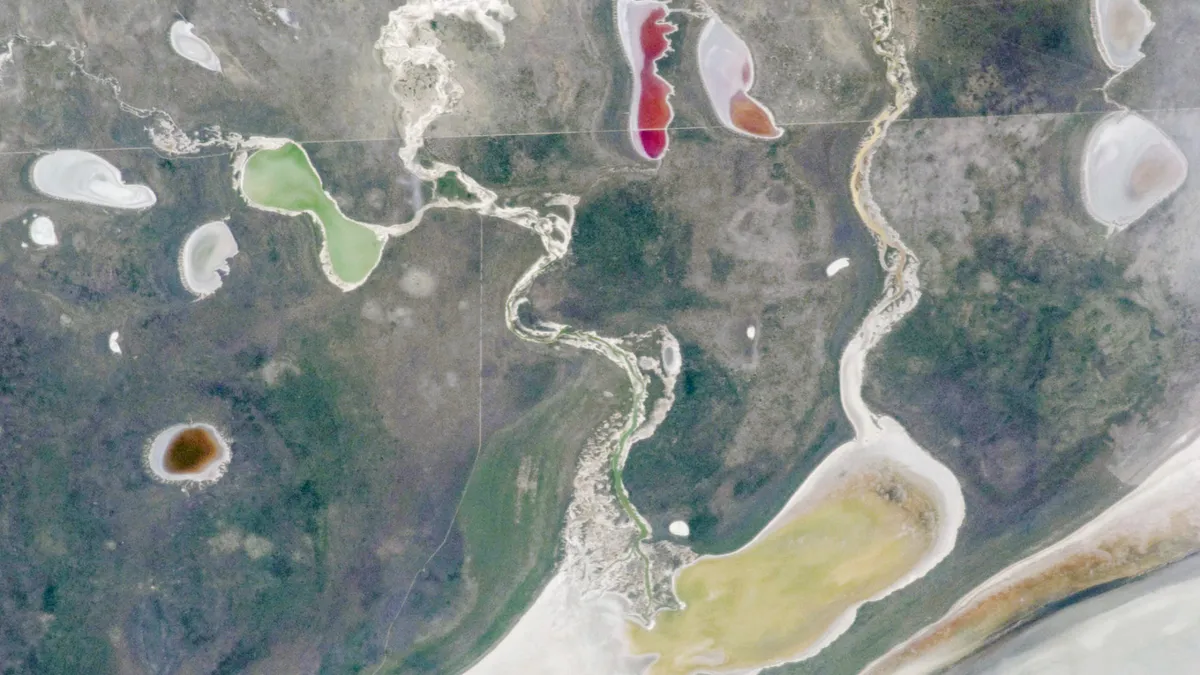
A satellite photo showing a pair of rivers and a series of colorful lakes surrounding a giant white expanse

Five brightly colored ephemeral lakes that emerged around the edge of Namibia’s Etosha Pan when a pair of rivers flooded in 2011. (Image credit: NASA/ISS program)

This rainbow-flecked white expanse is a 2011 aerial photo of the Etosha Pan, a roughly 1,800-square-mile (4,700 square kilometers) salt flat north of Namibia’s capital, Windhoek.

The satellite photo shows a serpentine pair of ephemeral rivers that drain into the pan. Surrounding the winding waterways are around a dozen bowl-like depressions that occasionally fill with water when the rivers sporadically flood their banks.

Follow Live Science on social media

Want more science news? Follow our Live Science WhatsApp Channel for the latest discoveries as they happen. It’s the best way to get our expert reporting on the go, but if you don’t use WhatsApp we’re also on Facebook, X (formerly Twitter), Flipboard, Instagram, TikTok, Bluesky and LinkedIn.


Share. Facebook Twitter LinkedIn Telegram WhatsApp Email

Keep Reading

Physicists create electron ‘catapult’ that moves particles through solar cells at record speed

Physicists create electron ‘catapult’ that moves particles through solar cells at record speed

Computing quiz: Can you match these ‘ancient’ devices to their pictures?

Computing quiz: Can you match these ‘ancient’ devices to their pictures?

‘That’s why there’s 9 billion of us and not 9 billion of some other primate’: Why our ability to adapt is humanity’s ‘superpower’

‘That’s why there’s 9 billion of us and not 9 billion of some other primate’: Why our ability to adapt is humanity’s ‘superpower’

Why are humans the only species with a chin?

Why are humans the only species with a chin?

Cannonball dating to the Alamo battle unearthed 1 day before 190th anniversary of the conflict that killed Davy Crockett

Cannonball dating to the Alamo battle unearthed 1 day before 190th anniversary of the conflict that killed Davy Crockett

Could a gene therapy treat the vast majority of Alzheimer’s?

Could a gene therapy treat the vast majority of Alzheimer’s?

NASA’s Artemis II rocket rolls to launch pad in final bid to meet April deadline

NASA’s Artemis II rocket rolls to launch pad in final bid to meet April deadline

Human-driven climate change is slowing Earth’s rotation at a rate not seen in 3.6 million years

Human-driven climate change is slowing Earth’s rotation at a rate not seen in 3.6 million years

Is the coming HIV pandemic inevitable? | Charles LeBaron

Is the coming HIV pandemic inevitable? | Charles LeBaron

Add A Comment
Leave A Reply Cancel Reply

Editors Picks

Aspiring sports agent Jack Seidler is UCLA’s Jerry Maguire

Aspiring sports agent Jack Seidler is UCLA’s Jerry Maguire

March 21, 2026
Physicists create electron ‘catapult’ that moves particles through solar cells at record speed

Physicists create electron ‘catapult’ that moves particles through solar cells at record speed

March 21, 2026
The surprising ways menopause can affect your mouth — and what you can do about it

The surprising ways menopause can affect your mouth — and what you can do about it

March 21, 2026
Variety slammed for saying Chuck Norris’ ‘cop agenda’ films overshadowed legacy

Variety slammed for saying Chuck Norris’ ‘cop agenda’ films overshadowed legacy

March 21, 2026

Subscribe to News

Get the latest USA news and updates directly to your inbox.

Latest News
17 Loose Spring Sundresses That Are Slimming for Brunch, Errands and Beyond — From

17 Loose Spring Sundresses That Are Slimming for Brunch, Errands and Beyond — From $10

March 21, 2026
Michigan State vs. Louisville prediction: March Madness odds, picks, best bet for Round of 32 Saturday

Michigan State vs. Louisville prediction: March Madness odds, picks, best bet for Round of 32 Saturday

March 21, 2026
Computing quiz: Can you match these ‘ancient’ devices to their pictures?

Computing quiz: Can you match these ‘ancient’ devices to their pictures?

March 21, 2026
Facebook X (Twitter) Pinterest WhatsApp TikTok Instagram
© 2026 USA Times. All Rights Reserved.
  • Privacy Policy
  • Terms
  • Advertise
  • Contact

Type above and press Enter to search. Press Esc to cancel.